THE CLASSIC COLLECTION✦An outlaw’s diary: the CommuneCLASSIC FREE BOOKS
An outlaw’s diary: the Commune
Cécile Tormay
THE CLASSIC COLLECTION · 1879
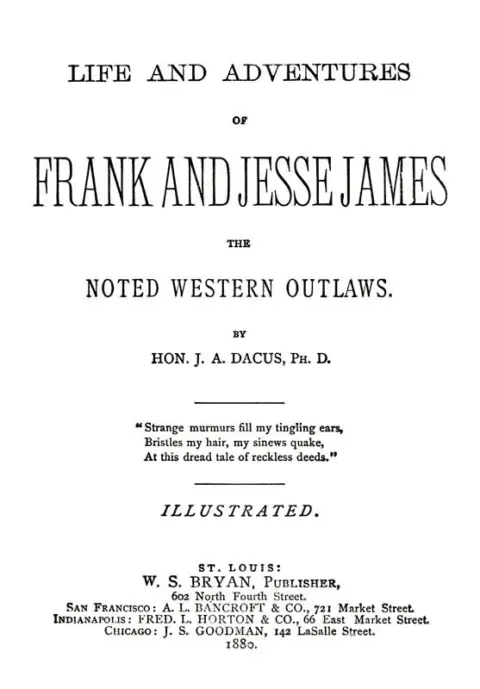
"Life and Adventures of Frank and Jesse James, the Noted Western Outlaws" by J.A. Dacus is a historical account written in the late 19th century. The narrative focuses on the notorious figures of Frank and Jesse James, detailing their early lives, their rise to infamy as outlaws, and the societal influences that shaped them. The book paints a picture of the brothers against the backdrop of the turbulent times of the American Civil War and the violent atmosphere of the post-war era, making it appealing to readers interested in American history and the lore of the Wild West. The opening of the book introduces the family background of Frank and Jesse James, highlighting their father, a respected preacher, and their mother, a determined woman who navigated the hardships of widowhood while raising her children. As the narrative unfolds, it describes the brothers' formative years, detailing their early fascination with firearms, which foreshadows their future lives as outlaws. We learn about the significant events that led them into the dark paths of guerrilla warfare and lawlessness, setting the stage for their notorious criminal careers. The text sets a somber yet curious tone, inviting readers to contemplate how ordinary beginnings can lead to extraordinary outcomes wrought with violence and tragedy.
Introduction adapted from the source catalogue; source summaries may be automatically generated.
Free to read · English · 84,613 words · No account needed
MAKE TIME FOR A GOOD BOOK
On by default. Untick to stop anonymous reading totals. Each page counts after 10 seconds in view. How this works.
Anonymous counting is on unless you have switched it off.
In a minute--nay, a moment--half a dozen rough-looking men, muffled and masked, stood by his side, armed with huge pistols and wicked-looking knives. Their pistols they held cocked in their hands. Then the leader, in a harsh, grating voice, said:
"Now, take care, make tracks out of this!"
The terrified citizens started to obey. As they were going, the
leader said:
"To the depot, do you hear!"
In great consternation, the little company of citizens filed away to the depot. In the depot was the operator and agent, Mr. McIntire, and Mr. W. E. Bridges, assistant auditor of the Chicago & Alton railway company, already under duress. When the citizens were all assembled in the room, the leader said:
"Now, sit down, act clever and keep still, or you will not have
heads left on you."
Of course, obedience to such an order was just then regarded by all the parties as a great virtue, and they therefore obeyed.
The masked men, who had now assembled to the number of twelve, according to one account--fourteen by another witness--tore away the telegraphic instrument and went out and cut the wires. The instrument was smashed.
"Now," said the leader, whose only mask was a long dark beard, "I want you to lower that green light!"
"But," said the agent, "the train will stop if I do."
"That's the alum! precisely what we want it to do, my buck, and the sooner you obey orders the better. I will give you a minute to lower the light," said the bearded leader, at the same time thrusting a cocked pistol to the face of the agent.
The operator could see the long, bright barrel of the pistol, and the dark, cavernous interior of the tube had a forbidding appearance. He looked up into the face of the long-bearded man. He saw a cold, fixed look, and every indication, so far as features could reveal intentions, that the robber chieftain meant just what he said, and he lowered the light. Of course the position of the light was an order to the conductor to stop at Glendale and receive fresh instructions, according to the code of signals in use among railway men.
But to be perfectly sure of the expected plunder, and in order to destroy even the possibility of the train passing without making a stop, the robbers heaped a pile of cross-ties, fence rails and other lumber across the track. Having completed their preparations, the robbers quietly awaited the coming of the train.
Your reading position is saved on this browser. Take it to another device with a library code. Reading pages adapt to text, rather than matching a printed edition.
BEHIND THE BOOK
This eBook is for the use of anyone anywhere in the United States and most other parts of the world at no cost and with almost no restrictions whatsoever. You may copy it, give it away or re-use it under the terms of the Project Gutenberg License included with this eBook or online at www.gutenberg.org. If you are not located in the United States, you will have to check the laws of the country where you are located before using this eBook. Read the source licence.
The original source file, including credits and licence, is retained by this library. Request an original-format copy at no charge. Please include the book title and Project Gutenberg identifier #45660.
KEEP YOUR CURIOSITY GOING
Cécile Tormay

Moritz Busch
John L. Ransom
Frances Wright
Cécile Tormay

Mabel Potter Daggett