THE CLASSIC COLLECTION✦Aztec place-namesCLASSIC FREE BOOKS
Aztec place-names
Frederick Starr
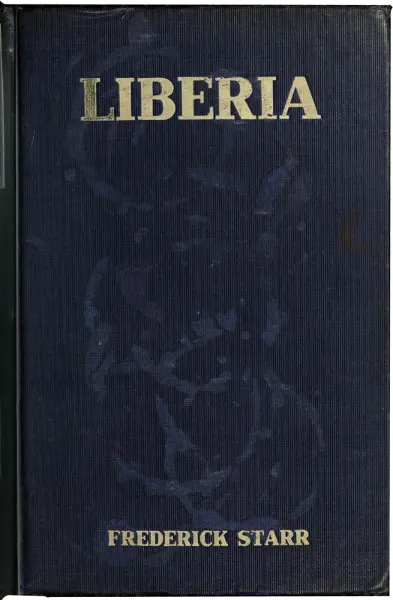
THE CLASSIC COLLECTION · 1913
"Liberia: Description, History, Problems" by Frederick Starr is a historical account written in the early 20th century. The work delves into the landscape, governance, society, and issues faced by the Republic of Liberia, which represents one of the few nations in Africa controlled by black inhabitants during a period of colonial dominance. The book explores themes of independence, the complexities of African governance, and the ongoing struggles for economic and social progress. At the start of the text, the author sets the stage by highlighting Liberia's unique position as a land of freedom for people of African descent escaping oppression in the United States. He reflects on the dichotomy between hopeful perspectives and prevalent criticisms of Liberia's governance, suggesting that its success or failure has implications for the entire African continent. The opening portion introduces references from other observers, such as Delafosse, who express concern about Liberia's socio-economic conditions while also acknowledging the potential for growth and improvement. Through this framework, Starr aims to provide a balanced examination of the republic, celebrating its achievements while earnestly addressing its challenges.
Introduction adapted from the source catalogue; source summaries may be automatically generated.
Free to read · English · 93,402 words · No account needed
MAKE TIME FOR A GOOD BOOK
On by default. Untick to stop anonymous reading totals. Each page counts after 10 seconds in view. How this works.
Anonymous counting is on unless you have switched it off.
Of course the sacrifice was without result. At the present time the whole question of the Franco-Liberian boundary is again open, and from the points urged by the French Government it is evident that it aims at new acquisition of territory and new restriction of the power of the little Republic.
We stand at the threshold of a new era; new political theories are being advanced; new interpretations are being given to the principles of international law; larger fulfilments of national obligations are being required of individual nations; new duties are being thrust upon us. They cannot be shirked, we must keep pace with world requirements. Regeneration and reform must be our watchword. The people must see that they become so. The process must operate from within outwards, or else influences from without will compass our ruin.--E. BARCLAY.
When President Barclay was in London, the British Government demanded that certain internal reforms should take place in the Republic before it would discuss a final settlement of either the Mano River or Kanre-Lahun difficulties. Shortly after the President’s return to Monrovia, Mr. Braithwait Wallis, Consul-General of Great Britain to Liberia, issued a memorandum on the subject--apparently under the fear “lest we forget”. This memorandum, which bears the date of January 14, 1908, occupies four printed pages, and condenses into that brief space an astonishing amount of venom and insolence. A few quotations will show its spirit:
“Your Excellency will remember then being informed that a critical moment had arrived in the history of the Republic, that however it might have been twenty or even ten years ago, the time had now gone by when Liberia could re-enact the part of a hermit kingdom, and that she must not lose a moment in setting herself seriously to work to put her house in order, or be prepared at no distant date, to disappear from the catalogue of independent countries. His Majesty’s Government, as Your Excellency is aware, have absolutely no designs against either the independence or the integrity of the Republic. Their only desire is that a country which, on one of its frontiers, marches with an important British Colony, and with which not only that Colony, but Great Britain itself, has large and growing commercial relations, should have such a stable or effective Government as will conduce to its own prosperity, and remove any danger of its losing its independence. His Majesty’s Government do not consider that the Government of the Republic is either stable or effective. Improvement has indeed resulted from the appointment of two Customs Officers, and the Customs revenue of the country has largely developed. But it is also considered as absolutely essential, if such improvement is to continue and to extend to other branches of the Government, that the finances of the country be placed, at any rate for the time being, in the hands of an European financial expert, and that at least three more European Customs experts be appointed. And further, no Government can be said to have a stable basis, when it is without any means of enforcing its authority. His Majesty’s Government, therefore, considers that it is essential that a trustworthy police, under European officers, should be at once established. With regard to the appointment of a financial expert, who could advise and assist the Secretary of the Treasury, in the financial affairs of the Country, Mr. Lamont has already been appointed Financial Adviser to the Republic. He is, however, only so in name, but should now be made so in actual fact. His Majesty’s Government further consider that the Liberian judiciary ought to undergo drastic reform.” Mr. Wallis recapitulates the reforms demanded in the following statement: (a) the appointment of a financial expert, who will place the finances of the country on a sound footing, and will advise the Secretary of the Treasury on financial matters. (b) The establishment of an efficient, well armed, and well disciplined police force under competent European Officers; and one that will command the respect of the Powers. (c) The appointment of at least three more European Customs experts. (d) The reform of the judiciary. “If the Liberian Government carry out the reforms herein indicated within SIX MONTHS, counted from the date of Your Excellency’s return to Monrovia from England, His Majesty’s Government will on their side be happy to assist in carrying them into effect in the same way as they have recently been assisting in the work of re-organizing the Liberian Customs. They will further be happy to suspend pressing the monetary and other claims which they have against Liberia, and will endeavor to come to a settlement, on a mutually satisfactory basis, on the long outstanding question of the navigation of the Mano River and the trouble on the Anglo-Liberian Frontier.”
Your reading position is saved on this browser. Take it to another device with a library code. Reading pages adapt to text, rather than matching a printed edition.
Frederick Starr
Frederick Starr
Frederick Starr
Frederick Starr
BEHIND THE BOOK
This eBook is for the use of anyone anywhere in the United States and most other parts of the world at no cost and with almost no restrictions whatsoever. You may copy it, give it away or re-use it under the terms of the Project Gutenberg License included with this eBook or online at www.gutenberg.org. If you are not located in the United States, you will have to check the laws of the country where you are located before using this eBook. Read the source licence.
The original source file, including credits and licence, is retained by this library. Request an original-format copy at no charge. Please include the book title and Project Gutenberg identifier #54542.
KEEP YOUR CURIOSITY GOING
Cécile Tormay

Moritz Busch
John L. Ransom
Frances Wright
Cécile Tormay

Mabel Potter Daggett