THE CLASSIC COLLECTION✦Aztec place-namesCLASSIC FREE BOOKS
Aztec place-names
Frederick Starr
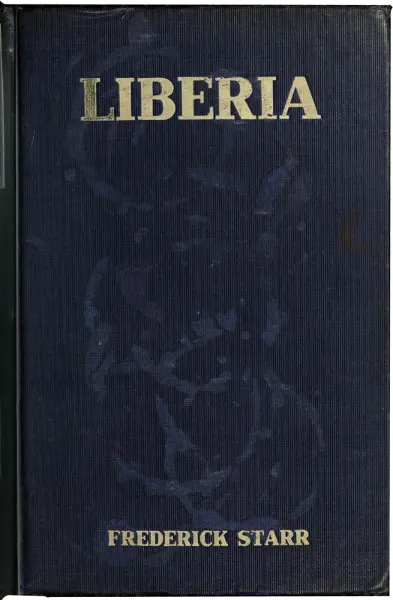
THE CLASSIC COLLECTION · 1913
"Liberia: Description, History, Problems" by Frederick Starr is a historical account written in the early 20th century. The work delves into the landscape, governance, society, and issues faced by the Republic of Liberia, which represents one of the few nations in Africa controlled by black inhabitants during a period of colonial dominance. The book explores themes of independence, the complexities of African governance, and the ongoing struggles for economic and social progress. At the start of the text, the author sets the stage by highlighting Liberia's unique position as a land of freedom for people of African descent escaping oppression in the United States. He reflects on the dichotomy between hopeful perspectives and prevalent criticisms of Liberia's governance, suggesting that its success or failure has implications for the entire African continent. The opening portion introduces references from other observers, such as Delafosse, who express concern about Liberia's socio-economic conditions while also acknowledging the potential for growth and improvement. Through this framework, Starr aims to provide a balanced examination of the republic, celebrating its achievements while earnestly addressing its challenges.
Introduction adapted from the source catalogue; source summaries may be automatically generated.
Free to read · English · 93,402 words · No account needed
MAKE TIME FOR A GOOD BOOK
On by default. Untick to stop anonymous reading totals. Each page counts after 10 seconds in view. How this works.
Anonymous counting is on unless you have switched it off.
Shortly after his election to the presidency of the Republic, President J. J. Roberts visited Europe. He was well received both in England and France. On one occasion, in 1848, when he was dining in London with the Prussian Ambassador, the conversation dealt with the difficulties which the Liberian settlers had with the native chiefs along the Gallinhas River; these hostilities were kept alive by slave traders who had their trading stations near the river’s mouth; these difficulties had generally been incited and directed by a chief named Mano. Among the guests who were present at the dinner were Lord Ashley and Mr. Gurney; it was suggested that an end might be put to these difficulties and the anti-slavery cause advanced, if Liberia would purchase this territory; considerable interest was aroused by the suggestion, and through Lord Ashley’s effort the necessary money was raised for consummating the purchase. On his return to Liberia, President Roberts entered into negotiations which extended from 1849 to 1856, by which the land was gradually acquired; the area secured stretched from the Mano River to the Sewa and Sherbro Island on the west. Through the annexation of this territory, Liberia’s domain extended from Cape Lahon to the eastward of Cape Palmas, west to the border of Sierra Leone, a distance of 600 miles. This acquisition of territory was attended with considerable difficulty; the influence of traders, of slavers, and even of England herself was thrown in the way of the negotiations--so Commodore Foote tells us. Nor did the acquisition of the territory put an end to the difficulties in that region. In the year 1860 John Myers Harris, an English trader, had established himself in the country between the Mano and Sulima Rivers and refused to acknowledge Liberia’s authority; as he was conducting a flagrant trade in contravention of Liberian laws of commerce, President Benson sent a coast guard to seize two schooners, the Phoebe and Emily, which had been consigned to him; the seizure was made between Cape Mount and Mano Point, clearly Liberian territory. It is curious that this seizure was made by a Liberian government vessel, the Quail, which had been a gift to the Republic from Great Britain. We have, then, a vessel, contributed through British sympathy, operating within an area secured through British philanthropy, against law-breaking indulged in by British subjects. The captured schooners were taken to Liberia and were held for legal adjudication; under the orders of the Sierra Leone Government, the British gunboat, Torch, appeared at Monrovia, and seized the two schooners by force on December 17; at the same time the commander of this gunboat demanded from the Liberian Government a penalty of fifteen pounds per day for nineteen days’ detention. Shortly after these events, President Benson, on his way to England for public business, visited the government of Sierra Leone and tried to adjust the difficulties which had arisen; he was, however, referred to London. At about this time part of the disputed territory was annexed by Sierra Leone to her own area. While in London, Benson took up the matter with the British Government. Lord Russell acknowledged the territorial rights of Liberia to extend from the coast east of Turner Point (Mattru) to the San Pedro River on the east, thus admitting the point for which Liberia contended. This decision was by no means satisfactory to the troublers in Africa. Harris agitated the matter in dispute. Backed by Governor Hall of Sierra Leone, he and neighboring traders protested against the concession Russell had made. A commission was therefore appointed and met at Monrovia April 25, 1863, continuing in session until May 4, when it adjourned without decision. The British Commissioners examined the title deeds held by Liberia and were inclined to recognize some of these and to refuse others; they objected to Liberia’s possessing any territory beyond the Mano River, and proposed that river as the boundary. The Liberian Commissioners demurred, urging the validity of the deeds they showed and proposing that the Sherbro should be their northwest boundary; they asserted a good title to the territories known as Cassee, Gumbo, and Muttru. The British Commissioners based their claims upon letters from the chiefs of the territories involved and on statements which they asserted had been made by them. The Commission broke up without a settlement, as the Liberians held strictly to the concession which Lord Russell had previously made. London, however, yielding to the colonial pressure, regretted that no solution had been reached, and claimed that it was “justified in view of the facts” in only recognizing Liberia’s sovereignty over Sugaree. The closing episode in this exchange of views was the sending of a letter by Dr. Blyden, who was then Secretary of State for the Republic, which ran as follows: “The President is equally grieved that the oral statements of barbarous and heathen chiefs on a subject affecting the prosperity of a rising Christian state should be regarded by Her Majesty’s Government as entitled to more weight than the statements of Christian men supported by written documents and by the known local conduct of the chiefs towards the Liberian Government since the cession of their territories until very recently.”
Your reading position is saved on this browser. Take it to another device with a library code. Reading pages adapt to text, rather than matching a printed edition.
Frederick Starr
Frederick Starr
Frederick Starr
Frederick Starr
BEHIND THE BOOK
This eBook is for the use of anyone anywhere in the United States and most other parts of the world at no cost and with almost no restrictions whatsoever. You may copy it, give it away or re-use it under the terms of the Project Gutenberg License included with this eBook or online at www.gutenberg.org. If you are not located in the United States, you will have to check the laws of the country where you are located before using this eBook. Read the source licence.
The original source file, including credits and licence, is retained by this library. Request an original-format copy at no charge. Please include the book title and Project Gutenberg identifier #54542.
KEEP YOUR CURIOSITY GOING
Cécile Tormay

Moritz Busch
John L. Ransom
Frances Wright
Cécile Tormay

Mabel Potter Daggett