THE CLASSIC COLLECTION✦Aztec place-namesCLASSIC FREE BOOKS
Aztec place-names
Frederick Starr
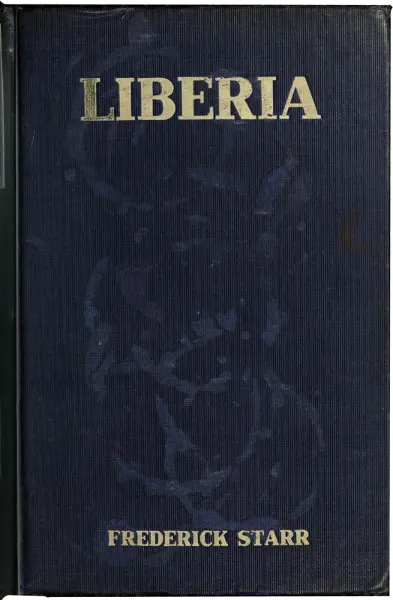
THE CLASSIC COLLECTION · 1913
"Liberia: Description, History, Problems" by Frederick Starr is a historical account written in the early 20th century. The work delves into the landscape, governance, society, and issues faced by the Republic of Liberia, which represents one of the few nations in Africa controlled by black inhabitants during a period of colonial dominance. The book explores themes of independence, the complexities of African governance, and the ongoing struggles for economic and social progress. At the start of the text, the author sets the stage by highlighting Liberia's unique position as a land of freedom for people of African descent escaping oppression in the United States. He reflects on the dichotomy between hopeful perspectives and prevalent criticisms of Liberia's governance, suggesting that its success or failure has implications for the entire African continent. The opening portion introduces references from other observers, such as Delafosse, who express concern about Liberia's socio-economic conditions while also acknowledging the potential for growth and improvement. Through this framework, Starr aims to provide a balanced examination of the republic, celebrating its achievements while earnestly addressing its challenges.
Introduction adapted from the source catalogue; source summaries may be automatically generated.
Free to read · English · 93,402 words · No account needed
MAKE TIME FOR A GOOD BOOK
On by default. Untick to stop anonymous reading totals. Each page counts after 10 seconds in view. How this works.
Anonymous counting is on unless you have switched it off.
The American Colonization Society was founded in Washington in December, 1816. To it Liberia is due. On the 23rd of December, 1816, the legislature of Virginia requested the governor of the state to correspond with the President of the United States “for the purpose of obtaining a territory on the coast of Africa, or at some other place not within any of the states, or territorial governments of the United States, to serve as an asylum for such persons of color as are now free, and may desire the same, and for those who may hereafter be emancipated within this commonwealth.” A few days after this a meeting was held at Washington to which persons interested were invited. Bushrod Washington presided; Mr. Clay, Mr. Randolph, and others took part in the discussions which ensued and which resulted in the organization of the American Colonization Society. Judge Washington was chosen president, a board of twelve managers were selected, together with seventeen vice-presidents from various states. The object of the Society was clearly set forth in the first and second articles of its constitution. “Article 1. This society shall be called The American Society for Colonizing the Free People of Color of the United States. Article 2. The object to which attention is to be exclusively directed, is to promote and execute a plan of colonizing (with their consent) the free people of color residing in our country, in Africa, or such other place as Congress shall deem most expedient. And the Society shall act to effect this object in co-operation with the general government and such of the states as may adopt regulations on the subject.”
We do not desire in the least to minimize the good, either of the intent or result, of the American Colonization Society. It is, however, only just to say that it was not a purely benevolent organization. Its membership included different classes. Of this Jay says: “First, such as sincerely desire to afford the free blacks an asylum from the oppression they suffer here, and by their means to extend to Africa the blessings of Christianity and civilization, and who at the same time flatter themselves that colonization will have a salutary influence in accelerating the abolition of slavery; Secondly, such as expect to enhance the value and security of slave property, by removing the free blacks; and Thirdly, such as seek relief from a bad population, without the trouble and expense of improving it.” As a matter of fact, the American Colonization Society was largely an organization of slave holders. Judge Washington was a southern man; of the seventeen vice-presidents twelve were from slave states; of the twelve managers all were slave holders. Through a period of years the American Colonization Society and the Abolition Societies of the United States waged a furious conflict. The real purpose of the organization was to get rid of the free blacks at any cost, and the attitude of its members toward free blacks was repeatedly expressed in the strongest terms. Thus, General Harper, to whom the names Liberia and Monrovia were due, said: “Free blacks are a greater nuisance than even slaves themselves.” Mercer, a vice-president of the Society, spoke of them as a “horde of miserable people,--the objects of universal suspicion,--subsisting by plunder.” Henry Clay, an original member of the Society and for many years vice-president, said: “Of all classes of our population, the most vicious is that of the free colored--contaminated themselves, they extend their vices to all around them.” Again Clay said: “Of all the descriptions of our population, and of either portion of the African race, the free persons of color are by far, as a class, the most corrupt, depraved, and abandoned.” And yet these excellent gentlemen repeatedly stated that in sending free black men to Africa, they were actually combatting the slave trade and Christianizing the natives. Clay himself said, in the same speech in which he referred to the free blacks as “corrupt, depraved, abandoned.” * * * “The Society proposes to send out not one or two pious members of Christianity into a foreign land; but to transport annually, for an indefinite number of years, in one view of its scheme, 6,000, in another, 56,000 missionaries of the descendants of Africa itself, to communicate the benefits of our religion and the arts.” Stripped of all pretense, the facts were that the free blacks of the day were not wanted in America, and that they must somehow be got rid of; accordingly they were dumped upon the African west coast.
Your reading position is saved on this browser. Take it to another device with a library code. Reading pages adapt to text, rather than matching a printed edition.
Frederick Starr
Frederick Starr
Frederick Starr
Frederick Starr
BEHIND THE BOOK
This eBook is for the use of anyone anywhere in the United States and most other parts of the world at no cost and with almost no restrictions whatsoever. You may copy it, give it away or re-use it under the terms of the Project Gutenberg License included with this eBook or online at www.gutenberg.org. If you are not located in the United States, you will have to check the laws of the country where you are located before using this eBook. Read the source licence.
The original source file, including credits and licence, is retained by this library. Request an original-format copy at no charge. Please include the book title and Project Gutenberg identifier #54542.
KEEP YOUR CURIOSITY GOING
Cécile Tormay

Moritz Busch
John L. Ransom
Frances Wright
Cécile Tormay

Mabel Potter Daggett