THE CLASSIC COLLECTION✦Aztec place-namesCLASSIC FREE BOOKS
Aztec place-names
Frederick Starr
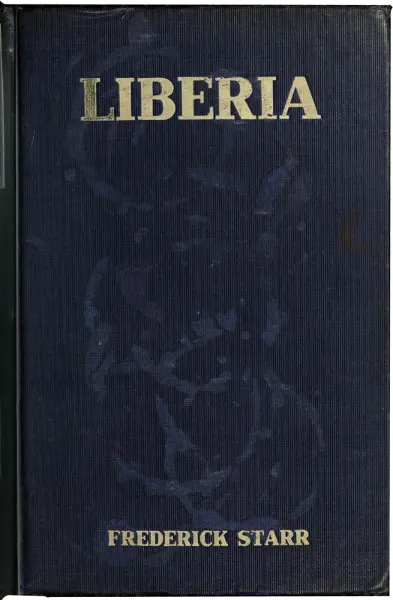
THE CLASSIC COLLECTION · 1913
"Liberia: Description, History, Problems" by Frederick Starr is a historical account written in the early 20th century. The work delves into the landscape, governance, society, and issues faced by the Republic of Liberia, which represents one of the few nations in Africa controlled by black inhabitants during a period of colonial dominance. The book explores themes of independence, the complexities of African governance, and the ongoing struggles for economic and social progress. At the start of the text, the author sets the stage by highlighting Liberia's unique position as a land of freedom for people of African descent escaping oppression in the United States. He reflects on the dichotomy between hopeful perspectives and prevalent criticisms of Liberia's governance, suggesting that its success or failure has implications for the entire African continent. The opening portion introduces references from other observers, such as Delafosse, who express concern about Liberia's socio-economic conditions while also acknowledging the potential for growth and improvement. Through this framework, Starr aims to provide a balanced examination of the republic, celebrating its achievements while earnestly addressing its challenges.
Introduction adapted from the source catalogue; source summaries may be automatically generated.
Free to read · English · 93,402 words · No account needed
MAKE TIME FOR A GOOD BOOK
On by default. Untick to stop anonymous reading totals. Each page counts after 10 seconds in view. How this works.
Anonymous counting is on unless you have switched it off.
The Commission arrived at home in August, 1909. An official reception was given them on the 18th by President Barclay. The address of welcome was given by the Secretary of State, F. E. R. Johnson, and other addresses by Acting Mayor Roberts and Postmaster-General Prout. Replies were made by Gibson, Dossen, Dunbar, and Faulkner. It is significant that in these addresses more emphasis was laid upon the subject of negro education in the United States than upon other matters. Both then and while in this country, Vice-President Dossen especially emphasized the importance of immigration; he wants 600,000 negroes from America to settle in Liberia, and claims that the people of Liberia feel that they are holding their territory in trust for this mass of immigrants. Music and refreshments were supplied and a speech of congratulation given by President Barclay. Of course nothing definite at this time could be said in regard to the actual results of the Commission’s visit; no one knew just what impression had been made upon our Government; no one knew just what to expect in the way of action.
Our Government, however, had seriously taken Liberian matters under advisement, and on the 4th of March, 1909, an American Commission was appointed to visit Liberia and to investigate Liberian conditions. The Commissioners were Roland P. Falkner, George Sale, and Emmett J. Scott, with George A. Finch as secretary. The Commission sailed on April 24th, 1909, and arrived in Monrovia on the 8th of May. They spent thirty days in Liberia and Sierra Leone. The work they had to do was wisely divided up among the members of the Commission, in order to permit their accomplishing the utmost in the short time at their disposition.
Their arrival at Liberia was hailed with joy. In anticipation of their coming the legislators had come from all the counties to Monrovia and were in the capital before the arrival of the Commission. The cruiser Chester arrived in front of Monrovia on the morning of May 8th, and at once saluted with twenty-one guns; the salute was returned by the Liberians from the shore. Ernest Lyon, the American Minister, at once boarded the vessel. When he returned, the Attorney-General with a party of citizens went on board to escort the Commissioners to the shore. The city was gaily decorated. The Mayor, Common Council, and a crowd of citizens met the Commissioners at the landing where, under the first arch of welcome, the acting Mayor made an address. Mr. Falkner replied on behalf of the Commission. Two companies of the militia escorted the Commission up the hill to the second arch, where Mrs. Parker addressed them on behalf of the Liberian ladies. Sale responded, after which Mrs. McGill spoke on behalf of the county of Grand Bassa. At the third arch Miss Irene A. Gant received them on behalf of Sinoe County, and Miss Matilda Roberts on behalf of Maryland County. Passing now to the American legation, they were officially received by the American Minister. Few public occasions in the history of Monrovia equal this reception, which fairly deserves to be called a popular ovation. On the 13th, President Barclay offered the Commission an official reception at which the President and the Cabinet, the Commission and attachés, and the United States Minister with his Secretary were present. In the afternoon of the 12th, a general reception was given at the Executive Mansion. During their stay in Africa, the Commission visited Grand Bassa and Maryland, and in both regions they were treated with distinguished courtesy. The report of the Commission sent to the Senate and House of Representatives by President Taft on March 25th, 1910, was an exceptionally good public document. The Commission recognized the importance of the work entrusted to it and did its work with thoroughness. They made six recommendations to our government. They were as follows: (1) That the United States extend its aid to Liberia in the prompt settlement of pending boundary disputes. (2) That the United States enable Liberia to refund its debt by assuming as guarantee for the payment of obligations under such arrangement the control and collection of the Liberian customs. (3) That the United States lend its assistance to the Liberian Government in the reform of its internal finances. (4) That the United States lend its aid to Liberia in organizing and drilling an adequate constabulary or frontier police force. (5) That the United States should establish and maintain a research station in Liberia. (6) That the United States re-open the question of a naval coaling station in Liberia. Some of these recommendations the United States has carried through. She has made the loan necessary for the refunding of the public debt; she is lending assistance to the Liberian Government in the reform of internal finances; she is aiding Liberia in the organization and drilling of her frontier force. These are good things, and it is to be hoped that they will prove as helpful as has been anticipated. We should help Liberia, and help her handsomely; she deserves all that we can do for her. We must be careful, of course, in our assistance, not to accustom her to the notion of dependency. Muscle can only be developed in a body by the exercise of that body itself. No being can develop muscle for another. Liberia, if she is to prosper, must develop energy, force, independence; she needs help but must work out her own salvation. Exercise to be valuable must not be a death struggle; we must protect her from her foes, but we must insist upon her self-development. There are, however, still many things that we can do for the Republic without reducing her to a condition of dependency and pauperization.
Your reading position is saved on this browser. Take it to another device with a library code. Reading pages adapt to text, rather than matching a printed edition.
Frederick Starr
Frederick Starr
Frederick Starr
Frederick Starr
BEHIND THE BOOK
This eBook is for the use of anyone anywhere in the United States and most other parts of the world at no cost and with almost no restrictions whatsoever. You may copy it, give it away or re-use it under the terms of the Project Gutenberg License included with this eBook or online at www.gutenberg.org. If you are not located in the United States, you will have to check the laws of the country where you are located before using this eBook. Read the source licence.
The original source file, including credits and licence, is retained by this library. Request an original-format copy at no charge. Please include the book title and Project Gutenberg identifier #54542.
KEEP YOUR CURIOSITY GOING
Cécile Tormay

Moritz Busch
John L. Ransom
Frances Wright
Cécile Tormay

Mabel Potter Daggett