THE CLASSIC COLLECTION✦Aztec place-namesCLASSIC FREE BOOKS
Aztec place-names
Frederick Starr
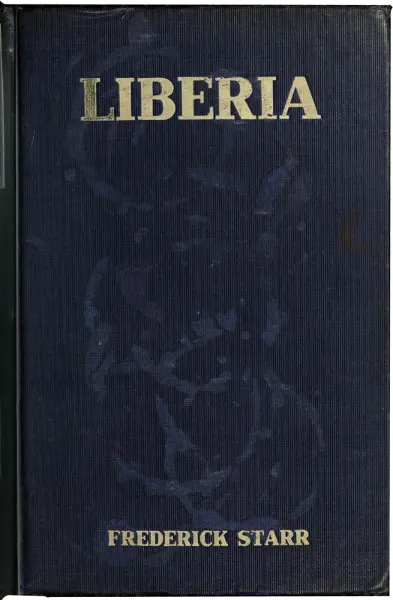
THE CLASSIC COLLECTION · 1913
"Liberia: Description, History, Problems" by Frederick Starr is a historical account written in the early 20th century. The work delves into the landscape, governance, society, and issues faced by the Republic of Liberia, which represents one of the few nations in Africa controlled by black inhabitants during a period of colonial dominance. The book explores themes of independence, the complexities of African governance, and the ongoing struggles for economic and social progress. At the start of the text, the author sets the stage by highlighting Liberia's unique position as a land of freedom for people of African descent escaping oppression in the United States. He reflects on the dichotomy between hopeful perspectives and prevalent criticisms of Liberia's governance, suggesting that its success or failure has implications for the entire African continent. The opening portion introduces references from other observers, such as Delafosse, who express concern about Liberia's socio-economic conditions while also acknowledging the potential for growth and improvement. Through this framework, Starr aims to provide a balanced examination of the republic, celebrating its achievements while earnestly addressing its challenges.
Introduction adapted from the source catalogue; source summaries may be automatically generated.
Free to read · English · 93,402 words · No account needed
MAKE TIME FOR A GOOD BOOK
On by default. Untick to stop anonymous reading totals. Each page counts after 10 seconds in view. How this works.
Anonymous counting is on unless you have switched it off.
The importance of education was recognized by the “fathers.” The quotation of President Roberts which we have given above voiced the feelings of the more thoughtful of the settlers. Yet it must be admitted that the educational situation is far from perfect. There is a recently established Department of Education, the Secretary of which holds a Cabinet position. In 1912 Dr. Payne had under his direction ninety-one public schools in different parts of the Republic. Most of these schools were housed in buildings totally unsuited to their purpose; they were small, badly built, and unsupplied with even the barest equipment. There are no book-stores in Liberia, and there is a notable lack of suitable text-books for the children’s use; there are few black-boards and those of poor quality; the desks, seats, and other furniture are conspicuous either for their absence or poor quality. Teachers are frequently badly prepared; they not infrequently neglect their duties; the number of days of teaching is uncertain--as often the teachers will be occupied with other work than that to which they are supposed to devote their time and attention. Salaries are very low and badly paid. Mr. Deputie, once Superintendent of Education, in his report of 1905, appealing to the legislature, said: “Lend a hand by your official acts that will tend to ameliorate the condition of the teachers in the public schools, that they may receive a just recompense of reward. Some of these teachers, after serving faithfully during the quarter, receive only ten shillings on their bills, while many others of them receive not a shilling.” In 1910 Mr. Edwin Barclay was General Superintendent of the Schools. He made a careful study of the situation and in his report presents interesting statistics and facts with reference to the condition. He made a series of thoughtful recommendations for the future, and drew up an entire scheme of proposed legislation. Much of that which he suggested has been approved and theoretically put in practice. In regard to the matter of teachers’ salaries, he makes an interesting statement in tabulated form, comparing the average salaries of teachers with those of clerks in the department of the Government and in mercantile establishments. He shows us that the average salary of public school teachers at that time was $143.95 per year; that this salary was stationary and without increment of any kind. At that same time, clerks in government departments received an average salary of $321.29 per year with definite chance of promotion and a career before them. Clerks in mercantile establishments did even better, receiving an average annual salary of $365.90 a year with contingent increment annually of from twenty to fifty per cent on net profits. It is hardly strange under the circumstances that good teachers are rare and that promising young men should look to other fields than that of teaching. Three grades of teachers are recognized in the public schools; all teachers are required to pass an examination and receive certificates; second grade teachers receive thirty dollars per year more than third grade teachers, and teachers of first grade, thirty dollars more than those of second grade. Public schools are subject to the inspection of a local school committee which “consists of three good, honest, substantial citizens of the locality, having an interest in education. Sex ought not to be a barrier. They need not be highly educated, but should be able to read and write intelligently and earnest friends of education.” Membership in the committee is purely honorary, no fee accompanying the appointment. The members of the committee are to take an annual census of children of school age and to see that they attend school; they are to keep tab on the teacher and report him if he be guilty of immoral conduct or fails to advance his school. Each county has a school Commissioner whose business it is to examine candidates for teaching, to employ and direct teachers, to approve bills of salary, to visit each school in his district without announcement at least once a quarter, to remove and replace teachers, to make reports to the General Superintendent, to supply text-books, and hold annual teachers’ meetings in order to develop greater ability on the part of the instructors. Compulsory education is recognized in the Republic; as, however, many young people are obliged to assist in the support of the families to which they belong, night schools are provided for those who may be working during the hours of the day. The public schools are practically confined to the Americo-Liberian settlements. The latest definite statistics in regard to the number of children in attendance on the public schools are those of 1910. At that time 1782 children were in the schools; of these 1225 were civilized, 557 uncivilized, i. e., native; the distribution according to counties was as follows: In Grand Bassa County, 407; in Maryland County, 148; in Montserrado County, 947; in Sinoe County, 280. The instillation of patriotism into the young mind is regarded as a matter of importance, and it is required that the flag of the Republic shall be daily displayed at every school-house or place where public school is held; and “the hoisting and striking of colors at the daily opening and close of school session shall be attended with such ceremonies as shall tend to instill into the minds of the pupils a respect and veneration for the flag and a knowledge of the principle for which it stands.”
Your reading position is saved on this browser. Take it to another device with a library code. Reading pages adapt to text, rather than matching a printed edition.
Frederick Starr
Frederick Starr
Frederick Starr
Frederick Starr
BEHIND THE BOOK
This eBook is for the use of anyone anywhere in the United States and most other parts of the world at no cost and with almost no restrictions whatsoever. You may copy it, give it away or re-use it under the terms of the Project Gutenberg License included with this eBook or online at www.gutenberg.org. If you are not located in the United States, you will have to check the laws of the country where you are located before using this eBook. Read the source licence.
The original source file, including credits and licence, is retained by this library. Request an original-format copy at no charge. Please include the book title and Project Gutenberg identifier #54542.
KEEP YOUR CURIOSITY GOING
Cécile Tormay

Moritz Busch
John L. Ransom
Frances Wright
Cécile Tormay

Mabel Potter Daggett