READ · DISCOVER · ENJOYClassic literature · Always free
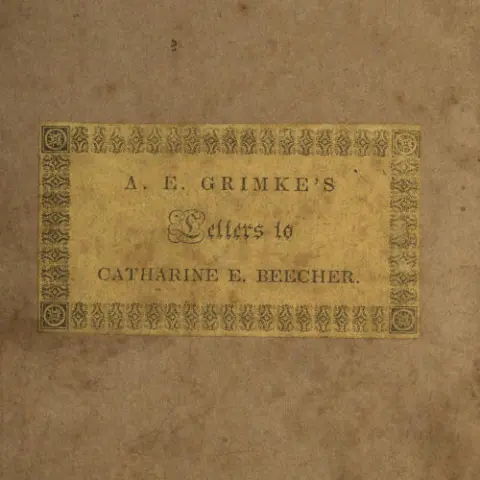
Letters to Catherine E. Beecher, in reply to an essay on slavery and abolitionism, addressed to A. E. Grimké — digital edition cover

THE CLASSIC COLLECTION · 1838

Letters to Catherine E. Beecher, in reply to an essay on slavery and abolitionism, addressed to A. E. Grimké

"Letters to Catherine E. Beecher, in reply to an essay on slavery and…" is a collection of letters addressing the complex issues of slavery and abolitionism, likely written in the early 19th century. The author, A. E. Grimké, articulates a staunch abolitionist perspective, responding to Beecher's remarks on the topic and challenging the moral implications of slaveholding. The letters convey the author's insistence that all forms of slavery are acts of theft against humanity, emphasizing the immediate and universal need for emancipation. The opening of the work establishes A. E. Grimké's position on abolitionism, beginning with a personal note directed at Beecher. Grimké expresses his struggle to address the weighty subject amid ongoing responsibilities but is determined to clarify the fundamental principles of abolitionists. He argues against her claims, stating that slaveholding is a continuous act of 'man-stealing' and that all who support it are complicit in systemic injustice. As he lays the groundwork for his critique, he confronts misconceptions about the abolitionist measures, affirming the moral imperatives underpinning their actions and arguing that the North shares the culpability of slavery. The fervent tone suggests a deep-seated conviction that immediate action against the institution of slavery is both a moral duty and a necessity for societal healing.

Introduction adapted from the source catalogue; source summaries may be automatically generated.

Start reading ↓

Free to read · English · 34,084 words · No account needed

MAKE TIME FOR A GOOD BOOK

Letters to Catherine E. Beecher, in reply to an essay on slavery and abolitionism, addressed to A. E. Grimké

On by default. Untick to stop anonymous reading totals. Each page counts after 10 seconds in view. How this works.

Anonymous counting is on unless you have switched it off.

Letters to Catherine E. Beecher, in reply to an essay on slavery and abolitionism, addressed to A. E. Grimké

In haste, I remain thy friend,

A. E. GRIMKÉ.

[1] And in ‘Laird’s Expedition to Africa, &c.’ a work recently published in England, this assertion of the slave trader is fully sustained. Laird relates that ‘there is proof of the horrid fact, that several of the wretches engaged in this traffic, when hotly pursued, consigned whole cargoes to the deep.’ He then goes on to state several such instances, from which I select the following: ‘In 1833, the Black Joke and Fair Rosamond fell in with the Hercule and Regule, two slave vessels off the Bonny River. On perceiving the cruisers, they attempted to regain the port, and pitched overboard upwards of 500 human beings, chained together, before they were captured; from the abundance of sharks in the river, their track was literally a blood-stained one. The slaver not only does this, but glories in it: the first words uttered by the captain of the Maria Isabelle, seized by captain Rose, were, ‘that if he had seen the man of war in chase an hour sooner, he would have thrown every slave in his vessel overboard, as he was fully insured.’

LETTER IV.

CONNECTION BETWEEN THE NORTH AND SOUTH.

DANVERS, Mass., 7th mo., 1837.

DEAR FRIEND:--I thank thee for having furnished me with just such a simile as I needed to illustrate the connection which exists between the North and the South. Thou sayest, ‘Suppose two rival cities, one of which becomes convinced that certain practices in trade and business in the other are dishonest, and have an oppressive bearing on certain classes in that city. Suppose, also, that these are practices, which, by those who allow them, are considered as honorable and right. Those who are convinced of this immorality wish to alter the opinions and the practices of the citizens of their rival city, and to do this they commence the collection of facts, that exhibit the tendencies of these practices and the evils they have engendered. But, instead of going among the community in which the evil exists, and endeavoring to convince them, they proceed to form voluntary associations among their neighbors at home, and spend their time, money, and efforts to convince their fellow citizens that the inhabitants of their rival city are guilty of a great sin.’ Now I will take up the comparison here, and suppose a few other things about these two cities. Suppose that the people in one city were known never to pay the laborer his wages, but to be in the constant habit of keeping back the hire of those who reaped down their fields; and that, on examination, it was found that the people in the other city were continually going over to live with these gentlemen oppressors, and instead of rebuking them, were joining hands in wickedness with them, and were actually more oppressive to the poor than the native inhabitants. Suppose, too, it was found that many of the merchants in the city of Fairdealing, as it was called, were known to hold mortgages, not only upon the property which ought to belong to the unpaid laborers, but mortgages, too, on the laborers themselves, ay, and their wives and children also, a thing altogether contrary to the laws of their city, and the customs of their people, and the principles of fundamental morality. Suppose, too, it was found that the people in the city of Oppression were in the constant practice of sending over to the city of Fairdealing, and bribing their citizens to seize the poorest, most defenceless of their people for them, because they were so lazy they would not do their own work, and so mean they would not pay others for doing it, and chose thus to supply themselves with laborers, who, when they once got into the city, were placed under such severe laws, that it was almost impossible for them ever to return to their afflicted wives and children. Suppose, too, that whenever any of these oppressed, unpaid laborers happened to escape from the city of Oppression, and after lying out in the woods and fastnesses which lay between the two cities, for many weeks, ‘in weariness and painfulness, in watchings, in hunger and thirst, in cold and nakedness,’ that, as soon as they reached the city of Fairdealing, they were most unmercifully hunted out and sent back to their cruel oppressors, who it was well known generally treated such laborers with great cruelty, ‘stern necessity’ demanding that they should be punished and ‘rebuked before all, that others might fear’ the consequences of such elopement. In short, suppose that the city of Fairdealing was so completely connected with the city of Oppression, that the golden strands of their interests were twisted together so as to form a bond of Union stronger than death, and that by the intermarriages which were constantly taking place, there was also a silken cord of love tying up and binding together the tender feelings of their hearts with all the intricacies of the Gordian knot; and then, again, that the identity of the political interests of these cities were wound round and round them like bands of iron and brass, altogether forming an union so complicated and powerful, that it was impossible even to speak in the most solemn manner, in the city of Fairdealing, of the enormous crimes which were common in the city of Oppression, without having brickbats and rotten eggs hurled at the speaker’s head. Suppose, too, that although it was perfectly manifest to every reflecting mind, that a most guilty copartnership existed between these two cities, yet that the ‘gentlemen of property and standing’ of the city of Fairdealing were continually taunting the people who were trying to represent their iniquitous league with the city of Oppression in its true and sinful bearings, with the query of ‘Why don’t you go to the city of Oppression, and tell the people there, not to rob the poor?’ Might not these reformers very justly remark, we cannot go there until we have persuaded our own citizens to cease their unholy co-operation with them, for they will certainly turn upon us in bitter irony and say--‘Physician, heal thyself;’ go back to your own city, and tell your own citizens ‘to break off their sins by righteousness, and their transgressions by showing mercy to the poor,’ who fly from our city into the gates of theirs for protection, but receive it not. Would not common sense bear them out in refusing to go there, until they had first converted their own people from the error of their ways? I will leave thee and my other readers to make the application of this comparison; and if thou dost not acknowledge that abolitionists have been governed by the soundest common sense in the course they have pursued at the North with regard to slavery, then I am very much disappointed in thy professions of candor. With regard to the parallel thou hast drawn (p. 16,) between abolitionists, and the ‘men (who) are daily going into the streets, and calling all bystanders around them’ and pointing out certain men, some as liars, some as dishonest, some as licentious, and then bringing proofs of their guilt and rebuking them before all; at the same time exhorting all around to point at them the finger of scorn; thou sayest, ‘they persevere in this course till the whole community is thrown into an uproar; and assaults and even bloodshed ensue.’ But why, I should like to know, if these people are themselves guiltless of the crimes alleged against the others? I cannot understand why they should be so angry, unless, like the Jews of old, they perceived that the parable had been spoken ‘against them.’ To my own mind, the exasperation of the North at the discussion of slavery is an undeniable proof of her guilt, a certain evidence of the necessity of her plucking the beam out of her own eye, before she goes to the South to rebuke sin there. To thee, and to all who are continually crying out, ‘Why don’t you go to the South?’ I retort the question by asking, why don’t YOU go to the South? We conscientiously believe that this work must be commenced here at the North; this is an all-sufficient answer for US; but YOU, who are ‘as much anti-slavery as we are,’ and differ only as to the modus operandi, believing that the South and not the North ought to be the field of Anti-Slavery labors--YOU, I say, have no excuse to offer, and are bound to go there now.

Your reading position is saved on this browser. Take it to another device with a library code. Reading pages adapt to text, rather than matching a printed edition.

BEHIND THE WORDS

About Angelina Emily Grimké

Angelina Emily Grimké (1805–1879). Explore Letters to Catherine E. Beecher, in reply to an essay on slavery and abolitionism, addressed to A. E. Grimké in this collection. These books span essays & ideas, history.

Explore this author’s books →

THE READERS’ VERDICT

How did this story stay with you?

Not rated yet
Your rating for Letters to Catherine E. Beecher, in reply to an essay on slavery and abolitionism, addressed to A. E. Grimké

Be the first to share your verdict.

One rating per browser, which you can change or remove. A necessary browser identifier remembers your vote. How ratings work

A GOOD STORY DESERVES COMPANY

Pass this book along.

A great read is even better when it’s shared.

SEND A LITTLE INSPIRATION

Share this book

BEHIND THE BOOK

Edition & source details.

Title
Letters to Catherine E. Beecher, in reply to an essay on slavery and abolitionism, addressed to A. E. Grimké
Author
Angelina Emily Grimké
First publication (Open Library catalogue match)
1838
Digital edition publisher
Project Gutenberg
Gutenberg release date
2016-12-31
Language
English
Source edition imprint
Not stated in source catalogue
Source identifier
Project Gutenberg #53852
Contributors
No additional named contributors in source metadata

Public-domain source & licence

This eBook is for the use of anyone anywhere in the United States and most other parts of the world at no cost and with almost no restrictions whatsoever. You may copy it, give it away or re-use it under the terms of the Project Gutenberg License included with this eBook or online at www.gutenberg.org. If you are not located in the United States, you will have to check the laws of the country where you are located before using this eBook. Read the source licence.

Full source licence and obtaining an original copy

The original source file, including credits and licence, is retained by this library. Request an original-format copy at no charge. Please include the book title and Project Gutenberg identifier #53852.

the full Project Gutenberg License must appear
prominently whenever any copy of a Project Gutenberg work (any work
on which the phrase “Project Gutenberg” appears, or with which the
phrase “Project Gutenberg” is associated) is accessed, displayed,
performed, viewed, copied or distributed:

This eBook is for the use of anyone anywhere in the United States and most
other parts of the world at no cost and with almost no restrictions
whatsoever. You may copy it, give it away or re-use it under the terms
of the Project Gutenberg™ License included with this eBook or online
at www.gutenberg.org. If you
are not located in the United States, you will have to check the laws
of the country where you are located before using this eBook.

1.E.2. If an individual Project Gutenberg electronic work is
derived from texts not protected by U.S. copyright law (does not
contain a notice indicating that it is posted with permission of the
copyright holder), the work can be copied and distributed to anyone in
the United States without paying any fees or charges. If you are
redistributing or providing access to a work with the phrase “Project
Gutenberg” associated with or appearing on the work, you must comply
either with the requirements of paragraphs 1.E.1 through 1.E.7 or
obtain permission for the use of the work and the Project Gutenberg
trademark as set forth in paragraphs 1.E.8 or 1.E.9.

1.E.3. If an individual Project Gutenberg electronic work is posted
with the permission of the copyright holder, your use and distribution
must comply with both paragraphs 1.E.1 through 1.E.7 and any
additional terms imposed by the copyright holder. Additional terms
will be linked to the Project Gutenberg License for all works
posted with the permission of the copyright holder found at the
beginning of this work.

1.E.4. Do not unlink or detach or remove the full Project Gutenberg
License terms from this work, or any files containing a part of this
work or any other work associated with Project Gutenberg.

1.E.5. Do not copy, display, perform, distribute or redistribute this
electronic work, or any part of this electronic work, without
prominently displaying the sentence set forth in paragraph 1.E.1 with
active links or immediate access to the full terms of the Project
Gutenberg License.

1.E.6. You may convert to and distribute this work in any binary,
compressed, marked up, nonproprietary or proprietary form, including
any word processing or hypertext form. However, if you provide access
to or distribute copies of a Project Gutenberg work in a format
other than “Plain Vanilla ASCII” or other format used in the official
version posted on the official Project Gutenberg website
(www.gutenberg.org), you must, at no additional cost, fee or expense
to the user, provide a copy, a means of exporting a copy, or a means
of obtaining a copy upon request, of the work in its original “Plain
Vanilla ASCII” or other form. Any alternate format must include the
full Project Gutenberg License as specified in paragraph 1.E.1.

1.E.7. Do not charge a fee for access to, viewing, displaying,
performing, copying or distributing any Project Gutenberg works
unless you comply with paragraph 1.E.8 or 1.E.9.

1.E.8. You may charge a reasonable fee for copies of or providing
access to or distributing Project Gutenberg electronic works
provided that:

• You pay a royalty fee of 20% of the gross profits you derive from
the use of Project Gutenberg works calculated using the method
you already use to calculate your applicable taxes. The fee is owed
to the owner of the Project Gutenberg trademark, but he has
agreed to donate royalties under this paragraph to the Project
Gutenberg Literary Archive Foundation. Royalty payments must be paid
within 60 days following each date on which you prepare (or are
legally required to prepare) your periodic tax returns. Royalty
payments should be clearly marked as such and sent to the Project
Gutenberg Literary Archive Foundation at the address specified in
Section 4, “Information about donations to the Project Gutenberg
Literary Archive Foundation.”

• You provide a full refund of any money paid by a user who notifies
you in writing (or by e-mail) within 30 days of receipt that s/he
does not agree to the terms of the full Project Gutenberg™
License. You must require such a user to return or destroy all
copies of the works possessed in a physical medium and discontinue
all use of and all access to other copies of Project Gutenberg™
works.

• You provide, in accordance with paragraph 1.F.3, a full refund of
any money paid for a work or a replacement copy, if a defect in the
electronic work is discovered and reported to you within 90 days of
receipt of the work.

• You comply with all other terms of this agreement for free
distribution of Project Gutenberg™ works.


1.E.9. If you wish to charge a fee or distribute a Project
Gutenberg™ electronic work or group of works on different terms than
are set forth in this agreement, you must obtain permission in writing
from the Project Gutenberg Literary Archive Foundation, the manager of
the Project Gutenberg™ trademark. Contact the Foundation as set
forth in Section 3 below.

1.F.

1.F.1. Project Gutenberg volunteers and employees expend considerable
effort to identify, do copyright research on, transcribe and proofread
works not protected by U.S. copyright law in creating the Project
Gutenberg™ collection. Despite these efforts, Project Gutenberg™
electronic works, and the medium on which they may be stored, may
contain “Defects,” such as, but not limited to, incomplete, inaccurate
or corrupt data, transcription errors, a copyright or other
intellectual property infringement, a defective or damaged disk or
other medium, a computer virus, or computer codes that damage or
cannot be read by your equipment.

1.F.2. LIMITED WARRANTY, DISCLAIMER OF DAMAGES - Except for the “Right
of Replacement or Refund” described in paragraph 1.F.3, the Project
Gutenberg Literary Archive Foundation, the owner of the Project
Gutenberg™ trademark, and any other party distributing a Project
Gutenberg™ electronic work under this agreement, disclaim all
liability to you for damages, costs and expenses, including legal
fees. YOU AGREE THAT YOU HAVE NO REMEDIES FOR NEGLIGENCE, STRICT
LIABILITY, BREACH OF WARRANTY OR BREACH OF CONTRACT EXCEPT THOSE
PROVIDED IN PARAGRAPH 1.F.3. YOU AGREE THAT THE FOUNDATION, THE
TRADEMARK OWNER, AND ANY DISTRIBUTOR UNDER THIS AGREEMENT WILL NOT BE
LIABLE TO YOU FOR ACTUAL, DIRECT, INDIRECT, CONSEQUENTIAL, PUNITIVE OR
INCIDENTAL DAMAGES EVEN IF YOU GIVE NOTICE OF THE POSSIBILITY OF SUCH
DAMAGE.

1.F.3. LIMITED RIGHT OF REPLACEMENT OR REFUND - If you discover a
defect in this electronic work within 90 days of receiving it, you can
receive a refund of the money (if any) you paid for it by sending a
written explanation to the person you received the work from. If you
received the work on a physical medium, you must return the medium
with your written explanation. The person or entity that provided you
with the defective work may elect to provide a replacement copy in
lieu of a refund. If you received the work electronically, the person
or entity providing it to you may choose to give you a second
opportunity to receive the work electronically in lieu of a refund. If
the second copy is also defective, you may demand a refund in writing
without further opportunities to fix the problem.

1.F.4. Except for the limited right of replacement or refund set forth
in paragraph 1.F.3, this work is provided to you ‘AS-IS’, WITH NO
OTHER WARRANTIES OF ANY KIND, EXPRESS OR IMPLIED, INCLUDING BUT NOT
LIMITED TO WARRANTIES OF MERCHANTABILITY OR FITNESS FOR ANY PURPOSE.

1.F.5. Some states do not allow disclaimers of certain implied
warranties or the exclusion or limitation of certain types of
damages. If any disclaimer or limitation set forth in this agreement
violates the law of the state applicable to this agreement, the
agreement shall be interpreted to make the maximum disclaimer or
limitation permitted by the applicable state law. The invalidity or
unenforceability of any provision of this agreement shall not void the
remaining provisions.

1.F.6. INDEMNITY - You agree to indemnify and hold the Foundation, the
trademark owner, any agent or employee of the Foundation, anyone
providing copies of Project Gutenberg™ electronic works in
accordance with this agreement, and any volunteers associated with the
production, promotion and distribution of Project Gutenberg™
electronic works, harmless from all liability, costs and expenses,
including legal fees, that arise directly or indirectly from any of
the following which you do or cause to occur: (a) distribution of this
or any Project Gutenberg work, (b) alteration, modification, or
additions or deletions to any Project Gutenberg work, and (c) any
Defect you cause.

Section 2. Information about the Mission of Project Gutenberg

Project Gutenberg is synonymous with the free distribution of
electronic works in formats readable by the widest variety of
computers including obsolete, old, middle-aged and new computers. It
exists because of the efforts of hundreds of volunteers and donations
from people in all walks of life.

Volunteers and financial support to provide volunteers with the
assistance they need are critical to reaching Project Gutenberg’s
goals and ensuring that the Project Gutenberg collection will
remain freely available for generations to come. In 2001, the Project
Gutenberg Literary Archive Foundation was created to provide a secure
and permanent future for Project Gutenberg and future
generations. To learn more about the Project Gutenberg Literary
Archive Foundation and how your efforts and donations can help, see
Sections 3 and 4 and the Foundation information page at www.gutenberg.org.

Section 3. Information about the Project Gutenberg Literary Archive Foundation

The Project Gutenberg Literary Archive Foundation is a non-profit
501(c)(3) educational corporation organized under the laws of the
state of Mississippi and granted tax exempt status by the Internal
Revenue Service. The Foundation’s EIN or federal tax identification
number is 64-6221541. Contributions to the Project Gutenberg Literary
Archive Foundation are tax deductible to the full extent permitted by
U.S. federal laws and your state’s laws.

The Foundation’s business office is located at 41 Watchung Plaza #516,
Montclair NJ 07042, USA, +1 (862) 621-9288. Email contact links and up
to date contact information can be found at the Foundation’s website
and official page at www.gutenberg.org/contact

Section 4. Information about Donations to the Project Gutenberg
Literary Archive Foundation

Project Gutenberg™ depends upon and cannot survive without widespread
public support and donations to carry out its mission of
increasing the number of public domain and licensed works that can be
freely distributed in machine-readable form accessible by the widest
array of equipment including outdated equipment. Many small donations
($1 to $5,000) are particularly important to maintaining tax exempt
status with the IRS.

The Foundation is committed to complying with the laws regulating
charities and charitable donations in all 50 states of the United
States. Compliance requirements are not uniform and it takes a
considerable effort, much paperwork and many fees to meet and keep up
with these requirements. We do not solicit donations in locations
where we have not received written confirmation of compliance. To SEND
DONATIONS or determine the status of compliance for any particular state
visit www.gutenberg.org/donate.

While we cannot and do not solicit contributions from states where we
have not met the solicitation requirements, we know of no prohibition
against accepting unsolicited donations from donors in such states who
approach us with offers to donate.

International donations are gratefully accepted, but we cannot make
any statements concerning tax treatment of donations received from
outside the United States. U.S. laws alone swamp our small staff.

Please check the Project Gutenberg web pages for current donation
methods and addresses. Donations are accepted in a number of other
ways including checks, online payments and credit card donations. To
donate, please visit: www.gutenberg.org/donate.

Section 5. General Information About Project Gutenberg electronic works

Professor Michael S. Hart was the originator of the Project
Gutenberg concept of a library of electronic works that could be
freely shared with anyone. For forty years, he produced and
distributed Project Gutenberg eBooks with only a loose network of
volunteer support.

Project Gutenberg eBooks are often created from several printed
editions, all of which are confirmed as not protected by copyright in
the U.S. unless a copyright notice is included. Thus, we do not
necessarily keep eBooks in compliance with any particular paper
edition.

Most people start at our website which has the main PG search
facility: www.gutenberg.org.

This website includes information about Project Gutenberg,
including how to make donations to the Project Gutenberg Literary
Archive Foundation, how to help produce our new eBooks, and how to
subscribe to our email newsletter to hear about new eBooks.


KEEP YOUR CURIOSITY GOING

Your next chapter awaits.

Your privacy choices

Reading is always free. You can change these settings at any time.

Book banners link to our books on simonward.net. They do not use advertising cookies or tracking.

Privacy & cookie policy · Reading data and privacy controls