
Last letters from the living dead man
David Patterson (Spirit) Hatch
THE CLASSIC COLLECTION · 1838
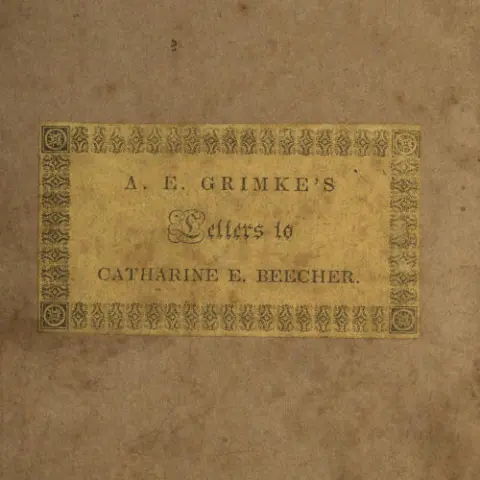
"Letters to Catherine E. Beecher, in reply to an essay on slavery and…" is a collection of letters addressing the complex issues of slavery and abolitionism, likely written in the early 19th century. The author, A. E. Grimké, articulates a staunch abolitionist perspective, responding to Beecher's remarks on the topic and challenging the moral implications of slaveholding. The letters convey the author's insistence that all forms of slavery are acts of theft against humanity, emphasizing the immediate and universal need for emancipation. The opening of the work establishes A. E. Grimké's position on abolitionism, beginning with a personal note directed at Beecher. Grimké expresses his struggle to address the weighty subject amid ongoing responsibilities but is determined to clarify the fundamental principles of abolitionists. He argues against her claims, stating that slaveholding is a continuous act of 'man-stealing' and that all who support it are complicit in systemic injustice. As he lays the groundwork for his critique, he confronts misconceptions about the abolitionist measures, affirming the moral imperatives underpinning their actions and arguing that the North shares the culpability of slavery. The fervent tone suggests a deep-seated conviction that immediate action against the institution of slavery is both a moral duty and a necessity for societal healing.
Introduction adapted from the source catalogue; source summaries may be automatically generated.
Free to read · English · 34,084 words · No account needed
MAKE TIME FOR A GOOD BOOK
On by default. Untick to stop anonymous reading totals. Each page counts after 10 seconds in view. How this works.
Anonymous counting is on unless you have switched it off.
A southern Minister of the Methodist Episcopal Church, at the session of the New York Annual Conference, in June of 1836, said: ‘Don’t give up Abolitionism--don’t bow down to slavery. You have thousands at the South who are secretly praying for you.’ In a subsequent conversation with the same individual, he stated, that the South is not that unit of which the pro-slavery party boast--there is a diversity of opinion among them in reference to slavery, and the REIGN OF TERROR alone suppresses the free expression of sentiment. That there are thousands who believe slaveholding to be sinful, who secretly wish the abolitionists success, and believe God will bless their efforts. That the ministers of the gospel and ecclesiastical bodies who indiscriminately denounce the abolitionists, without doing any thing themselves to remove slavery, have not the thanks of thousands at the South, but on the contrary are viewed as taking sides with slaveholders, and recreant to the principles of their own profession.--Zion’s Watchman, November, 1836.
The Christian Mirror, published in Portland, Maine, has the following letter from a minister who has lately taken up his abode in Kentucky, to a friend in Maine:--‘Several ministers have recently left the State, I believe, on account of slavery; and many of the members of churches, as I have understood, have sold their property, and removed to the free States. Many are becoming more and more convinced of the evil and sin of slavery, and would gladly rid themselves and the community of this scourge; and I feel confident that influences are already in operation, which, if properly directed and regulated by the principles of the gospel, may ‘break every yoke and let the oppressed go free’ in Kentucky.
In 1st month, 1835, when Theodore D. Weld was lecturing in Pittsburgh, Pennsylvania, at the close of one of his evening lectures, a man sought him through the crowd, and extending his hand to him through his friends, by whom he was surrounded, solicited him to step aside with him for a moment. After they had retired by themselves, the gentleman said to him with great earnestness, ‘I am a slaveholder from Maryland--you are right--the doctrine you advocate is truth.’ Why, then, said the lecturer, do you not emancipate your slaves? ‘Because,’ said the Marylander, ‘I have not religion enough’--He was a professing christian--‘I dare not subject myself to the torrent of opposition which, from the present state of public sentiment, would be poured upon me; but do you abolitionists go on, and you will effect a change in public sentiment, which will render it possible and easy for us to emancipate our slaves. I know,’ continued he, ‘a great many slaveholders in my State, who stand on precisely the same ground that I do in relation to this matter. Only produce a correct public sentiment at the North and the work is done; for all that keeps the South in countenance while continuing this system, is the apology and argument afforded so generally by the North; only produce a right feeling in the North generally, and the South cannot stand before it; let the North be thoroughly converted, and the work is at once accomplished at the South.’ Another fact which may be adduced to prove that the South is looking to the North for help, is the following: At an Anti-Slavery concert of prayer for the oppressed, held in New York city, in 1836, a gentleman arose in the course of the meeting, declaring himself a Virginian and a slaveholder. He said he came to that city filled with the deepest prejudice against the abolitionists, by the reports given of their character in papers published at the North. But he determined to investigate their character and designs for himself. He even boarded in the family of an abolitionist, and attended the monthly concert of prayer for the slaves and the slaveholders. And now, as the result of his investigations and observations, he was convinced that not only the spirit but the principles and measures of the abolitionists ARE RIGHTEOUS. He was now ready to emancipate his own slaves, and had commenced advocating the doctrine of immediate emancipation--‘and here,’ said he, pointing to two men sitting near him, ‘are the first fruits of my labors--these two fellow Virginians and slaveholders, are converts with myself to abolitionism. And I know a thousand Virginians, who need only to be made acquainted with the true spirit and principles of abolitionists, in order to their becoming converts as we are. Let the abolitionists go on in the dissemination of their doctrines, and let the Northern papers cease to misrepresent them at the South--let the true light of abolitionism be fully shed upon the Southern mind, and the work of immediate and general emancipation will be speedily accomplished.‘--Morning Star, N. Y.
Your reading position is saved on this browser. Take it to another device with a library code. Reading pages adapt to text, rather than matching a printed edition.
BEHIND THE BOOK
This eBook is for the use of anyone anywhere in the United States and most other parts of the world at no cost and with almost no restrictions whatsoever. You may copy it, give it away or re-use it under the terms of the Project Gutenberg License included with this eBook or online at www.gutenberg.org. If you are not located in the United States, you will have to check the laws of the country where you are located before using this eBook. Read the source licence.
The original source file, including credits and licence, is retained by this library. Request an original-format copy at no charge. Please include the book title and Project Gutenberg identifier #53852.
KEEP YOUR CURIOSITY GOING
David Patterson (Spirit) Hatch

David Patterson (Spirit) Hatch

David Patterson (Spirit) Hatch
Cécile Tormay

Moritz Busch
John L. Ransom