THE CLASSIC COLLECTION✦My diaries, being a personal narrative of events 1888-1914, Part 2 (1900-1914)CLASSIC FREE BOOKS
My diaries, being a personal narrative of events 1888-1914, Part 2 (1900-1914)
Wilfrid Scawen Blunt
THE CLASSIC COLLECTION · 1822
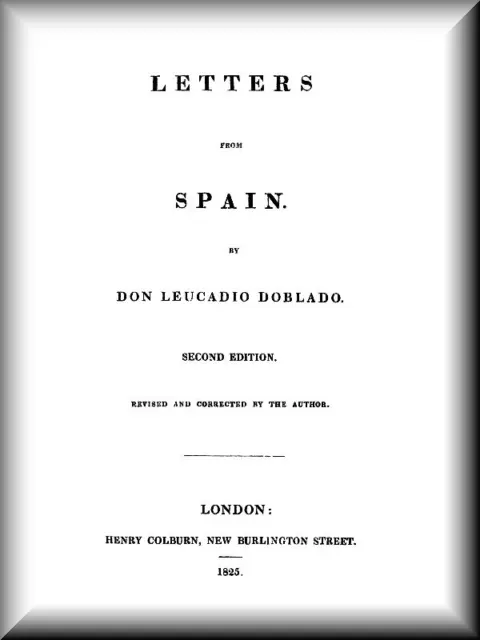
"Letters from Spain" by Joseph Blanco White is a collection of personal observations and reflections written in the early 19th century. The text presents a unique perspective on Spanish life, manners, customs, and religion, as seen through the eyes of a native who has lived abroad. It aims to offer insight into the social and political state of Spain during a tumultuous time, particularly in the context of the French invasion. At the start of the work, the author introduces himself as Leucadio Doblado, indicating his long absence from Spain and his return to Cadiz. He shares comical anecdotes about his struggles with the Spanish language and the peculiarities of customs and life in his homeland. This opening portion sets the stage for a rich exploration of the fusion of religion with daily life in Spain, where traditional practices and superstitions intertwine with the contemporary issues of social class and identity, reflecting on the intricate realities of Spanish society at the time. Through vivid descriptions and a candid tone, Blanco White provides a thoughtful and engaging account that promises to captivate readers interested in cultural and historical narratives.
Introduction adapted from the source catalogue; source summaries may be automatically generated.
Free to read · English · 107,770 words · No account needed
MAKE TIME FOR A GOOD BOOK
On by default. Untick to stop anonymous reading totals. Each page counts after 10 seconds in view. How this works.
Anonymous counting is on unless you have switched it off.
The ladies’ walking-dress is susceptible of little variety. Nothing short of the house being on fire would oblige a Spanish woman to step out of doors without a black petticoat, called Basquiña, or Saya, and a broad black veil, hanging from the head over the shoulders, and crossed on the breast like a shawl, which they call Mantilla. The mantilla is, generally, of silk trimmed round with broad lace. In summer-evenings some white mantillas are seen; but no lady would wear them in the morning, and much less venture into a church in such a profane dress.
A showy fan is indispensable, in all seasons, both in and out of doors. An Andalusian woman might as well want her tongue as her fan. The fan, besides, has this advantage over the natural organ of speech--that it conveys thought to a greater distance. A dear friend at the farthest end of the public walk, is greeted and cheered by a quick, tremulous motion of the fan, accompanied with several significant nods. An object of indifference is dismissed with a slow, formal inclination of the fan, which makes his blood run cold. The fan, now, screens the titter and whisper; now condenses a smile into the dark sparkling eyes, which take their aim just above it. A gentle tap of the fan commands the attention of the careless; a waving motion calls the distant. A certain twirl between the fingers betrays doubt or anxiety--a quick closing and displaying the folds, indicates eagerness or joy. In perfect combination with the expressive features of my countrywomen, the fan is a magic wand, whose power is more easily felt than described.
What is mere beauty, compared with the fascinating power arising from extreme sensibility? Such as are alive to those invisible charms, will hardly find a plain face among the young women of Andalusia. Their features may not, at first view, please the eye; but seem to improve every day till they grow beautiful. Without the advantages of education, without even external accomplishments, the vivacity of their fancy sheds a perpetual glow over their conversation; and the warmth of their heart gives the interest of affection to their most indifferent actions. But Nature, like a too fond mother, has spoilt them, and Superstition has completed their ruin. While the activity of their minds is allowed to run waste for want of care and instruction, the consciousness of their powers to please, impresses them with an early notion that life has but one source of happiness. Were their charms the effect of that cold twinkling flame which flutters round the hearts of most Frenchwomen, they would be only dangerous to the peace and usefulness of one half of society. But, instead of being the capricious tyrants of men, they are, generally, their victims. Few, very few Spanish women, and none, I will venture to say, among the Andalusians, have it in their power to be coquettes. If it may be said without a solecism, there is more of that vice in our men than in our females. The first, leading a life of idleness, and deprived by an ignorant, oppressive, and superstitious government, of every object that can raise and feed an honest ambition, waste their whole youth, and part of their manly age, in trifling with the best feelings of the tender sex, and poisoning, for mere mischief’s sake, the very springs of domestic happiness. But ours is the most dire and complex disease that ever preyed upon the vitals of human society. With some of the noblest qualities that a people can possess (you will excuse an involuntary burst of national partiality), we are worse than degraded--we are depraved, by that which is intended to cherish and exalt every social virtue. Our corrupters, our mortal enemies, are religion and government. To set the practical proofs of this bold position in a striking light is, undoubtedly, beyond my abilities. Yet such, I must say, is the force of the proofs I possess on this melancholy topic, that they nearly overcome my mind with intuitive evidence. Let me, then, take leave of the subject into which my feelings have hurried me, by assuring you, that wherever the slightest aid is afforded to the female mind in this country, it exhibits the most astonishing quickness and capacity; and that, probably, no other nation in the world can present more lovely instances of a glowing and susceptible heart preserving unspotted purity, not from the dread of public opinion, but in spite of its encouragements.
Your reading position is saved on this browser. Take it to another device with a library code. Reading pages adapt to text, rather than matching a printed edition.
BEHIND THE BOOK
This eBook is for the use of anyone anywhere in the United States and most other parts of the world at no cost and with almost no restrictions whatsoever. You may copy it, give it away or re-use it under the terms of the Project Gutenberg License included with this eBook or online at www.gutenberg.org. If you are not located in the United States, you will have to check the laws of the country where you are located before using this eBook. Read the source licence.
The original source file, including credits and licence, is retained by this library. Request an original-format copy at no charge. Please include the book title and Project Gutenberg identifier #48203.
KEEP YOUR CURIOSITY GOING
Wilfrid Scawen Blunt
Wilfrid Scawen Blunt

E. W. (Edgar Watson) Howe

David Patterson (Spirit) Hatch

David Patterson (Spirit) Hatch

David Patterson (Spirit) Hatch