THE CLASSIC COLLECTION✦My diaries, being a personal narrative of events 1888-1914, Part 2 (1900-1914)CLASSIC FREE BOOKS
My diaries, being a personal narrative of events 1888-1914, Part 2 (1900-1914)
Wilfrid Scawen Blunt
THE CLASSIC COLLECTION · 1822
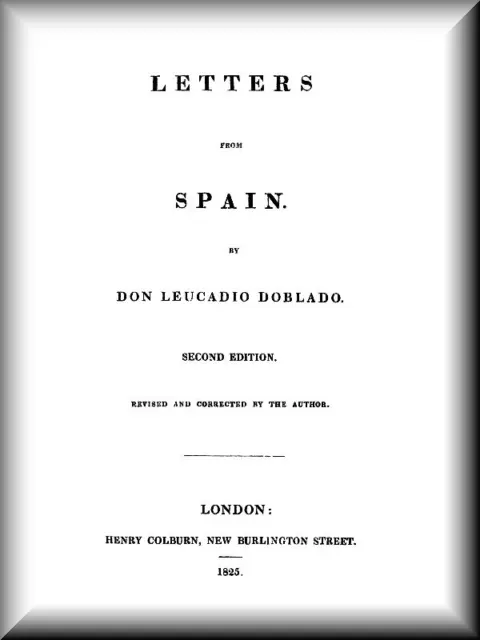
"Letters from Spain" by Joseph Blanco White is a collection of personal observations and reflections written in the early 19th century. The text presents a unique perspective on Spanish life, manners, customs, and religion, as seen through the eyes of a native who has lived abroad. It aims to offer insight into the social and political state of Spain during a tumultuous time, particularly in the context of the French invasion. At the start of the work, the author introduces himself as Leucadio Doblado, indicating his long absence from Spain and his return to Cadiz. He shares comical anecdotes about his struggles with the Spanish language and the peculiarities of customs and life in his homeland. This opening portion sets the stage for a rich exploration of the fusion of religion with daily life in Spain, where traditional practices and superstitions intertwine with the contemporary issues of social class and identity, reflecting on the intricate realities of Spanish society at the time. Through vivid descriptions and a candid tone, Blanco White provides a thoughtful and engaging account that promises to captivate readers interested in cultural and historical narratives.
Introduction adapted from the source catalogue; source summaries may be automatically generated.
Free to read · English · 107,770 words · No account needed
MAKE TIME FOR A GOOD BOOK
On by default. Untick to stop anonymous reading totals. Each page counts after 10 seconds in view. How this works.
Anonymous counting is on unless you have switched it off.
The passage from Xenophon translated in the text is this: Οἱ οὖν ἀμφὶ τὸν Σωκράτην πρῶτον μέν, ὥσπερ εἰκὸς ἦν, ἐπαινοῦντες τὴν κλῆσιν οὐχ ὑπισχνοῦντο συνδειπνήσειν. ὡς δὲ πάνυ ἀχθόμενος φανερὸς ἦν, εἰ μὴ ἕψοιντο, συνηκολούθησαν. Sympos. c. 1. 7. Ernesti is angry at the ὥσπερ εἰκὸς, which is soon after repeated, when speaking of the order in which the guests placed themselves at table. He wants, in the last passage, to change it into ὡς ἔτυχον. But though the emendation is plausible, there seems to be no necessity to alter the reading. Xenophon is, indeed, remarkably fond of that phrase. The εἰκὸς, in both places, probably means according to custom. It might be applied to the order of precedence in England, and it should seem to have been used by Xenophon to denote the Greek sense of propriety in taking a place at table. In Spain, where there is no established order, a great deal of bowing and scraping takes place before the guests can arrange that important point. But, without any settled rule, there is a tact which seldom misleads any one who wishes not to give offence. This is probably the second ὥσπερ εἰκὸς of Xenophon.
“A little work that gave an amusing Miracle of the Virgin for every Day in the Year.” p. 70.
The book alluded to in the text is the Año Virgineo. The moral tendency of this and similar books may be shewn by the following story--technically named an Example--which I will venture to give from memory:--A Spanish soldier, who had fought in the Netherlands, having returned home with some booty, was leading a profligate and desperate life. He had, however, bled for the Faith: and his own was perfectly orthodox. A large old picture of the Virgin Mary hung over the inside of the door of his lodgings, which, it seems, did not correspond in loftiness to the brave halberdier’s mind and demeanour. Early every morning he used to sally forth in pursuit of unlawful pleasure; but, though he never did bend his knees in prayer, he would not cross the threshold without a loud Hail Mary! to the picture, accompanied by an inclination of the halbert, which partly from his outrageous hurry to break out of the nightly prison, partly from want of room for his military salute, inflicted many a wound on the canvass. Thus our soldier went on spending his life and money, till a sharp Spanish dagger composed him to rest, in the heat of a brawl. “He died and made no sign.” The Devil, who thought him as fair a prize as any that had ever been within his grasp, waited only for the sentence which, according to Catholics, is passed on every individual immediately after death, in what they call the Particular Judgment. At this critical moment the Virgin Mary presented herself in a black mantle, similar to that which she wore in the picture, but sadly rent and slit in several places. “These are the marks,” she said to the affrighted soul, “of your rude, though certainly well-meant civility. I will not, however, permit that one who has so cordially saluted me every day, should go into everlasting fire.” Thus saying, she bade the evil spirit give up his prisoner, and the gallant soldier was sent to purge off the dross of his boisterous nature, in the gentler flames of purgatory.--A portion of the book from which I recollect this story, was, for many years, read every evening in one of the principal parishes at Seville. I observed the same practice at a town not far from the capital of Andalusia; and, for any thing I know to the contrary, it may be very common all over Spain. Such is the doctrine which, disowned in theory by the divines of the Roman church, but growing out of the system of saint-worship, constitutes the main religious feeling of the vulgar, and taints strongly the minds of the higher classes in Spain. The Chronicles of the Religious Orders are full of narratives, the whole drift of which is to represent their patron saint as powerful to save from the very jaws of hell. The skill of the painter has often been engaged to exhibit these stories to the eye, and the Spanish convents abound in pictures more encouraging to vice than the most profligate prints of the Palais Royal. I recollect one at Seville in the convent of the Antonines--a species of the genus Monachus Franciscanus of the Monachologia--so strangely absurd, that I hope the reader will forgive my lengthening this note with its description. The picture I allude to was in the cloisters of the convent of San Antonio, facing the principal entrance, so late as the year 1810, when I was last at Seville. The subject is the hairbreadth escape of a great sinner, whom St. Francis saved against all chances. An extract from the Chronicles of the Order, which is found in a corner of the painting, informs the beholder that the person whose soul is represented on the canvass, was a lawless nobleman, who, fortified in his own castle, became the terror and abhorrence of the neighbourhood. As neither the life of man, nor the honour of woman, was safe from the violence of his passions, none willingly dwelt upon his lands, or approached the gate of the castle. It chanced, however, that two Franciscan friars, having lost the way in a stormy night, applied for shelter at the wicked nobleman’s gate, where they met with nothing but insult and scorn. It was well for them that the fame of St. Francis filled the world at that time. The holy saint, with the assistance of St. Paul, had lately cut the throat of an Italian bishop, who had resisted the establishment of the Franciscans in his diocese.[66]
Your reading position is saved on this browser. Take it to another device with a library code. Reading pages adapt to text, rather than matching a printed edition.
BEHIND THE BOOK
This eBook is for the use of anyone anywhere in the United States and most other parts of the world at no cost and with almost no restrictions whatsoever. You may copy it, give it away or re-use it under the terms of the Project Gutenberg License included with this eBook or online at www.gutenberg.org. If you are not located in the United States, you will have to check the laws of the country where you are located before using this eBook. Read the source licence.
The original source file, including credits and licence, is retained by this library. Request an original-format copy at no charge. Please include the book title and Project Gutenberg identifier #48203.
KEEP YOUR CURIOSITY GOING
Wilfrid Scawen Blunt
Wilfrid Scawen Blunt

E. W. (Edgar Watson) Howe

David Patterson (Spirit) Hatch

David Patterson (Spirit) Hatch

David Patterson (Spirit) Hatch