THE CLASSIC COLLECTION✦My diaries, being a personal narrative of events 1888-1914, Part 2 (1900-1914)CLASSIC FREE BOOKS
My diaries, being a personal narrative of events 1888-1914, Part 2 (1900-1914)
Wilfrid Scawen Blunt
THE CLASSIC COLLECTION · 1822
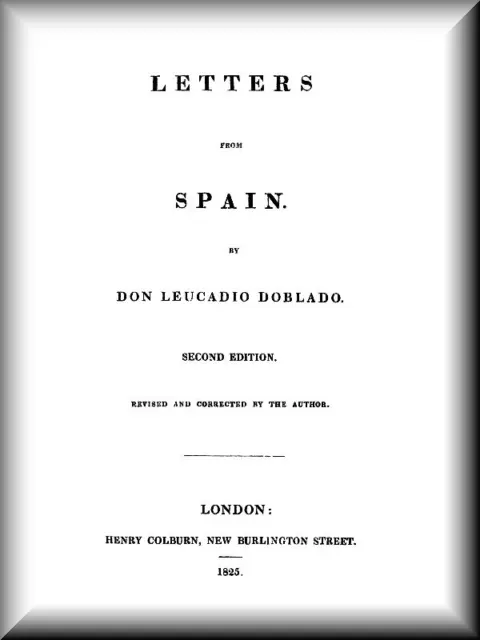
"Letters from Spain" by Joseph Blanco White is a collection of personal observations and reflections written in the early 19th century. The text presents a unique perspective on Spanish life, manners, customs, and religion, as seen through the eyes of a native who has lived abroad. It aims to offer insight into the social and political state of Spain during a tumultuous time, particularly in the context of the French invasion. At the start of the work, the author introduces himself as Leucadio Doblado, indicating his long absence from Spain and his return to Cadiz. He shares comical anecdotes about his struggles with the Spanish language and the peculiarities of customs and life in his homeland. This opening portion sets the stage for a rich exploration of the fusion of religion with daily life in Spain, where traditional practices and superstitions intertwine with the contemporary issues of social class and identity, reflecting on the intricate realities of Spanish society at the time. Through vivid descriptions and a candid tone, Blanco White provides a thoughtful and engaging account that promises to captivate readers interested in cultural and historical narratives.
Introduction adapted from the source catalogue; source summaries may be automatically generated.
Free to read · English · 107,770 words · No account needed
MAKE TIME FOR A GOOD BOOK
On by default. Untick to stop anonymous reading totals. Each page counts after 10 seconds in view. How this works.
Anonymous counting is on unless you have switched it off.
[62] The reader must be aware that this was an imitation of a foot tournament, an amusement as frequent among the ancient Spanish knights as the jousts on horseback. It is called in the Spanish Chronicles Tornéo de a pié.
“At five in the afternoon, the Marshal, attended by his Adjutant, presented himself in the lists. He was followed by four children, in the dress used to represent angels, with lighted torches in their hands. Another child, personating Michael the Archangel, was the leader of a second group of six angels, who were the bearers of the prizes--a Lamb and a Male Infant. The Judges, Justice and Mercy, appeared last of all, and took their appointed seats.
“The sound of drums, fifes, and clarions, announced soon after, the approach of another group, composed of two savages of gigantic dimensions, with large clubs on their shoulders, eight torch-bearers in black, and two infernal Furies, and, in the centre, the challenger’s shield-bearer, followed by the challenger’s supporter or second, dressed in black and gold, with a plume of black and yellow feathers. This band having walked round the stage, the second brought the challenger out of the tent, who, dressed uniformly with his supporter, appeared wielding a lance twenty-five hands in length.[63]
[63] Though the Spanish writer has forgotten to mention the allegory of the challenger, it is evident, from the sequel, that he was intended to represent Sin.
The following is a list of the Adventurers, their attendants, or torch-bearers, and supporters or seconds:--
Attendants Seconds --------------------------------------------------------- Adam 6 Clowns { Hope and { Innocence.
Cain 6 Infernal Furies Envy.
Abraham 6 Dwarfs,[64] three } Angels in the habit } Faith. of Pilgrims, } and Isaac }
Job 6 Pages Patience.
David 6 Squires Repentance.
Jeroboam 4 Jews Idolatry.
Ahab 12 Squires Covetousness.
John the Baptist 12 Squires { Divine Love { and Grace.
[64] Dwarfs were formerly very common among the servants of the Spanish nobility. But it is not easy to guess for what reason they were allotted to Abraham, on this occasion.
“The dresses (continues the historian) were all splendid, and suited
to the characters.
“The Adventurers engaged the challenger in succession, and all were wounded by the first stroke of his enormous lance. In this state they drew their swords, and fought with various success, some conquering the common enemy, while others yielded to his superior force. None, however, distinguished himself so much as the Baptist, who, regardless of the wound he had received at the first onset, and being armed with fresh weapons by Grace, beat the adversary in every succeeding rencounter. His extraordinary success was rewarded with a seat near the Judges, and the Lamb was awarded him as a prize.
Your reading position is saved on this browser. Take it to another device with a library code. Reading pages adapt to text, rather than matching a printed edition.
BEHIND THE BOOK
This eBook is for the use of anyone anywhere in the United States and most other parts of the world at no cost and with almost no restrictions whatsoever. You may copy it, give it away or re-use it under the terms of the Project Gutenberg License included with this eBook or online at www.gutenberg.org. If you are not located in the United States, you will have to check the laws of the country where you are located before using this eBook. Read the source licence.
The original source file, including credits and licence, is retained by this library. Request an original-format copy at no charge. Please include the book title and Project Gutenberg identifier #48203.
KEEP YOUR CURIOSITY GOING
Wilfrid Scawen Blunt
Wilfrid Scawen Blunt

E. W. (Edgar Watson) Howe

David Patterson (Spirit) Hatch

David Patterson (Spirit) Hatch

David Patterson (Spirit) Hatch