THE CLASSIC COLLECTION✦My diaries, being a personal narrative of events 1888-1914, Part 2 (1900-1914)CLASSIC FREE BOOKS
My diaries, being a personal narrative of events 1888-1914, Part 2 (1900-1914)
Wilfrid Scawen Blunt
THE CLASSIC COLLECTION · 1822
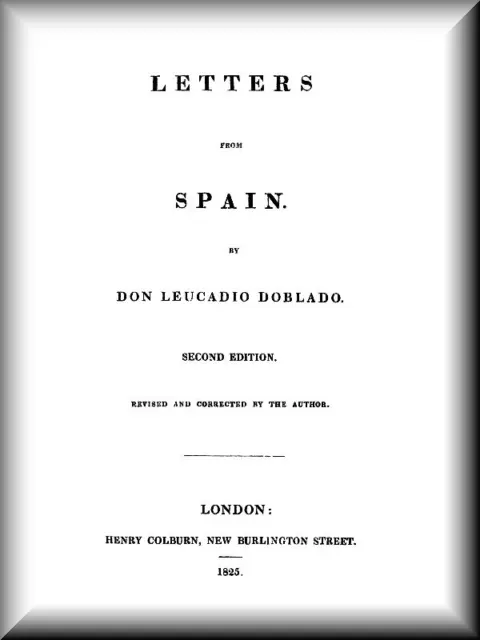
"Letters from Spain" by Joseph Blanco White is a collection of personal observations and reflections written in the early 19th century. The text presents a unique perspective on Spanish life, manners, customs, and religion, as seen through the eyes of a native who has lived abroad. It aims to offer insight into the social and political state of Spain during a tumultuous time, particularly in the context of the French invasion. At the start of the work, the author introduces himself as Leucadio Doblado, indicating his long absence from Spain and his return to Cadiz. He shares comical anecdotes about his struggles with the Spanish language and the peculiarities of customs and life in his homeland. This opening portion sets the stage for a rich exploration of the fusion of religion with daily life in Spain, where traditional practices and superstitions intertwine with the contemporary issues of social class and identity, reflecting on the intricate realities of Spanish society at the time. Through vivid descriptions and a candid tone, Blanco White provides a thoughtful and engaging account that promises to captivate readers interested in cultural and historical narratives.
Introduction adapted from the source catalogue; source summaries may be automatically generated.
Free to read · English · 107,770 words · No account needed
MAKE TIME FOR A GOOD BOOK
On by default. Untick to stop anonymous reading totals. Each page counts after 10 seconds in view. How this works.
Anonymous counting is on unless you have switched it off.
Don Manuel de Roda, an Aragonese by birth, and an eminent lawyer at Madrid, had imbibed very early both the theological and political tenets of the Jansenists. He had been distinguished at the bar by his resolute and virulent opposition to the members of the Colegios Mayores. That institution, founded for the education and assistance of poor students, had been perverted from its original intentions: for though no one could be admitted but upon competition and a plurality of voices, it consisted de facto entirely of persons of family. Its members, by the aid of exclusive privileges in the career of the law, by mutual assistance, and a corporation spirit, not unlike that of the Jesuits themselves, had obtained a large portion of ecclesiastical and legal patronage, and enjoyed almost a monopoly of the highest judicial offices in Castile. The members of these colleges were enabled to succeed to the offices of Fiscal, Oydor, and other magistracies, without the previous ceremony of passing advocates, which was a gradation none but those who were Colegiales could dispense with. These privileges gave them great influence, and the expense which attended their elections, (especially that of the Rectors of each College, an annual office of great consideration among them,) served as an effectual bar to the pretensions of any who had not birth and wealth to recommend them. It is just, however, to observe, that if they were infected with the narrow spirit of corporations, they retained to the last the high sense of honour which is always the boast, and sometimes the characteristic, of privileged orders of men. It has ever been acknowledged by their enemies, that since the abolition of their exclusive privileges, which Roda lived to accomplish, and, yet more, since their further discouragement by the Prince of Peace, the judicial offices have not been filled by persons of equal character for integrity, learning, and honour. But those who studied the laws without the advantages of an education at the Colegios Mayores, were naturally and justly indignant at the privileges which they enjoyed. The boldness of Don Manuel de Roda’s opposition to an order of men so invidiously distinguished, ingratiated him with the lawyers, who, in Spain as elsewhere, constitute a large, active, and formidable body of men. But the same high spirit having involved him in a dispute with a man of rank and influence, his friend and protector the Duke of Alva thought it prudent for him to withdraw from Court; and with a view of enabling him to do so with credit to himself, entrusted him with a public commission to Rome, where he was received as the agent of the King of Spain. He here, no doubt, acquired that knowledge which was so useful to him afterwards in the prosecution of his important design. By what fatality he became minister, I know not. Charles III. must have departed from his general rule of appointing every Minister at the recommendation of his predecessor, for Roda succeeded a Marquis of Campo Villar, who had been educated at the Colegios Mayores, and was attached to the Jesuits. Possibly the interest of the Duke of Alva was the cause of his promotion. He was appointed Minister of Grace and Justice, I believe, as early as 1763, though Jovellanos implies that he was not Minister till 1765 or even 1766. From the period of his nomination, however, one may safely date the design of suppressing the Jesuits in Spain. It was systematically, though slowly and secretly pursued, by a portion of the Spanish Cabinet. Indeed the views, not only of the ministry, but of the understanding of Roda, were so exclusively directed to such objects, that Azara sarcastically observed, that he wore spectacles, through one glass of which he could perceive nothing but a Colegial, and through the other nothing but a Jesuit. If, however, his views were contracted, he had the advantage often attributed to a short sight--a clear and more accurate perception of every thing that came within the limited scope of his organs. He had the discernment to discover those, who, with dispositions congenial to his own had talents to assist him. He had cunning enough to devise the means of converting to his purpose the weaknesses of such as without predisposition to co-operate with him, were from station or accident necessary to his design. Though a strict Jansenist himself, he selected his associates and partizans indiscriminately from Jansenists and philosophers or freethinkers. Among the first, the most remarkable was Tavira, bishop of Salamanca; among the latter Campomanes and the Count de Aranda.
Your reading position is saved on this browser. Take it to another device with a library code. Reading pages adapt to text, rather than matching a printed edition.
BEHIND THE BOOK
This eBook is for the use of anyone anywhere in the United States and most other parts of the world at no cost and with almost no restrictions whatsoever. You may copy it, give it away or re-use it under the terms of the Project Gutenberg License included with this eBook or online at www.gutenberg.org. If you are not located in the United States, you will have to check the laws of the country where you are located before using this eBook. Read the source licence.
The original source file, including credits and licence, is retained by this library. Request an original-format copy at no charge. Please include the book title and Project Gutenberg identifier #48203.
KEEP YOUR CURIOSITY GOING
Wilfrid Scawen Blunt
Wilfrid Scawen Blunt

E. W. (Edgar Watson) Howe

David Patterson (Spirit) Hatch

David Patterson (Spirit) Hatch

David Patterson (Spirit) Hatch