THE CLASSIC COLLECTION✦My diaries, being a personal narrative of events 1888-1914, Part 2 (1900-1914)CLASSIC FREE BOOKS
My diaries, being a personal narrative of events 1888-1914, Part 2 (1900-1914)
Wilfrid Scawen Blunt
THE CLASSIC COLLECTION · 1822
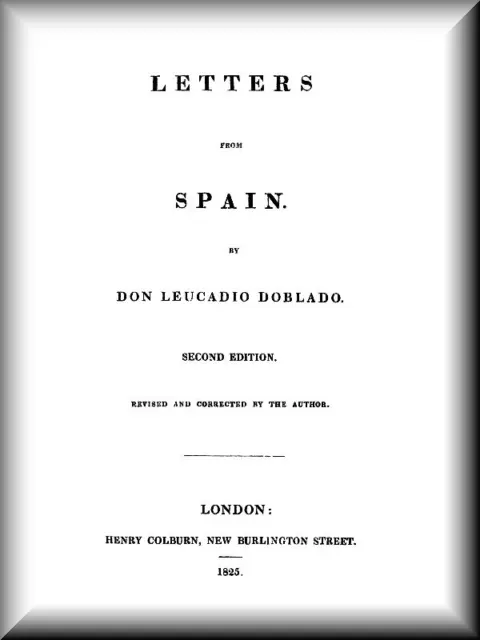
"Letters from Spain" by Joseph Blanco White is a collection of personal observations and reflections written in the early 19th century. The text presents a unique perspective on Spanish life, manners, customs, and religion, as seen through the eyes of a native who has lived abroad. It aims to offer insight into the social and political state of Spain during a tumultuous time, particularly in the context of the French invasion. At the start of the work, the author introduces himself as Leucadio Doblado, indicating his long absence from Spain and his return to Cadiz. He shares comical anecdotes about his struggles with the Spanish language and the peculiarities of customs and life in his homeland. This opening portion sets the stage for a rich exploration of the fusion of religion with daily life in Spain, where traditional practices and superstitions intertwine with the contemporary issues of social class and identity, reflecting on the intricate realities of Spanish society at the time. Through vivid descriptions and a candid tone, Blanco White provides a thoughtful and engaging account that promises to captivate readers interested in cultural and historical narratives.
Introduction adapted from the source catalogue; source summaries may be automatically generated.
Free to read · English · 107,770 words · No account needed
MAKE TIME FOR A GOOD BOOK
On by default. Untick to stop anonymous reading totals. Each page counts after 10 seconds in view. How this works.
Anonymous counting is on unless you have switched it off.
Carnival, properly so called, is limited to Quinquagesima-Sunday, and the two following days, a period which the lower classes pass in drinking and rioting in those streets where the meaner sort of houses abound, and especially in the vicinity of the large courts, or halls, called Corrales, surrounded with small rooms or cells, where numbers of the poorest inhabitants live in filth, misery, and debauch. In front of these horrible places are seen crowds of men, women, and children, singing, dancing, drinking, and pursuing each other with handfuls of hair-powder. I have never seen, however, an instance of their taking liberties with any person above their class; yet, such bacchanals produce a feeling of insecurity, which makes the approach of those spots very unpleasant during the Carnival.
At Madrid, where whole quarters of the town, such as Avapiés and Maravillas, are inhabited exclusively by the rabble, these Saturnalia are performed upon a larger scale. I once ventured with three or four friends, all muffled in our cloaks, to parade the Avapiés during the Carnival. The streets were crowded with men, who, upon the least provocation, real or imaginary, would have instantly used the knife, and of women equally ready to take no slight share in any quarrel: for these lovely creatures often carry a poniard in a sheath, thrust within the upper part of the left stocking, and held up by the garter. We were, however, upon our best behaviour, and by a look of complacency on their sports, and keeping at the most respectful distance from the women, came away without meeting with the least disposition to insolence or rudeness.
A gentleman who, either out of curiosity or depraved taste, attends the amusements of the vulgar, is generally respected, provided he is a mere spectator, and appears indifferent to the females. The ancient Spanish jealousy is still observable among the lower classes; and while not a sword is drawn in Spain upon a love-quarrel, the knife often decides the claims of more humble lovers. Yet, love is, by no means, the main instigator of murder among us. A constitutional irritability, especially in the southern provinces, leads, without any more assignable reason, to the frequent shedding of blood. A small quantity of wine, nay, the mere blowing of the easterly wind, called Soláno, is infallibly attended with deadly quarrels in Andalusia. The average of dangerous or mortal wounds, on every great festival at Seville, is, I believe, about two or three. We have, indeed, a well-endowed hospital, named de los Herídos, which, though open to all persons who meet with dangerous accidents, is from this unhappy disposition of the people, almost confined to the wounded. The large arm-chair where the surgeon in attendance examines the patient just as he is brought in, usually upon a ladder, is known in the whole town by the name of the Bullies’ chair--Silla de los Guapos. Every thing, in fact, attests both the generality and inveteracy of that horrible propensity among the Spaniards. I have met with an original unpublished privilege granted in 1511, by King Don Manoel of Portugal, to the German merchants established at Lisbon, whereby their servants, to the number of six, are allowed to carry arms both day and night, provided such privileged servants be not Spaniards.[38] Had this clause been inserted after the Portuguese nation had thrown off the Spanish yoke, I should attribute it to political jealousy; but, considering its date, I must look upon it as proving the inveteracy and notoriety of the barbarous disposition, the mention of which has led me into this digression.
Your reading position is saved on this browser. Take it to another device with a library code. Reading pages adapt to text, rather than matching a printed edition.
BEHIND THE BOOK
This eBook is for the use of anyone anywhere in the United States and most other parts of the world at no cost and with almost no restrictions whatsoever. You may copy it, give it away or re-use it under the terms of the Project Gutenberg License included with this eBook or online at www.gutenberg.org. If you are not located in the United States, you will have to check the laws of the country where you are located before using this eBook. Read the source licence.
The original source file, including credits and licence, is retained by this library. Request an original-format copy at no charge. Please include the book title and Project Gutenberg identifier #48203.
KEEP YOUR CURIOSITY GOING
Wilfrid Scawen Blunt
Wilfrid Scawen Blunt

E. W. (Edgar Watson) Howe

David Patterson (Spirit) Hatch

David Patterson (Spirit) Hatch

David Patterson (Spirit) Hatch