
Last letters from the living dead man
David Patterson (Spirit) Hatch
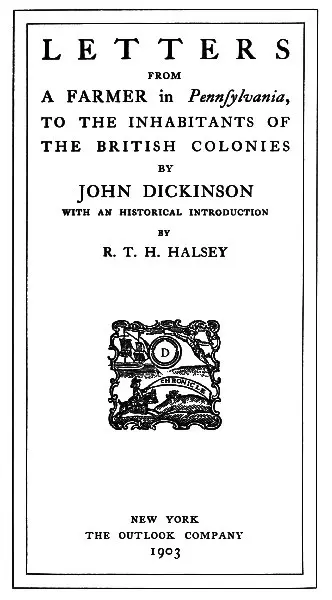
THE CLASSIC COLLECTION · 1903
"Letters from a Farmer in Pennsylvania, to the Inhabitants of the British Colonies" by John Dickinson is a series of essays written between 1767 and 1768. Published under a pseudonym, these twelve letters united American colonists against British taxation by arguing that Parliament could regulate colonial trade but not raise revenue from the colonies. The essays challenged prevailing British views on sovereignty and became the most influential colonial writing until Thomas Paine's "Common Sense," shaping revolutionary thinking while advocating for peaceful resistance within the British constitutional system.
Introduction adapted from the source catalogue; source summaries may be automatically generated.
Free to read · English · 45,757 words · No account needed
MAKE TIME FOR A GOOD BOOK
On by default. Untick to stop anonymous reading totals. Each page counts after 10 seconds in view. How this works.
Anonymous counting is on unless you have switched it off.
Such were the sentiments of this great and excellent man whose vast abilities, and the calamities of the time in which he lived, enabled him, by mournful experience, to form a just judgement on the conduct of the friends and enemies of liberty.
From these reflections I conclude, that every free State should incessantly watch, and instantly take alarm on any condition being made to the power exercised over them, innumerable instances might be produced to shew, from what slight beginnings the most extensive consequences have flowed: but I shall select two only from the history of England.
Henry the seventh was the first monarch of that kingdom, who established a standing body of armed men. This was a band of 50 archers, called yeomen of the guard: And this institution, notwithstanding the smallness of the number, was, to prevent discontent, [52]"disguised under the pretence of majesty and grandeur." In 1684, the standing forces were so much augmented, that Rapin says--"The King, in order to make his people fully sensible of their new slavery, affected to muster his troops, which amounted to 4000 well armed and disciplined men." I think our army, at this time, consists of more than seventy regiments.
[52] Rapin's History of England.
The method of taxing by excise was first introduced amidst the convulsions of civil wars. Extreme necessity was pretended, and its short continuance promised. After the restoration, an excise upon beer, ale and other liquors, was granted to the[53] King, one half in fee, the other for life, as an equivalent for the court of wards. Upon James the second's accession, the parliament[54] gave him the first excise, with an additional duty on wine, tobacco, and some other things. Since the revolution it has been extended to salt, candles, leather, hides, hops, soap, paper, paste-board, mill-boards, scaleboards, vellum, parchment, starch, silks, calicoes, linens, stuffs, printed, stained, &c. wire, wrought plate, coffee, tea, chocolate, &c.
[53] 12 Car. II. Chap. 23, and 24.
[54] James II. Chap. 1, and 4.
Thus a standing army and excise have, from the first slender origins, tho' always hated, always feared, always opposed, at length swelled up to their vast present bulk.
Your reading position is saved on this browser. Take it to another device with a library code. Reading pages adapt to text, rather than matching a printed edition.
BEHIND THE BOOK
This eBook is for the use of anyone anywhere in the United States and most other parts of the world at no cost and with almost no restrictions whatsoever. You may copy it, give it away or re-use it under the terms of the Project Gutenberg License included with this eBook or online at www.gutenberg.org. If you are not located in the United States, you will have to check the laws of the country where you are located before using this eBook. Read the source licence.
The original source file, including credits and licence, is retained by this library. Request an original-format copy at no charge. Please include the book title and Project Gutenberg identifier #47111.
KEEP YOUR CURIOSITY GOING
David Patterson (Spirit) Hatch

David Patterson (Spirit) Hatch

David Patterson (Spirit) Hatch
Cécile Tormay

Moritz Busch
John L. Ransom