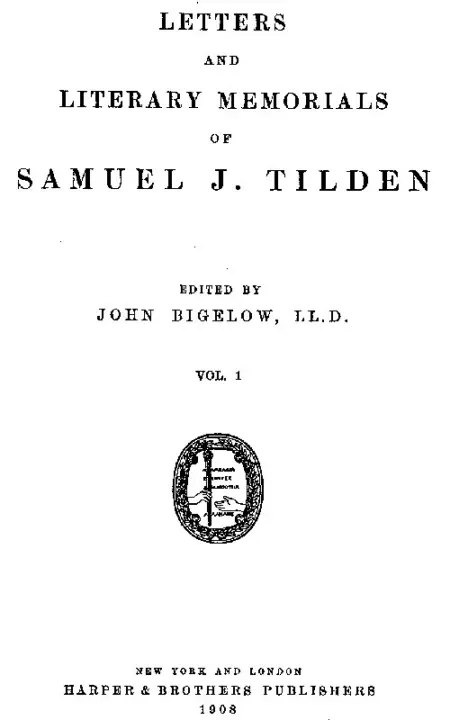
Letters and Literary Memorials of Samuel J. Tilden, v. 1
Samuel J. (Samuel Jones) Tilden

THE CLASSIC COLLECTION · 1908
"Letters and Literary Memorials of Samuel J. Tilden, v. 2" by Samuel J. Tilden is a collection of letters and documents related to the public and political life of Samuel J. Tilden, likely written in the late 19th century. This volume reflects Tilden's engagement with significant political issues of his time, particularly concerning corruption and reform within government structures, as well as the dynamics within the Democratic Party during a critical period leading up to the presidential election. The opening of the work features a series of letters exchanged between Tilden and various contemporaries discussing political strategies, state matters, and personal notes of admiration and support. Key figures like David A. Wells and Charles O'Conor express concerns over corruption in municipal governance, particularly relating to the notorious Tweed Ring, and discuss the urgency for reform. This section highlights the camaraderie and tactical interactions among politicians as they navigate a fraught political landscape, setting the stage for the broader themes of integrity and governance that permeate Tilden's legacy.
Introduction adapted from the source catalogue; source summaries may be automatically generated.
Free to read · English · 131,014 words · No account needed
MAKE TIME FOR A GOOD BOOK
On by default. Untick to stop anonymous reading totals. Each page counts after 10 seconds in view. How this works.
Anonymous counting is on unless you have switched it off.
"DEAR SIR,--I did not forget, on my return to Washington, the promise I made in New York to send you the copy I have of Judge Bradley's letter explaining his action on the electoral commission, but for some days I could not find it. Having now found it, I enclose it to you, and also an extract from an article which appeared in the Newark Daily Advertiser about the same time, and to which the judge evidently refers in his letter.
"The language of the letter[21] justifies some of the comments of the press upon the change of views which the judge experienced shortly before the vote was taken in the Florida case.
I am, very sincerely yours,
"STEPHEN J. FIELD."
[21] Judge Bradley's peculiar if not exclusive responsibility for counting Mr. Hayes instead of the candidate chosen by the people into the Presidency is more clearly set forth in a communication of the writer entitled, "The Supreme Court and the Electoral Commission: An Open Letter to the Hon. Joseph H. Choate," first published in the New York Sun, on the 19th July, 1903, and later in a pamphlet by G. P. Putnam's Sons, New York.
[Justice Bradley to the Newark "Daily Advertiser" and the Electoral
Commission.]
The Sun gives Bradley's letter in full as follows:
"'STOWE, VT., September 6.
"'SIR,--I perceive the New York Sun has reiterated its charge that after preparing a written opinion in favor of the Tilden electors in the Florida case and submitting it to the electoral commission, I changed my views during the night preceding the vote in consequence of the pressure brought to bear upon me by Republican politicians and the Pacific Railroad men, whose carriages, it is said, surrounded my house during the evening. This, I believe, is the important point of the charge. Whether I wrote one opinion or twenty in my private examination of the subject, is of little consequence and of no concern to anybody. The opinion which I finally gave was the result of my deliberations without influence from outside parties. The above slander was published some time since, but I never saw it until recently, and deemed it too absurd to need refutation. But as it is categorically repeated, perhaps I ought to notice it. The same story about the carriages of leading Republicans and others congregating about my house was circulated in Washington at one time, and came to the ears of my family only to raise a smile of contempt. The whole thing is a falsehood. Not one visitor called at my house that evening, and during the whole sitting of the commission I had no private discussion whatever of the subjects at issue with any person interested on the Republican side, and but few words with any persons. Indeed, I zealously sought to avoid all discussion outside the commission itself. The allegation that I read my opinion to Judges Clifford and Field is entirely untrue. I read no opinion to either of them, and have no recollection of expressing one; if I did, it could only have been suggestively, or in a hypothetical manner, and not for committal of my final judgment or action. The question was one of great importance to me, of much difficulty and embarrassment. I earnestly endeavored to come to a right decision, free from all political or extraneous considerations. In my private examination of the principal question, about going behind the returns, I wrote and rewrote the arguments and considerations on both sides as they occurred to me, sometimes being inclined to one view of the subject and sometimes to the other, but finally I threw aside these lucubrations, and as you have rightly stated, wrote out a short opinion, which I read in the Florida case during the sitting of the commission. This decision expresses the conviction to which I had arrived, and which after a full consideration of the whole subject seemed to me a satisfactory solution of the questions; and I may say that the more I have reflected since, the more satisfied have I become that it was right. At all events, it was the result of my own reflections and consideration, without any suggestions from any quarter, except the arguments adduced by counsel in the public discussion and by members of the commission in private consultation. As for the insinuation contained in a recent article published in a prominent periodical by a noted politician, implying that the case was decided in consequence of political conspiracy, I can only say that from the peculiar position I occupied on the commission I am able positively to say that it is utterly devoid of truth, at least, so far as the action of the commission itself was concerned. In that article the writer couples my name with the names of those whom he supposes are obnoxious to the public odium. The decencies of public expression, if nothing more, might well have deterred so able a writer from making personal imputations which he did not know to be well founded.
Your reading position is saved on this browser. Take it to another device with a library code. Reading pages adapt to text, rather than matching a printed edition.
Samuel J. (Samuel Jones) Tilden
BEHIND THE BOOK
This eBook is for the use of anyone anywhere in the United States and most other parts of the world at no cost and with almost no restrictions whatsoever. You may copy it, give it away or re-use it under the terms of the Project Gutenberg License included with this eBook or online at www.gutenberg.org. If you are not located in the United States, you will have to check the laws of the country where you are located before using this eBook. Read the source licence.
The original source file, including credits and licence, is retained by this library. Request an original-format copy at no charge. Please include the book title and Project Gutenberg identifier #47317.
KEEP YOUR CURIOSITY GOING

David Patterson (Spirit) Hatch

David Patterson (Spirit) Hatch

David Patterson (Spirit) Hatch
Cécile Tormay

Moritz Busch
John L. Ransom