
Letters and Literary Memorials of Samuel J. Tilden, v. 2
Samuel J. (Samuel Jones) Tilden
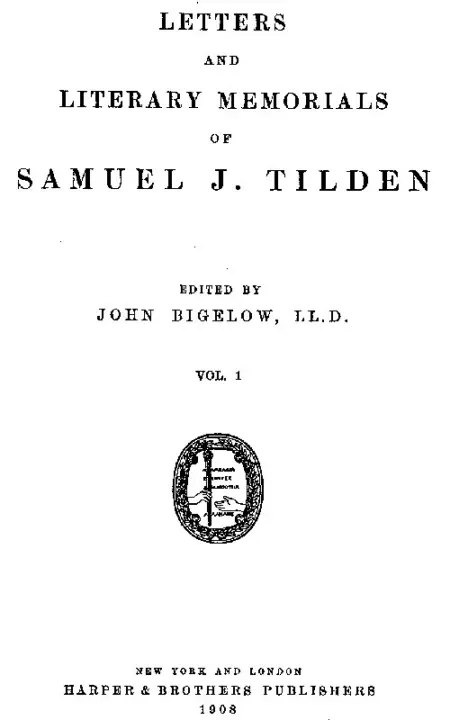
THE CLASSIC COLLECTION · 1908
"Letters and Literary Memorials of Samuel J. Tilden, v. 1" by Samuel J. Tilden is a historical collection of letters and writings from one of the significant political figures of the 19th century, likely written in the late 19th century. The book presents an extensive array of Tilden's correspondence, speeches, and public documents that illuminate his influential role during pivotal moments in American history, particularly in the realm of politics and governance. The opening portion introduces the context in which the collection was compiled, noting that it includes Tilden's reflections on his political career, his views on major national issues, and his interactions with contemporaneous political leaders. Tilden's correspondence addresses important events and ideas, reflecting his perspectives on political integrity, governance, and the ethical foundations of public service. As the volume unfolds, it promises to offer insight into the making of American political history, particularly through Tilden's significant contributions and the ethical dilemmas he navigated throughout his career.
Introduction adapted from the source catalogue; source summaries may be automatically generated.
Free to read · English · 154,416 words · No account needed
MAKE TIME FOR A GOOD BOOK
On by default. Untick to stop anonymous reading totals. Each page counts after 10 seconds in view. How this works.
Anonymous counting is on unless you have switched it off.
"I replied to Ritchie's caution--which was the first I received; and which was given when I was talking with some decision, with great dignity. I ought to have thanked him for its good intention while I intimated that it was superfluous--I told him that I did not come here to forget what was due to Mr. Polk or what was due to myself; I had no design to obtrude upon the President; I had no personal interest in the question about Van Ness or any solicitude except as it should affect the party and the administration; my only doubt was whether I should seek an interview on the subject; I was willing to state facts, make explanations, expose the whole truth, if the President desired to hear it, respectfully but frankly; the administration was mainly interested in coming to a right decision. We had no idea of hostility to it if it was faithful to our principles--the only question was whether it was to assail us. All we asked of it was to let us alone. Our politics were now in excellent condition. We could take care of the Whigs and Conservatives together if the administration would not systematically embarrass us, and I rather thought we could if it did. But we thought we were entitled to an amnesty from our friends at least while we were so busy with our enemies. The old gentleman seemed greatly mystified, but I promised to explain hereafter.
"(Confidential.)
"Sund. Morn.
"I was not able to send my letter yesterday, and now add a word. I had an interview with the President yesterday. I ran over the case of Van Ness pretty freely. He replied at considerable length, ascribing the delay in his removal to the improper manner in which it had been demanded. He did not say, but implied that he had never intended not to remove him; made no defence or argument on the question of its propriety; merely excused the delay. Mr. Butler, he said, had written to him that it would do no harm to retain him until the year expired, if it were immediately announced that a particular man would then be appointed. He complained bitterly of the attempts to intimidate and coerce him--talking magnificently about being himself President and the locum tenen for nobody; said that in his own time, perhaps Monday, perhaps afterwards, Van Ness should be removed, but swore with that terrible oath, "if the heavens and the earth come together," by which Ritchie and Green and Barton had successively warned me he might refuse if a mischance word of mine should chafe his angry mood, that he would not appoint Coddington. He should select a man, he said, who would be received with applause throughout the State; on his own judgment, whom he knew and had served with. Who that man was he did not say and I did not inquire, though I did express myself with some freedom as to what the man should do. Probably the question may now be deemed settled; for you remember he employed the same planetary concussion to illustrate the fixed irrevocable fate by which Marcy was to represent New York in the Cabinet. His solemn form of fiat, I suppose, answers as the "By the Eternal" of the younger Hickory, and, being partly of earth and partly of heaven, is undoubtedly of an improved quality of imaginary thunder. Still it did not shake my nerves, as a lady's displeasure might. I took it quietly, and talked occasionally as I had a chance, not so fully on all points as I wished, or mean, if an opportunity comes unsought; but, although I was conscious of having exposed myself to a part of a very respectable performance for the benefit of the rebellious Butler, Dix, and O'Sullivan, in which, perhaps, I might lose a little when it came to be privately repeated to the Cabinet and confidants, I thought that, nevertheless, I should not be justified in converting farce into tragedy. So I behaved well and was myself well treated. I inquired what was the 'intimidation' and 'coercion' referred to, and I believe was not very definitely answered. The only specification I got was letters from three--not more, he said, than three persons, whose names, he said, he would not tell me--who might never know about it themselves, whom he could not answer without getting into a correspondence inconsistent with his dignity, who might not be aware of the expressions they had incautiously and rashly used. Your letter to Bancroft was distinctly alluded to as, among other offences, alleging 'violated pledges.' I expressed great doubts whether its contents had not been exaggerated, and when he said he had not seen it, and it was not intended for him, advised him to get it and read it. The warmth of these communications I vindicated as true representations of public feeling, expressed in honest freedom; though this part of the subject came up when the interview was forced to a close, and I could not do full justice. Some explanations, which it was not prudent to make in the danger of exoneration, I have since made to his intimates with kindness but clearness and coldness, and shall to him if circumstances solicit. Am not I a lucky fellow? Soothed all day by the fiery Southerns, and then sitting quietly, as in a summer shower, when the storm is beating fiercely on those imprudent young men, Butler, Dix, O'Sullivan--even, while refreshing myself, putting up my umbrella to protect them! I only talked treason.
Your reading position is saved on this browser. Take it to another device with a library code. Reading pages adapt to text, rather than matching a printed edition.
Samuel J. (Samuel Jones) Tilden
BEHIND THE BOOK
This eBook is for the use of anyone anywhere in the United States and most other parts of the world at no cost and with almost no restrictions whatsoever. You may copy it, give it away or re-use it under the terms of the Project Gutenberg License included with this eBook or online at www.gutenberg.org. If you are not located in the United States, you will have to check the laws of the country where you are located before using this eBook. Read the source licence.
The original source file, including credits and licence, is retained by this library. Request an original-format copy at no charge. Please include the book title and Project Gutenberg identifier #47220.
KEEP YOUR CURIOSITY GOING

David Patterson (Spirit) Hatch

David Patterson (Spirit) Hatch

David Patterson (Spirit) Hatch
Cécile Tormay

Moritz Busch
John L. Ransom