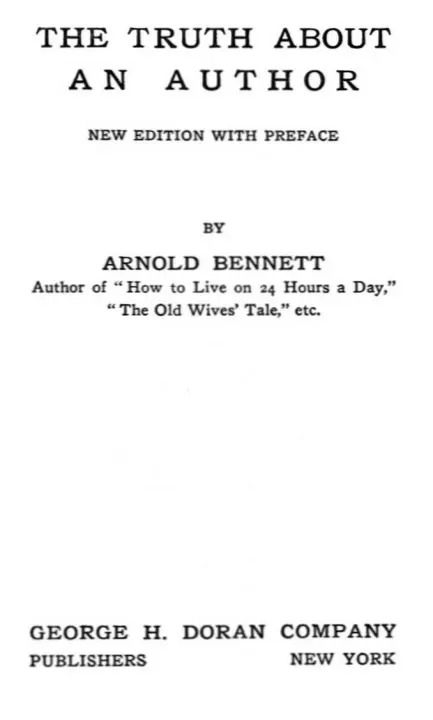
The Truth About an Author
Arnold Bennett
THE CLASSIC COLLECTION · 1900
"Leonora" by Arnold Bennett is a novel written during the early 20th century. The story revolves around Leonora Stanway, a beautiful and accomplished woman who grapples with the complexities of her life, her marriage to John Stanway, the pressures of family, and her unfulfilled desires. As the narrative unfolds, it delves into themes of aging, societal expectations, and the contrast between appearances and hidden truths within an industrial town setting. At the start of "Leonora," readers are introduced to the titular character as she navigates her life in the Five Towns. On her fortieth birthday, Leonora reflects on her marriage and family, revealing her feelings of dissatisfaction and longing for a more exciting existence. The opening chapter showcases her interactions with her husband John and their three daughters, highlighting the tensions in their relationships. As John leaves for a meeting filled with his own frustrations, Leonora contemplates her own place in the world, feeling both beautiful and trapped by her domestic life. The juxtaposition of her elegant presence against the grim reality of her industrial environment sets the tone for the explorations of identity and ambition that follow.
Introduction adapted from the source catalogue; source summaries may be automatically generated.
Free to read · English · 74,683 words · No account needed
MAKE TIME FOR A GOOD BOOK
On by default. Untick to stop anonymous reading totals. Each page counts after 10 seconds in view. How this works.
Anonymous counting is on unless you have switched it off.
'Good afternoon,' Ethel simpered foolishly, and she had it in her to have slain both men because she felt such a silly schoolgirl.
'I wanted Ryley. Where is he?'
'He's somewhere on the bank,[3] sir--speaking to the mouldmaker, I
think.'
[3] Bank = earthenware manufactory. But here the word is used in a limited sense, meaning the industrial, as distinguished from the bureaucratic, part of the manufactory.
'Well, just bring me in that letter from Paris that came on Saturday, will you?' Stanway requested.
'I've several things to speak to you about,' said Mr. Mayer, when he had
brought the letter.
'Directly,' Stanway answered, waving him away, and then turning to Ethel: 'Now, young lady, I want this letter translating.' He placed it before her on the table, together with some blank paper.
'Yes, father,' she said humbly.
Three hours a week for seven years she had sat in front of French manuals at the school at Oldcastle; but she knew that, even if the destiny of nations turned on it, she could not translate that letter of ten lines. Nevertheless she was bound to make a pretence of doing so.
'I don't think I can without a dictionary,' she plaintively murmured,
after a few minutes.
'Oh! Here's a French dictionary,' he replied, producing one from a drawer, much to her chagrin; she had hoped that he would not have a dictionary.
Then Stanway began to look through a pile of correspondence, and to scribble in a large saffron-coloured diary. He went out to Mr. Mayer; Mr. Mayer came in to him; they called to each other from room to room. The machinery stopped beneath and started again. A horse fell down in the yard, and Stanway, watching from the window, exclaimed: 'Tsh! That carter!'
Various persons unceremoniously entered and asked questions, all of which Stanway answered with equal dryness and certainty. At intervals he poked the fire with an old walking-stick, Ethel never glanced up. In a dream she handled the dictionary, the letter, the blank paper, and wrote unfinished phrases with the thick office pen.
'Done it?' he inquired at last.
'I--I--can't make out the figures,' she stammered. 'Is that a 5 or a 7?' She pushed the letter across.
'Oh! That's a French 7,' he replied, and proceeded to make shots at the meaning of sentences with a flair far surpassing her own skill, though it was notorious that he knew no French whatever. She had a sudden perception of his cleverness, his capacity, his force, his mysterious hold on all kinds of things which eluded her grasp and dismayed her.
Your reading position is saved on this browser. Take it to another device with a library code. Reading pages adapt to text, rather than matching a printed edition.
Arnold Bennett
Arnold Bennett
Arnold Bennett
Arnold Bennett
BEHIND THE BOOK
This eBook is for the use of anyone anywhere in the United States and most other parts of the world at no cost and with almost no restrictions whatsoever. You may copy it, give it away or re-use it under the terms of the Project Gutenberg License included with this eBook or online at www.gutenberg.org. If you are not located in the United States, you will have to check the laws of the country where you are located before using this eBook. Read the source licence.
The original source file, including credits and licence, is retained by this library. Request an original-format copy at no charge. Please include the book title and Project Gutenberg identifier #13723.
KEEP YOUR CURIOSITY GOING
Coulson Kernahan

Maurice Baring
Frances Wright
Cécile Tormay

Frederic Jesup Stimson

W. H. P. (William Henry Pope) Jarvis