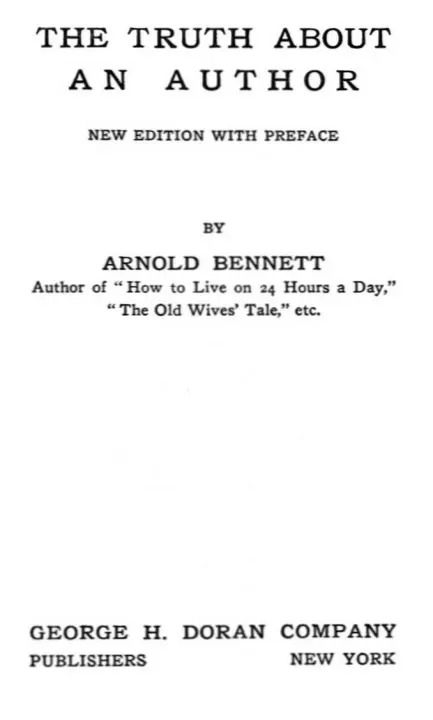
The Truth About an Author
Arnold Bennett
THE CLASSIC COLLECTION · 1900
"Leonora" by Arnold Bennett is a novel written during the early 20th century. The story revolves around Leonora Stanway, a beautiful and accomplished woman who grapples with the complexities of her life, her marriage to John Stanway, the pressures of family, and her unfulfilled desires. As the narrative unfolds, it delves into themes of aging, societal expectations, and the contrast between appearances and hidden truths within an industrial town setting. At the start of "Leonora," readers are introduced to the titular character as she navigates her life in the Five Towns. On her fortieth birthday, Leonora reflects on her marriage and family, revealing her feelings of dissatisfaction and longing for a more exciting existence. The opening chapter showcases her interactions with her husband John and their three daughters, highlighting the tensions in their relationships. As John leaves for a meeting filled with his own frustrations, Leonora contemplates her own place in the world, feeling both beautiful and trapped by her domestic life. The juxtaposition of her elegant presence against the grim reality of her industrial environment sets the tone for the explorations of identity and ambition that follow.
Introduction adapted from the source catalogue; source summaries may be automatically generated.
Free to read · English · 74,683 words · No account needed
MAKE TIME FOR A GOOD BOOK
On by default. Untick to stop anonymous reading totals. Each page counts after 10 seconds in view. How this works.
Anonymous counting is on unless you have switched it off.
'Well, Harry,' said Leonora with languid good nature. He paid his homage in form to the mistress of the house; raised his eyebrows at Milly, who returned the gesture; smiled upon Ethel, who feebly waved a hand as if too exhausted to do more; and then sat down on the piano-stool, carefully easing the strain on his trousers at the knees and exposing an inch of fine wool socks above his American boots. He was a familiar of the house, and had had the unconditional entrée since he and the Stanway girls first went to the High Schools at Oldcastle.
'I hope I haven't disturbed your beauty sleep--any of you,' was his
opening remark.
'Yes, you have,' said Ethel.
He continued: 'I just came in to seek a little temporary relief from the excellent Quain. Quain at breakfast, Quain at chapel, Quain at dinner.... I got him to slumber on one side of the hearth and mother on the other, and then I slipped away in case they awoke. If they do, I've told Cissie to say that I've gone out to take a tract to a sick friend--back in five minutes.'
'Oh, Harry, you are silly!' Millicent laughed. Every one, including the narrator, was amused by this elaborate fiction of the managing of those two impressive persons, Mrs. Burgess and the venerable Christian geologist, by a kind, indulgent, bored Harry. Leonora, who had resumed her magazine, looked up and smiled the guarded smile of the mother.
'I'm afraid you're getting worse,' she murmured, and his candid seductive face told her that while he was on no account not to be regarded as a gay dog, and a sad dog, and a worldly dog, yet nevertheless he and she thoroughly appreciated and understood each other. She did indeed like him, and she found pleasure in his presence; he gratified the eye.
'I wish you'd sing something, Milly,' he began again after a pause.
'No,' said Milly, 'I'm not going to sing now.'
'But do. Can't she, Mrs. Stanway?'
'Well, what do you want me to sing?'
'Sing "Love is a plaintive song," out of the second act.'
Harry was the newly appointed secretary of the Bursley Amateur Operatic Society, of which both Ethel and Millicent were members. In a few weeks' time the Society was to render Patience in the Town Hall for the benefit of local charities, and rehearsals were occurring frequently.
'Oh! I'm not Patience,' Milly objected stiffly; she was only Ella. 'Besides, I mayn't, may I, mamma?'
'Your father might not like it,' said Leonora.
Your reading position is saved on this browser. Take it to another device with a library code. Reading pages adapt to text, rather than matching a printed edition.
Arnold Bennett
Arnold Bennett
Arnold Bennett
Arnold Bennett
BEHIND THE BOOK
This eBook is for the use of anyone anywhere in the United States and most other parts of the world at no cost and with almost no restrictions whatsoever. You may copy it, give it away or re-use it under the terms of the Project Gutenberg License included with this eBook or online at www.gutenberg.org. If you are not located in the United States, you will have to check the laws of the country where you are located before using this eBook. Read the source licence.
The original source file, including credits and licence, is retained by this library. Request an original-format copy at no charge. Please include the book title and Project Gutenberg identifier #13723.
KEEP YOUR CURIOSITY GOING
Coulson Kernahan

Maurice Baring
Frances Wright
Cécile Tormay

Frederic Jesup Stimson

W. H. P. (William Henry Pope) Jarvis