THE CLASSIC COLLECTION✦MarianelaCLASSIC FREE BOOKS
Marianela
Benito Pérez Galdós
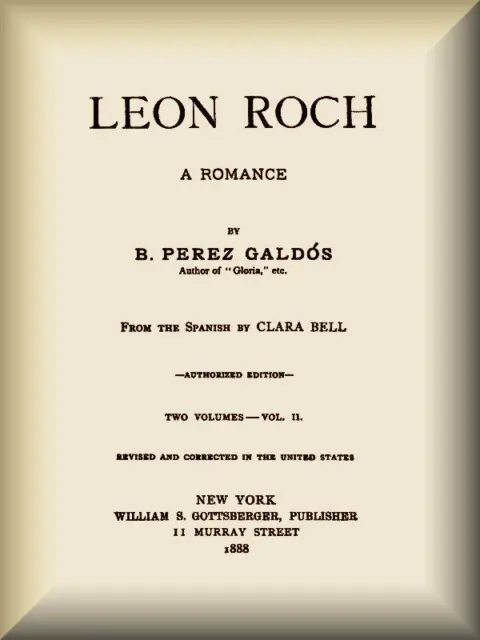
THE CLASSIC COLLECTION · 1888
"Leon Roch: A Romance, vol. 2 (of 2)" by Benito Pérez Galdós is a novel written in the late 19th century. The narrative primarily centers around the turmoil in the lives of the Telleria family as they confront personal disgrace, moral dilemmas, and social intrigue. The key character at the heart of the story is María de Roch, whose relationship with her husband Leon is fraught with conflict, leading to deep emotional upheaval as she grapples with love, betrayal, and her faith. The beginning of this second volume situates us within the deteriorating circumstances of the Telleria family, emphasizing their desperate attempts to maintain appearances despite their personal crises. Following the revelation of her husband's alleged unfaithfulness with another woman, María is caught in a whirlwind of jealousy, anguish, and epiphanies about her own devotion and desires. As she prepares to confront Leon, her reflections on love, fidelity, and self-worth culminate in a dramatic confrontation that lays bare the complexities of their marriage and the societal pressures they both navigate. Through vivid character portrayals and intricate dialogues, the opening chapters set the stage for a compelling exploration of the intersections between personal integrity and societal expectation.
Introduction adapted from the source catalogue; source summaries may be automatically generated.
Free to read · English · 77,231 words · No account needed
MAKE TIME FOR A GOOD BOOK
On by default. Untick to stop anonymous reading totals. Each page counts after 10 seconds in view. How this works.
Anonymous counting is on unless you have switched it off.
“That was what I was telling you, and you did not listen,” said Don Pedro, who was also suffering from a wound. “It is only our duty to show our unfortunate guest how deeply we sympathise in his misfortune. We must do something worthy of our house and name. Do not you think it will be well to perform a religious ceremony that may give due expression to our desire to see María out of danger? We will do it on a scale of magnificence. The chapel here stood me in eighty thousand dollars--though it might have cost less if the artists I employed had been men of less talent and pretensions.--Well then, to-morrow I will have a solemn penitential service, which all the servants and people shall attend, with you at their head. I give you full authority to spend as much as you think proper in tapers. The worthy priest from Polvoranca shall celebrate mass, and if you would like to have some more priests, send to all that are within reach.”
Having thus spoken, he sighed deeply and left her. Was it that, having a heavy burthen on his own soul, he yearned to petition the favour and mercy of Heaven on his own behalf? But we do not know what were the troubles which had so suddenly transformed the marquis’ radiant smiles into a sour grimace of annoyance. The loan, after crossing the troubled waters of the Spanish bourse with a fair wind, would this very day reach the haven of realization; and it was quite certain that Fúcar, Soligny and a few other birds of the same feather in Paris, Amsterdam, and London, would haul in a handful of gold for interest, brokerage and commission. What then...?
The chapel of Suertebella was a handsome edifice, at one angle of the mansion; high-roofed, thick-walled, and shining as if it had been varnished. The interior was of stucco, full of imitations of coloured marbles and porphyry, with a great deal of gilding on bosses and mouldings, which produced the effect of a lavish display of livery-buttons and gold cord on the pediments and spandrils. The style of architecture can only be described as Græco-Chino-Roman--Gothic gargoyles combined with ornament of the new classical style which originated at Munich, and which our architects have adopted for the porticoes of our houses, the pantheons of our cemeteries, the entrances of our town-halls, and the dining-rooms of our millionaires. The pseudojasper, gold, and brilliant colours dazzled the eye till they all seemed to be swimming round and round the dome like fishes in a glass bowl. The roof was supported by highly respectable angels who, in the sculptor’s studio, had played the part of seductive nymphs; and the paintings in the dome represented the cardinal Virtues, who had been predestined to figure as Muses. Everything blazed with the glaring splendour which is now fashionable in our private rooms, and which in them is not out of place. There was not a Christian attribute or allegory that had not been evolved from the palette or the sculptor’s mould by the artists employed to decorate this chapel. We shall presently become acquainted with a ribald jester who, it was said, was one day giving a farcical, not to say a sacrilegious explanation of the figures that adorned it: This female figure with bandaged eyes and a chalice in her hand, represented Spain whom the financiers of state had blindfolded that she might not see the bitterness of her cup of ruin; that one, leaning on an anchor, with her eyes disconsolately turned up to Heaven, was Commerce in despair; and the matron caressing a whole tribe of children was Beneficence, a pleasing emblem of the interest taken by the Fúcars in property and labour, and of the tender solicitude with which they lent them a helping hand to the work-house. The four Fathers of the Church, all represented as writing very gravely with “The Eagle’s Quill,” personified the Press, always ready to sing the praises of wealthy capitalists, who, before acting on their own account, take advantage of its ready pen. The vessel sinking in the waves of Tiberias was the State, whose orators and leaders suffer so much buffeting, while the Multiplication of the Loaves was obviously prefigurative of the distribution and reception of certain articles supplied under contract; finally, the stolid Sibyls, sitting with their hands before them in utter absence of mind, represented government administration. And the irreverent commentator went on to give new readings of the texts that were inscribed on the fillets and architraves for the edification of the faithful: “I am Pedro (Peter) and on this stone I will build my house. Give unto me that which is Cæsar’s, and that which is God’s.”
Your reading position is saved on this browser. Take it to another device with a library code. Reading pages adapt to text, rather than matching a printed edition.
Benito Pérez Galdós
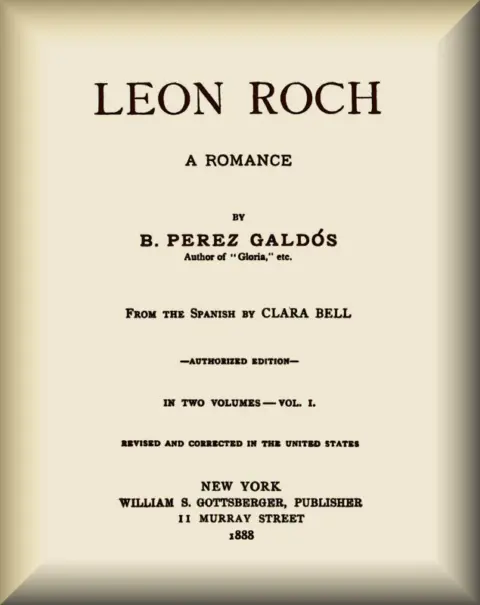
Benito Pérez Galdós
Benito Pérez Galdós
BEHIND THE BOOK
This eBook is for the use of anyone anywhere in the United States and most other parts of the world at no cost and with almost no restrictions whatsoever. You may copy it, give it away or re-use it under the terms of the Project Gutenberg License included with this eBook or online at www.gutenberg.org. If you are not located in the United States, you will have to check the laws of the country where you are located before using this eBook. Read the source licence.
The original source file, including credits and licence, is retained by this library. Request an original-format copy at no charge. Please include the book title and Project Gutenberg identifier #49272.
KEEP YOUR CURIOSITY GOING
Coulson Kernahan

Maurice Baring
Frances Wright
Cécile Tormay

Frederic Jesup Stimson

W. H. P. (William Henry Pope) Jarvis