THE CLASSIC COLLECTION✦MarianelaCLASSIC FREE BOOKS
Marianela
Benito Pérez Galdós
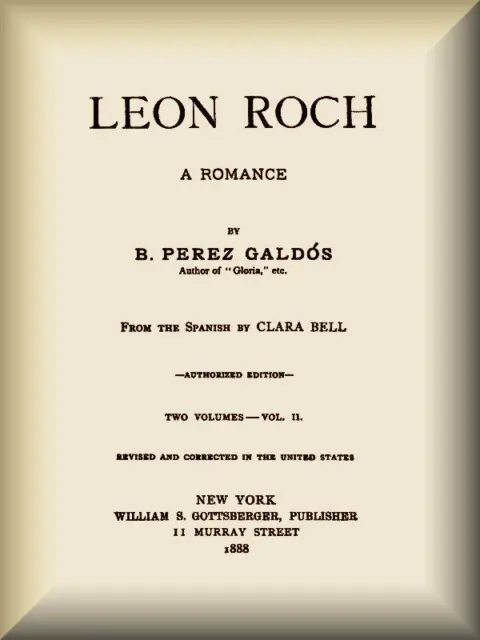
THE CLASSIC COLLECTION · 1888
"Leon Roch: A Romance, vol. 2 (of 2)" by Benito Pérez Galdós is a novel written in the late 19th century. The narrative primarily centers around the turmoil in the lives of the Telleria family as they confront personal disgrace, moral dilemmas, and social intrigue. The key character at the heart of the story is María de Roch, whose relationship with her husband Leon is fraught with conflict, leading to deep emotional upheaval as she grapples with love, betrayal, and her faith. The beginning of this second volume situates us within the deteriorating circumstances of the Telleria family, emphasizing their desperate attempts to maintain appearances despite their personal crises. Following the revelation of her husband's alleged unfaithfulness with another woman, María is caught in a whirlwind of jealousy, anguish, and epiphanies about her own devotion and desires. As she prepares to confront Leon, her reflections on love, fidelity, and self-worth culminate in a dramatic confrontation that lays bare the complexities of their marriage and the societal pressures they both navigate. Through vivid character portrayals and intricate dialogues, the opening chapters set the stage for a compelling exploration of the intersections between personal integrity and societal expectation.
Introduction adapted from the source catalogue; source summaries may be automatically generated.
Free to read · English · 77,231 words · No account needed
MAKE TIME FOR A GOOD BOOK
On by default. Untick to stop anonymous reading totals. Each page counts after 10 seconds in view. How this works.
Anonymous counting is on unless you have switched it off.
“The presence of these two persons, who will be scandalized, no doubt, by my words, shall not prevent my expressing my feelings.--To me, this woman is mine, mine by the divine law of love. I, radical as I am, bow to this law of the heart; but when I wish to put these anarchical views into practice, I tremble and dare not. The fierce rebellion lingers in my soul and cannot venture forth. Those who cannot transform the world and uproot its errors, must respect them. Those who cannot see the mysterious limit-line between legality and iniquity, must yield to the law with the patience of slaves. Those whose souls rise with cries and struggles in a revolt which seems legitimate, are nevertheless incompetent to place a sounder constitution in the place of that which crushes them, and can only suffer in silence.”
“We are all slaves to the laws of the age we live in,” said Don Justo
sternly.
“That is true,” Leon said; he was evidently speaking for Pepa’s benefit alone. “Our spirits are but a part of the spirit that made those laws; we are so far responsible for their defects that we must accept the consequences. If every one who felt injured by the machine in which we move--the majority in lazy indifference--if the sufferers, I say, were to set to work to alter it and could not repair it, what a world this would become! We must submit to be torn and mangled, secretly bewailing our misery, and only wishing we could live to see new machinery at work. But even that, I have no doubt, would hurt some one, since every improvement in one phase of human life brings some fresh form of suffering. Life is an aspiration--a thirst which revives as soon as it is quenched. If we could conceive of immortality under no other aspect, we could imagine it as consisting in seeing ourselves constantly under the dominion of--whether in small actions or in great ones--and constantly enchanted by the lovely vision of that distant horizon we call perfection.--If you, poor soul, could only know how I have fought with myself since we last talked together. I reconsidered every impossible alternative. It would be so easy to escape from this maze by simply following the impulse of my heart, and shielding myself behind theoretical and selfish arguments which no one but myself could follow and which even I could not distinctly marshall.--You were ready to come, the carriage was waiting, all the means of flight were ready, there was not an obstacle in sight and we could have afforded to think lightly of the opinion of society.--To be off and happy in some distant land! How easy and pleasant it seemed! You--not my wife--I your lover; both living in the practice of social anarchy, our illicit connection an outrage on the noblest and most necessary institution of human society; I haunted by a ghost, and you by a living man, who on every possible occasion would proclaim and urge his rights; neither of us having any claims against others while the whole world would have claims against us. Your daughter, again, growing up with this horrible example before her innocent eyes; and on what moral ground could you damn me if one day she felt inclined to become the mistress of the first man who fell in love with her? When once we break the bounds, we have no choice but to cast off all the ties that give order and stability to the world.--Yes, I thought over everything that could be said on either side. Then I considered whether I could not stay here, and soothe my anxieties with the satisfaction of being near you, even though I should neither see you nor speak to you. But that again cannot be. If I stay within reach of you, some time or other, almost without intending it, we should be certain to meet. Then that man I loathe would interfere--I should be unable to control my hatred, and I know, I feel, it would end in bloodshed. If I do not go away--far away, and soon--I know how that baleful impulse would grow stronger in me; it is like some hideous bidding to kill. Under my calmer reason turbid springs seethe in my soul, surging up to sweep away every obstacle. There is that within me which urges me to violence and rebellion; but I lack courage, for I reflect that nothing permanent, right, or moral, can be built up on anarchy or on blood. I take refuge in my conscience, and I have decided to go. I go to save your honour and the happiness of your child.”
Your reading position is saved on this browser. Take it to another device with a library code. Reading pages adapt to text, rather than matching a printed edition.
Benito Pérez Galdós
Benito Pérez Galdós
Benito Pérez Galdós
BEHIND THE BOOK
This eBook is for the use of anyone anywhere in the United States and most other parts of the world at no cost and with almost no restrictions whatsoever. You may copy it, give it away or re-use it under the terms of the Project Gutenberg License included with this eBook or online at www.gutenberg.org. If you are not located in the United States, you will have to check the laws of the country where you are located before using this eBook. Read the source licence.
The original source file, including credits and licence, is retained by this library. Request an original-format copy at no charge. Please include the book title and Project Gutenberg identifier #49272.
KEEP YOUR CURIOSITY GOING
Coulson Kernahan

Maurice Baring
Frances Wright
Cécile Tormay

Frederic Jesup Stimson

W. H. P. (William Henry Pope) Jarvis