THE CLASSIC COLLECTION✦The Patriot (Piccolo Mondo Antico)CLASSIC FREE BOOKS
The Patriot (Piccolo Mondo Antico)
Antonio Fogazzaro
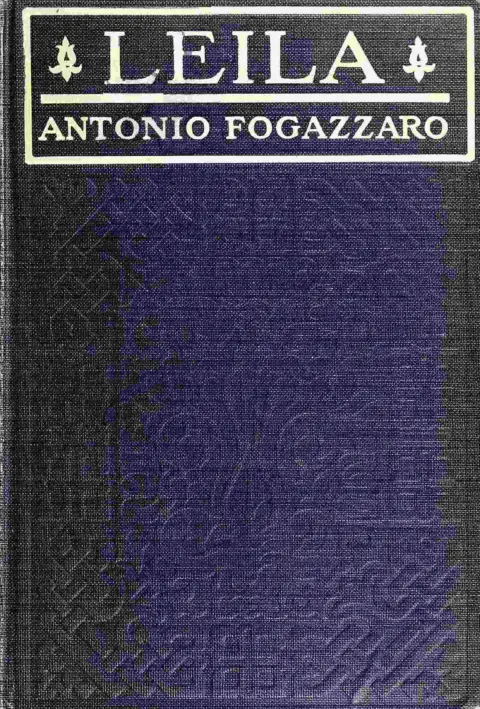
THE CLASSIC COLLECTION · 1910
Leila by Antonio Fogazzaro. Explore this classic work in a free online edition. Subjects include Italian fiction -- Translations into English. Read the locally hosted text below, adjust the reading display, and continue where you left off.
Introduction adapted from the source catalogue; source summaries may be automatically generated.
Free to read · English · 145,232 words · No account needed
MAKE TIME FOR A GOOD BOOK
On by default. Untick to stop anonymous reading totals. Each page counts after 10 seconds in view. How this works.
Anonymous counting is on unless you have switched it off.
"How can that matter?" she said. "Love will change all that easily enough. Besides, I do not suppose that you expect me also, simply because I am very fond of you, to become an enthusiastic follower of your Master. It seems to me that we need no other Master than the One who has guided us now for some nineteen hundred years."
Massimo would have liked to reply to this, but Donna Fedele dismissed him, saying: "Go now, go!" with her usual sweet smile, wherein there was just a suspicion of irony.
Massimo took the road to the upper Val d'Astico, that led farthest away from the Montanina. Passing the village of Barcarola, he left the Pedescala bridge on his right, and went down through the fields to the banks of the Astico, where for some time he watched the green water flowing rapidly by, listening to its even murmur and to the beating of his own heart. The sky was veiled with grey; the mountains that guard the stream on either side, enveloped in heavy mists, looked like silent cloaked mourners.
Shortly after nine o'clock Donna Fedele's unpretentious carriage was slowly toiling upwards towards the Montanina. To her great surprise, on turning in the direction of the candelabrum chestnut, she heard the querulous tinkling of the bell of Santa Maria ad Montes. It was always Don Aurelio who said Mass there, from time to time, on certain festivals. Was it possible he had not started? Leaving her carriage at the chestnut-tree, she went up to the little church on foot, and entered. It was empty, but some one was moving in the sacristy. On going to see who it was, she found herself face to face with Don Emanuele. She could not check an exclamation of surprise, and turned quickly away, while the chaplain sank on his knees upon the prayer-stool, to prepare himself for the Mass. Presently the little altar-boy told her that the Mass would be for the repose of the soul of Signora Trento, this being the anniversary of her death. The priest's preparation lasted a long time, and twice again the querulous little bell tinkled. Donna Fedele, seated near the small stone holy-water font with its frieze of "alpine-stars," reflected, not without some pity, how difficult it would be for the poor chaplain to recover from his unpleasant surprise. When she thought how furious he had made her, she experienced a sense of remorse and humility. Amongst the leaves of the mystic vine adorning the choir, she noticed the words of Christ: "Ego sum vitis, vos palmites." The little demon of sarcasm that dwelt in her brain took his revenge by suggesting to her that perhaps Don Emanuele was an unfruitful tendril, but she despised herself for such thoughts as these, coming to her in church, even while contemplating the Lord's vine. "At least," she told herself, "the chaplain would be a green tendril, while I am but a withered one." Signor Marcello came in, and not having expected her to be there, thanked her by a glance, believing she had come for the anniversary. Leila came in behind him. Don Emanuele said Mass with all the gravity of an ascetic and a prelate. Of the three participants Signor Marcello showed the most devotion, and having put on his eye-glasses, stood reading the "Imitation of Christ" from the beginning of Mass to the end, without once sitting down. Leila was not praying, and her glance often wandered through the little side-door to the green landscape of the Velo Park and the bright strip of field between the chestnuts, that she had crossed in the night. Donna Fedele glanced often and sadly at Signor Marcello, who seemed to her to have grown even thinner, while his face was worse than pale, it was yellow. She also studied Leila, who looked dissatisfied and sullen. She could not help thinking of her coming interview with this girl, and although she reproached herself for her distraction, of poor Alberti's grief should Leila's answer be a refusal, and of the mixed feelings of regret and satisfaction that such an answer would bring to Signor Marcello. For Don Aurelio had told her that Signor Marcello would certainly rejoice in her loyalty should she refuse, but in the event of her consenting he would feel that in Massimo Alberti he was regaining some part of his son, and that the danger of Leila's falling again into her parents' power, or forming some unfortunate union later on, would be definitely removed. The soft, persistent murmur of the little fountain in the small vestibule behind her soothed her melancholy; all this uncertainty would soon come to an end, the interview would be a thing of the past, and its consequences, whatever they might be, would pass away also; perhaps she herself would soon be no more. She gave no further thought to anything but the eternal words the priest was uttering. The quarter of an hour's drive had sufficed to increase her suffering. During the Communion she was obliged to sit down, and she felt that she looked like a dead woman. The lad who was serving the Mass stared at her as he stood waiting with the two flasks for the priest to present the chalice, and she smiled inwardly on perceiving his look of amazement. When Mass was over, her indomitable will helped her to rise and pass out by the side-door, followed by Leila, while Signor Marcello remained behind a moment longer. His profuse thanks embarrassed Donna Fedele, who, however, concluded it would be wiser to accept them in silence.
Your reading position is saved on this browser. Take it to another device with a library code. Reading pages adapt to text, rather than matching a printed edition.
BEHIND THE BOOK
This eBook is for the use of anyone anywhere in the United States and most other parts of the world at no cost and with almost no restrictions whatsoever. You may copy it, give it away or re-use it under the terms of the Project Gutenberg License included with this eBook or online at www.gutenberg.org. If you are not located in the United States, you will have to check the laws of the country where you are located before using this eBook. Read the source licence.
The original source file, including credits and licence, is retained by this library. Request an original-format copy at no charge. Please include the book title and Project Gutenberg identifier #78258.
KEEP YOUR CURIOSITY GOING
Coulson Kernahan

Maurice Baring
Frances Wright
Cécile Tormay

Frederic Jesup Stimson

W. H. P. (William Henry Pope) Jarvis