THE CLASSIC COLLECTION✦A dead man’s diaryCLASSIC FREE BOOKS
A dead man’s diary
Coulson Kernahan
THE CLASSIC COLLECTION · 1873
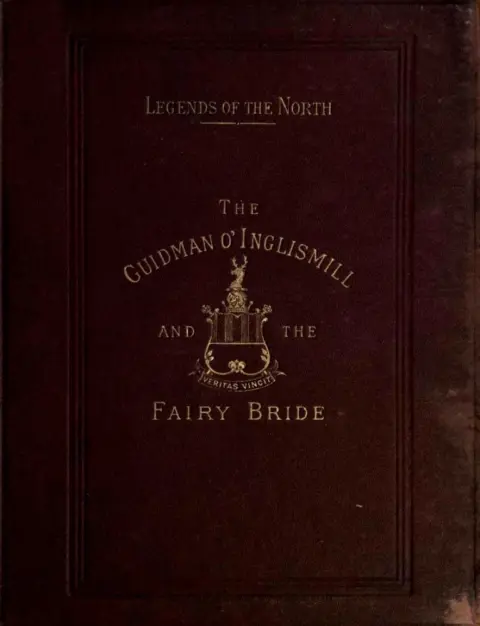
"Legends of the North: The Guidman O' Inglismill and The Fairy Bride" by Buchan is a collection of Scottish folk tales written in the late 19th century. This work intertwines elements of local superstition and folklore with narratives about love and the supernatural. The stories focus on themes of rural life, enchantment, and the relationship between mortals and fairies, making it a delightful exploration of Scottish cultural mythology. The book consists of two main tales. In "The Guidman O' Inglismill," a hardworking farmer named Inglis struggles with his penchant for drink and his obligations to his wife, which ultimately leads him into the fairy realm after a night of indulgence. There, he faces a challenge from the fairy folk related to his drinking habits, ultimately finding wisdom and commitment to change upon his return. The second tale, "The Fairy Bride," tells of a beautiful fairy named Claribel, who longs for love and takes the form of a human to win the affection of a noble knight. Their forbidden love leads to a romantic union that both delights and bewilders, showcasing the allure and consequences of mingling with the fantastical. Together, these stories celebrate the enchanting and often perilous intersections between human desires and the mystical world of fairies.
Introduction adapted from the source catalogue; source summaries may be automatically generated.
Free to read · English · 13,725 words · No account needed
MAKE TIME FOR A GOOD BOOK
On by default. Untick to stop anonymous reading totals. Each page counts after 10 seconds in view. How this works.
Anonymous counting is on unless you have switched it off.
"We sleep in rose-buds soft and sweet,
We revel in the stream,
We wanton lightly on the wind,
Or glide on a sunbeam.
"And all our wants are well supplied
From every rich man's store,
Who thankless sins the gifts he gets,
And vainly grasps for more.
"And it is sic a bonnie place,
And I like it sae well,
That I wou'd never tire, Janet,
In Elfish land to dwell.
"But aye, at ilka seven years,
They pay the teind to hell;
And I'm sae fat and fair of flesh,
I fear 'twill be mysel'!"
And so the brave Janet, actuated by that greatest of all feelings--a true woman's love--took her lover from the procession on Hallow-e'en, by "pulling him down" from the "milk-white steed" on which he rode, and holding him fast in spite of all the "horrible and awfu'" changes he underwent in her hands, discovering, when he returns to his true likeness, that he is her old boyish love, son of Randolph, Earl of Murray, whom the fairies had, years before, stolen away.
There were, as in all communities, a good and a bad section, known as the "seelie" and the "unseelie court." The seelie court were kind, courteous, and charitable to the aged, the poor, and the afflicted, to whom they gave gifts suited to their necessities, as in the rhyme--
"Meddle and mell
Wi' the fiends o' hell,
And a weirdless wicht ye'll be;
But tak' and len'
Wi' the fairy men,
Ye'll thrive until ye dee."
The unseelie court, on the other hand, from those who offended them, stole their goods and killed their cattle by elf-shot, occasionally found on the moors or turned up in the fields now-a-days, but which science ruthlessly asserts to be the arrow-heads of our prehistoric ancestors. They entertained a particular dislike against those who wore clothing of a green colour. To this cause the Highlanders ascribed the death of Viscount Dundee at Killiecrankie. But their most wicked prank of all was the carrying away of handsome unbaptized children from the side of the lying-in mother, substituting their own loathsome and sickly progeny in their stead. To prevent this misfortune, it was customary in the Highlands to perform the Dessil--that is, carrying fire in the right hand, and in the direction from right to left, morning and evening, round the house in which lay the mother and child, until the baptism and churching had taken place. "This was," says Martin, in his "History of the West Highlands," "considered an effectual means to preserve both the mother and infant from the power of evil spirits, who are ready at such times to do mischief, and sometimes carry away the infants and return poor, meagre skeletons; and these infants have voracious appetites. In this case, it was usual for those who believed that their children were thus taken away to dig a grave in the fields on quarter-day, and there to lay the fairy skeleton till next morning, at which time the parents went to the place, where they doubted not to find their own child instead of the skeleton." They had also, in other localities, recourse to the barbarous charm of burning, with a live coal, the toes of the suffering infant, the supposed changeling. They were not content with abstracting handsome children--beautiful maidens and wives sometimes disappeared, and, of course, the fairies were the abductors. The Miller of Menstrie,[1] in Fife, who possessed a charming spouse, had given offence to the "unseelie" court, and was, in consequence, deprived of his fair helpmate. His distress was aggravated by hearing his wife singing in the air--
Your reading position is saved on this browser. Take it to another device with a library code. Reading pages adapt to text, rather than matching a printed edition.
BEHIND THE BOOK
This eBook is for the use of anyone anywhere in the United States and most other parts of the world at no cost and with almost no restrictions whatsoever. You may copy it, give it away or re-use it under the terms of the Project Gutenberg License included with this eBook or online at www.gutenberg.org. If you are not located in the United States, you will have to check the laws of the country where you are located before using this eBook. Read the source licence.
The original source file, including credits and licence, is retained by this library. Request an original-format copy at no charge. Please include the book title and Project Gutenberg identifier #37375.
KEEP YOUR CURIOSITY GOING
Coulson Kernahan

Maurice Baring
Frances Wright
Cécile Tormay
Francis Greenleaf Allinson & Anne C. E. (Anne Crosby Emery) Allinson

Frederic Jesup Stimson