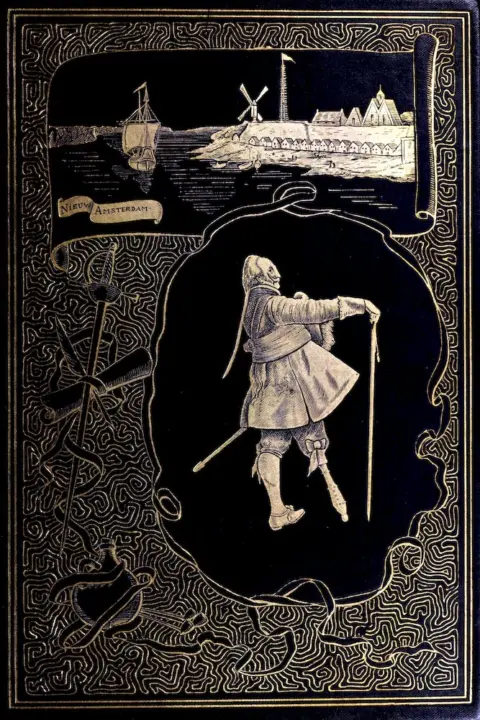
Knickerbocker’s history of New York, vol. 2 (of 2)
Washington Irving
THE CLASSIC COLLECTION · 1835
"Legends of the conquest of Spain" by Washington Irving is a collection of historical legends written in the early 19th century. Blending history with romantic folklore, it retells the fall of Visigothic Spain to the Saracens. The narrative centers on King Roderick, Count Julian, Florinda, and the Arab commanders Taric and Muza, using vivid episodes and prophetic portents to dramatize the collapse of a kingdom.
The opening of the work sets out a preface defending the use of old chronicles and marvels, then launches into the “Legend of Don Roderick.” It sketches Spain’s earlier invasions and the Gothic ascendancy, condemns Witiza’s corrupt reign, and shows Roderick’s rise and his later decadence. Roderick marries the Moorish princess Elyata (baptized Exilona), betrays Count Julian’s trust by violating his daughter Florinda, and defies warnings to unlock the enchanted tower at Toledo, where a vision foretells Arab conquest and ominous signs follow. In Africa, Julian defeats the Arabs at Ceuta, learns of his daughter’s dishonor, and, with Bishop Oppas, plots treason—emptying Spain of arms, courting Muza, and guiding Taric’s probing raid. Muza secures the Caliph’s leave; Taric returns with an army, burns his ships, seizes Calpe (Gibraltar), and beats back Theodomir’s first stand. As Roderick dispatches Prince Ataulpho to the south, Taric steels his men with a visionary promise, and the two armies draw up for battle at Calpe, where the excerpt breaks off.
Introduction adapted from the source catalogue; source summaries may be automatically generated.
Free to read · English · 54,569 words · No account needed
MAKE TIME FOR A GOOD BOOK
On by default. Untick to stop anonymous reading totals. Each page counts after 10 seconds in view. How this works.
Anonymous counting is on unless you have switched it off.
[1] Many of the facts in this legend are taken from an old chronicle, written in quaint and antiquated Spanish, and professing to be a translation from the Arabian chronicle of the Moor Rasis, by Mohammed, a Moslem writer, and Gil Parez, a Spanish priest. It is supposed to be a piece of literary mosaic work, made up from both Spanish and Arabian chronicles: yet from this work most of the Spanish historians have drawn their particulars relative to the fortunes of Don Roderick.
[2] Florian de Ocampo, lib. iii. c. 12. Justin Abrev. Trog. Pomp. lib. xliv. Bleda. Cronica, lib. ii. c. 3.
[3] Chron. de Luitprando, 709. Abarca Anales de Aragon (el Mahometismo,
fol. 5.)
[4] Mariana, Hist. Esp. lib. vi. c. 21.
[5] Perdida de España por Abulcacim Tarif Abentarique, lib. i.
[6] Lope de Vega.
[7] By some she is called Zara.
[8] “Como esta Infanta era muy hermosa, y el Rey [Don Rodrigo] dispuesta y gentil hombre, entro por medio el amor y aficion, y junto con el regalo con que la avia mandado hospedar y servir ful causa que el rey persuadio esta Infanta, que si se tornava a su ley de Christiano la tomaria por muger, y que la haria señora de sus Reynos. Con esta persuasion ella fue contenta, y aviendose vuelto Christiana, se caso con ella, y se celebraron sus bodas con muchas fiestas y regozijos, como era razon.”—Abulcasim, Conq’st de Espan, cap. 3.
[9] Condes Espatorios; so called from the drawn swords of ample size and breadth, with which they kept guard in the antechambers of the Gothic kings. Comes Spathariorum, custodum corporis Regis Profectus. Hunc et Propospatharium appellatum existimo.—Patr. Pant. de Offic. Goth.
[10] Perdida de España por Abulcasim Tarif Abentarique, lib. i. c. 6. Cronica del Rey Don Rodrigo por el moro Rasis, lib. i. c. 1. Bleda, Cron. cap. vii.
[11] From the minute account of the good friar, drawn from the ancient chronicles, it would appear that the walls of the tower were pictured in mosaic work.
[12] Bleda, Cronica, cap. 7.
[13] Bleda, Cronica, cap. 7.
[14] Bleda, cap. 5.
[15] Bleda, cap. 4.
[16] Beuter, Cron. Gen. de España, lib. i. c. 28. Marmol. Descrip. de
Africa, lib. ii. c. 10.
[17] Bleda, Cron. c. 5.
[18] Conde, Hist. Dom. Arab. part. i. c. 8.
[19] Conde, part i. c. 8.
[20] Perdida de España, por Abulcasim Tarif Abentarique, lib. i. c. 7.
[21] Conde, part i. c. 9.
[22] La Perdida de España, cap. 9. Bleda, lib. ii. c. 8.
[23] This name was given to it subsequently by the Arabs. It signifies the River of Death. Vide Pedruza, Hist. Granad. p. 3. c. 1.
[24] Bleda, Cronica.
[25] Eutrand. Chron. an. Christ. 714.
[26] This battle is called indiscriminately by historians the battle of Guadalete, or Xeres, from the neighbourhood of that city.
Your reading position is saved on this browser. Take it to another device with a library code. Reading pages adapt to text, rather than matching a printed edition.
Washington Irving
William Irving & Washington Irving & James Kirke Paulding
Washington Irving
Washington Irving
BEHIND THE BOOK
This eBook is for the use of anyone anywhere in the United States and most other parts of the world at no cost and with almost no restrictions whatsoever. You may copy it, give it away or re-use it under the terms of the Project Gutenberg License included with this eBook or online at www.gutenberg.org. If you are not located in the United States, you will have to check the laws of the country where you are located before using this eBook. Read the source licence.
The original source file, including credits and licence, is retained by this library. Request an original-format copy at no charge. Please include the book title and Project Gutenberg identifier #77685.
KEEP YOUR CURIOSITY GOING
Cécile Tormay

Moritz Busch
John L. Ransom
Frances Wright
Cécile Tormay

Mabel Potter Daggett