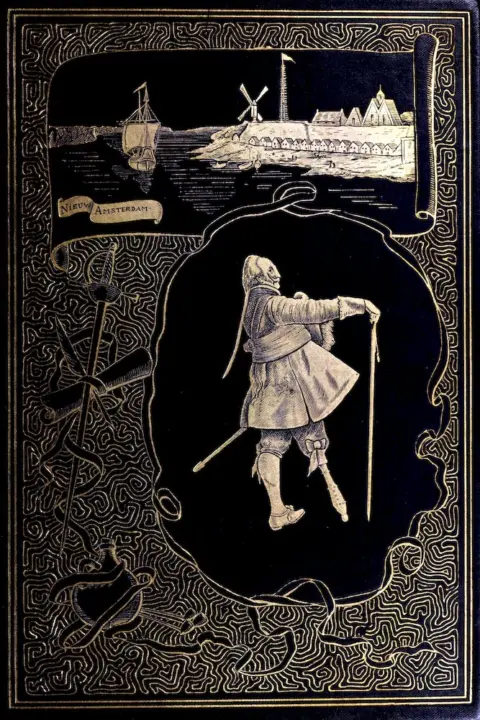
Knickerbocker’s history of New York, vol. 2 (of 2)
Washington Irving
THE CLASSIC COLLECTION · 1835
"Legends of the conquest of Spain" by Washington Irving is a collection of historical legends written in the early 19th century. Blending history with romantic folklore, it retells the fall of Visigothic Spain to the Saracens. The narrative centers on King Roderick, Count Julian, Florinda, and the Arab commanders Taric and Muza, using vivid episodes and prophetic portents to dramatize the collapse of a kingdom.
The opening of the work sets out a preface defending the use of old chronicles and marvels, then launches into the “Legend of Don Roderick.” It sketches Spain’s earlier invasions and the Gothic ascendancy, condemns Witiza’s corrupt reign, and shows Roderick’s rise and his later decadence. Roderick marries the Moorish princess Elyata (baptized Exilona), betrays Count Julian’s trust by violating his daughter Florinda, and defies warnings to unlock the enchanted tower at Toledo, where a vision foretells Arab conquest and ominous signs follow. In Africa, Julian defeats the Arabs at Ceuta, learns of his daughter’s dishonor, and, with Bishop Oppas, plots treason—emptying Spain of arms, courting Muza, and guiding Taric’s probing raid. Muza secures the Caliph’s leave; Taric returns with an army, burns his ships, seizes Calpe (Gibraltar), and beats back Theodomir’s first stand. As Roderick dispatches Prince Ataulpho to the south, Taric steels his men with a visionary promise, and the two armies draw up for battle at Calpe, where the excerpt breaks off.
Introduction adapted from the source catalogue; source summaries may be automatically generated.
Free to read · English · 54,569 words · No account needed
MAKE TIME FOR A GOOD BOOK
On by default. Untick to stop anonymous reading totals. Each page counts after 10 seconds in view. How this works.
Anonymous counting is on unless you have switched it off.
The Casa del Gallo, even until within twenty years, possessed two great halls beautifully decorated with Morisco reliefs. It then caught fire, and was so damaged as to require to be nearly rebuilt. It is now a manufactory of coarse canvas, and has nothing of the Moorish character remaining. It commands a beautiful view of the city and the Vega.
[35] Pedraza, Hist. Granada, p. iii. c. 2. Bleda, Cronica, lib. ii. c. 10.
[36] Conde, Hist. de las Arabes en España, c. 12.
[37] The stratagem of the Jews of Toledo is recorded briefly by Bishop Lucas de Tuy, in his chronicle, but is related at large in the chronicle of the Moor Rasis.
[38] According to Arabian legends, this table was a mirror revealing all great events; insomuch that by looking on it the possessor might behold battles and sieges and feats of chivalry, and all actions worthy of renown; and might thus ascertain the truth of all historic transactions. It was a mirror of history, therefore, and had very probably aided King Solomon in acquiring that prodigious knowledge and wisdom for which he was renowned.
[39] Abulcasim. Perdita de España, lib. i. c. 13.
[40] Cron. Gen. de España, por Alonzo el Sabio, p. iii. c. 1.
[41] Bleda, Cronica, lib. ii. c. 11.
[42] Conde, p. i. c. 13. Ambrosio de Morales.—N.B. In the Chronicle of Spain, composed by order of Alonzo the Wise, this anecdote is given as having happened at the siege of Seville.
[43] Marmol. Descrip. de Africa, t. i. l. 2.
[44] Abulcasim, Perdida de España, l. i. c. 13.
[45] Espinosa. Antq. y Grand. de Seville, lib. ii c. 3.
[46] Conde, p. i. c. 14.
[47] Conde, p. i. Cronica del moro Rasis. Cron. Gen. España, por Alonzo
el Sabio, p. iii. c. 1.
[48] Conde, p. i. c. 15.
[49] Conde, p. i. c. 15.
[50] Conde, p. i. c. 16.
[51] Conde, p. i. c. 17.
[52] Algarbe, or Algarbia, in Arabic signifies the west, as Axarkia is the east, Algufia the north, and Aquibla the south. This will serve to explain some of the geographical names on the peninsula which are of Arabian origin.
[53] Faxardo, Corona, Gothica, t. i. p. 492. Joan. Mar. de Reb. Hisp. l.
vi. c. 27.
[54] Conde, p. i. c. 17.
[55] Cron. Gen. de Alonzo el Sabio, p. 3. Joan. Mar. de Reb. Hisp. lib. vi. c. 27. Conde, p. i. cap. 19.
Your reading position is saved on this browser. Take it to another device with a library code. Reading pages adapt to text, rather than matching a printed edition.
Washington Irving
William Irving & Washington Irving & James Kirke Paulding
Washington Irving
Washington Irving
BEHIND THE BOOK
This eBook is for the use of anyone anywhere in the United States and most other parts of the world at no cost and with almost no restrictions whatsoever. You may copy it, give it away or re-use it under the terms of the Project Gutenberg License included with this eBook or online at www.gutenberg.org. If you are not located in the United States, you will have to check the laws of the country where you are located before using this eBook. Read the source licence.
The original source file, including credits and licence, is retained by this library. Request an original-format copy at no charge. Please include the book title and Project Gutenberg identifier #77685.
KEEP YOUR CURIOSITY GOING
Cécile Tormay

Moritz Busch
John L. Ransom
Frances Wright
Cécile Tormay

Mabel Potter Daggett