THE CLASSIC COLLECTION✦Sweet HoursCLASSIC FREE BOOKS
Sweet Hours
Carmen Sylva
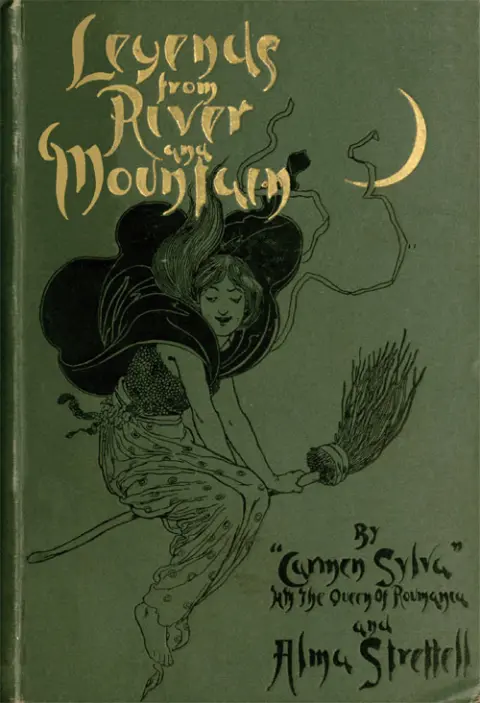
THE CLASSIC COLLECTION · 1896
"Legends from River & Mountain" by Carmen Sylva and Alma Strettell is a collection of folklore stories written in the late 19th century. The work presents enchanting tales rooted in Roumanian and German folklore, incorporating elements of magic, nature, and rich characterizations. These legends not only traverse across geographical landscapes but also evoke the deep cultural significance of the regions they explore, weaving stories that reflect human emotions and moral lessons. The opening of the anthology introduces readers to the mystical landscape of Roumanian mountains, notably the Bucegi group and the captivating twin peaks of Jipi. The tale of the Jipi reveals two inseparable brothers, Andrei and Mirea, who indulge in adventures and embody unwavering camaraderie. Their lives intertwine with a spirited wood-fairy, Urlanda, leading to humorous interactions, deep affection, and a poignant conclusion that binds their destinies in a tragic yet beautiful transformation. As they navigate love and loyalty against a backdrop of enchanting natural beauty, this initial story sets the stage for the themes of sacrifice, love, and the intertwining of human fates with folklore, thus drawing the reader into a realm of wonder and reflection.
Introduction adapted from the source catalogue; source summaries may be automatically generated.
Free to read · English · 74,871 words · No account needed
MAKE TIME FOR A GOOD BOOK
On by default. Untick to stop anonymous reading totals. Each page counts after 10 seconds in view. How this works.
Anonymous counting is on unless you have switched it off.
But when once a child had begun to say, “This is mine,” all the others wanted to say it too. Some built themselves huts like the first; but others found it much easier to nestle into those that were already made, and then, when the owners cried and complained, the unkind little conquerors laughed. Thereupon those who had been cheated of their belongings struck out with their fists, and so the first battle arose. Some ran and brought complaints to the Caraiman, who in consequence blew a mighty thunder upon his bagpipes, which frightened all the children terribly.
So they learnt for the first time to know fear; and afterwards they showed anger against the tale-bearers. In this way even strife and division entered into the Caraiman’s beautiful, peaceful kingdom.
He was deeply grieved when he saw how the tiny folk in his kingdom behaved in just the same way as the grown people in other lands, and he debated how he might cure the evil. Should he blow them all away into the sea, and make a new family? But the new ones would soon be as bad as these, and then he was really too fond of his little people. Next he thought of taking away everything over which they might quarrel; but then all would become dry and barren, for it was but over a handful of earth and moss that the strife had arisen, and, in truth, only because some of the children had been industrious and others lazy. Then he bethought himself of making them presents, and gave to each sheep and dogs and a garden for his particular use. But this only made things far worse. Some planted their gardens, but others let them run wild, and then perceived that the cultivated gardens were the fairest, and that the sheep that had good pasture gave the most milk. Then the trouble became great indeed. The lazy children made a league against the others, attacked them, and took away many of their gardens. Then the industrious ones moved to a fresh spot, which soon grew fair also under their hands; or else they refused to be driven out, and long conflicts arose, in the course of which some of the children were slain. When they saw death for the first time they were greatly frightened and grieved, and swore to keep peace with one another. But all in vain--they could not stay quiet for long; so, as they were now loth to kill one another, they began to take away each other’s property by stealth and with cunning. And this was far sadder to see; the Caraiman, indeed, grew so heavy of heart over it that he wept rivers of tears. They flowed down through the valley and into the sea; yet the wicked children never considered that these were the tears their kind father was weeping over them, and went on bickering and quarrelling. Thereupon the Caraiman wept ever more and more, and his tears turned to torrents and cataracts that devastated the land, and ended by changing it into one large lake, wherein countless living creatures came to their death. Then he ceased weeping, and blew a mighty wind, which left the land dry again; but now all the green growth had vanished, houses and gardens lay buried under heaps of stones, and the sheep, for lack of pasture, no longer gave any milk. Then the children cut their throats open with sharp stones, to see if the milk would not flow out in a fresh place; but instead of milk, blood gushed out, and when they had drunk that they became fierce, and were always craving for more of it. So they slew many other sheep, stealing those of their brethren, and drank blood and ate meat. Then the Caraiman said, “There must be larger animals made, or there will soon be none left!” and blew again upon his bagpipes. And behold! wild bulls came into the world, and winged horses with long scaly tails, and elephants, and serpents. The children now began to fight with all these creatures, and thereby grew very tall and strong themselves. Many of the animals allowed themselves to be tamed and made useful; but others pursued the children and killed them, and as they no longer dwelt in such peace and safety, many grievous and dangerous sicknesses appeared among them. Soon they became in all respects like the men of other lands, and the Caraiman grew more and more soured and gloomy, since all that which he had intended to use for good, had but turned to evil. His creatures, too, neither loved nor trusted him, and instead of perceiving that they themselves had wrought the harm, thought that the Caraiman had sent sorrow upon them out of wanton cruelty and sport. They would no longer listen to the bagpipes, whose sweet strains had of old been wont to delight their ears. The old giant, indeed, did not often care to play on his pipes now. He had grown weary for very sorrow, and would sleep for hours together under the shade of his eyebrows, which had grown down into his beard. But sometimes he would start up out of sleep, put the pipes to his mouth, and blow a very trumpet-blast out into the wicked world. Hence there at last arose such a raging storm that the trees ground, creaking and groaning, against one another, and caused a fire to burst out, so that soon the whole forest was in flames. Then he reached up with the tree that grew upon his head, till he touched the clouds, and shook down rain, to quench the fire. But all this while the human beings below had but one thought--how to put the bagpipes to silence for ever and ever. So they set out with lances and spears, and slings and stones, to give battle to the giant; but at the sight of them he burst into such laughter that an earthquake took place, which swallowed them all up, with their dwellings and their cattle. Then another host set out against him with pine-torches, wherewith to set his beard on fire. He did but sneeze, however, and all the torches were extinguished and their bearers fell backwards to the earth. A third host would have bound him while he slept, but he stretched his limbs, and the bonds burst, and all the men about him were crushed to atoms. Then they would have set upon him all the mighty wild beasts he had created. But he swept the air together and made thereof an endless fall of snow, that covered them over and over, and buried them deep, and turned to ice above them; so that after thousands of years, when their like was no more to be seen on earth, those beasts still lay, with fur and flesh unchanged, embedded in the ice.
Your reading position is saved on this browser. Take it to another device with a library code. Reading pages adapt to text, rather than matching a printed edition.
BEHIND THE BOOK
This eBook is for the use of anyone anywhere in the United States and most other parts of the world at no cost and with almost no restrictions whatsoever. You may copy it, give it away or re-use it under the terms of the Project Gutenberg License included with this eBook or online at www.gutenberg.org. If you are not located in the United States, you will have to check the laws of the country where you are located before using this eBook. Read the source licence.
The original source file, including credits and licence, is retained by this library. Request an original-format copy at no charge. Please include the book title and Project Gutenberg identifier #52417.
KEEP YOUR CURIOSITY GOING

Maurice Baring
Francis Greenleaf Allinson & Anne C. E. (Anne Crosby Emery) Allinson
Stuart Dodgson Collingwood
Percy Keese Fitzhugh
Mary Macleod & Edmund Spenser

Cooke Don-Carlos