THE CLASSIC COLLECTION✦Frank Merriwell’s dangerCLASSIC FREE BOOKS
Frank Merriwell’s danger
Burt L. Standish
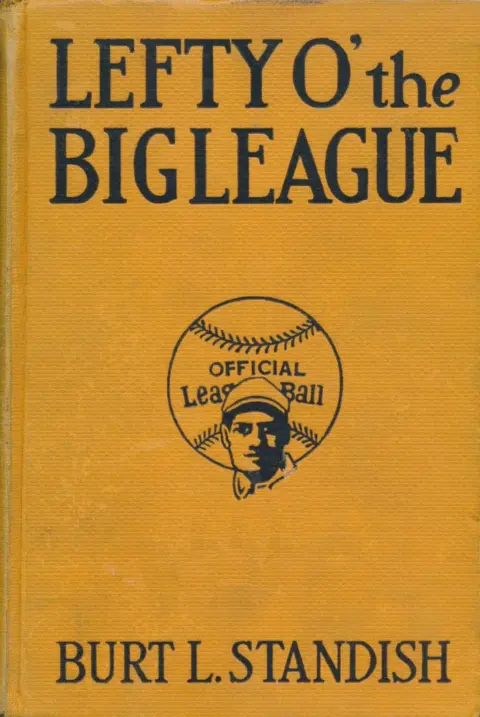
THE CLASSIC COLLECTION · 1914
"Lefty o' the Big League" by Burt L. Standish is a novel written in the early 20th century. The story revolves around a young pitcher named Lefty Locke as he attempts to make his way into the competitive world of professional baseball. As he faces challenges from both the manager and fellow players, Lefty's journey captures the ups and downs of trying to prove oneself in a demanding sport filled with rivalries and personal conflicts. The opening of the novel introduces Lefty Locke as he arrives at the baseball park to report for training with the Hornets. Immediately met with skepticism from the team's manager, Brennan, and ridicule from veteran players, Lefty tries to assert himself. Tensions escalate when he eventually ends up in a precarious situation, facing criticism and hostility as he seeks to earn his place on the team. As the narrative unfolds, Lefty's encounters with both supportive and antagonistic teammates set the stage for his development, revealing themes of perseverance, ambition, and the quest for acceptance amidst the trials of sports life.
Introduction adapted from the source catalogue; source summaries may be automatically generated.
Free to read · English · 58,929 words · No account needed
MAKE TIME FOR A GOOD BOOK
On by default. Untick to stop anonymous reading totals. Each page counts after 10 seconds in view. How this works.
Anonymous counting is on unless you have switched it off.
As before, it was Hagin who raced forward, scooped up the ball on the run, and lined it to second. Brown had taken a fair lead, however, and made the second sack by a hair’s breadth, amid a cloud of dust.
“Got ’em going, boys!” yelled Schaeffer. “They’re e-easy. Now, Pete, you know what to do.”
Nevens, third baseman, evidently did. He was prepared to sacrifice, but Locke kept the ball high so that it was difficult for him to bunt effectively. He was finally forced to hit, and hit he did, though not safely. Nevertheless, he pounded the ball into the diamond, and the two runners advanced, while he was thrown out at first.
“That’s the stuff,” laughed Schaeffer, as he stepped out with his bat. “Here’s where we pull the Hornet’s stinger.”
He had a peculiar swaggering gait, and carried himself in a manner which showed how thoroughly he appreciated his own ability. Lefty felt an intense desire to fan the fellow, who seemed so cocksure of himself. He was glancing at Fargo, ready to take the signal, when he saw that Schaeffer had crowded up to the plate, his toes well over the box line.
“Get back,” Locke said sharply.
“Aw, pitch the ball!” snapped Schaeffer. “What’s bitin’ you?”
“You’re out of your box,” declared Lefty. “I’m liable to hit you.”
“I’ll take a chance, Willie,” the Texan retorted offensively. “I ain’t seen you pass up anything very dangerous so far.”
Nevertheless, at the umpire’s command, he edged back grudgingly, but persisted in keeping a bit of his toes over the line.
“The close ones for him,” Lefty decided swiftly. “With that reach of his, he can hit anything a foot outside the pan.”
He therefore shook his head when Fargo signaled. When the big backstop changed the sign, Lefty, after a glance at the base runners, used a short, swift delivery, and passed up an inshoot, intending to keep the ball close to the knuckles of the batter.
Schaeffer stepped in, and was unable to dodge that shoot. It caught him glancingly, high up on the body, and made him stagger a bit. Then, growling a few choice epithets, he obeyed the umpire’s signal to take his base.
“That man stepped out of his box, Mr. Umpire,” Fargo protested. “He wouldn’t have been hit if he’d kept his place.”
“Aw, cut that out!” snarled Schaeffer, limping in an exaggerated manner. “I was hit a-purpose. Just wait, my young squab,” he added out of the corner of his mouth to Lefty. “I’ll get you.”
The umpire refused to reverse his decision.
Your reading position is saved on this browser. Take it to another device with a library code. Reading pages adapt to text, rather than matching a printed edition.
Burt L. Standish
Burt L. Standish
Burt L. Standish
Burt L. Standish
BEHIND THE BOOK
This eBook is for the use of anyone anywhere in the United States and most other parts of the world at no cost and with almost no restrictions whatsoever. You may copy it, give it away or re-use it under the terms of the Project Gutenberg License included with this eBook or online at www.gutenberg.org. If you are not located in the United States, you will have to check the laws of the country where you are located before using this eBook. Read the source licence.
The original source file, including credits and licence, is retained by this library. Request an original-format copy at no charge. Please include the book title and Project Gutenberg identifier #75250.
KEEP YOUR CURIOSITY GOING
Coulson Kernahan

Maurice Baring
Frances Wright
Cécile Tormay

Frederic Jesup Stimson

W. H. P. (William Henry Pope) Jarvis