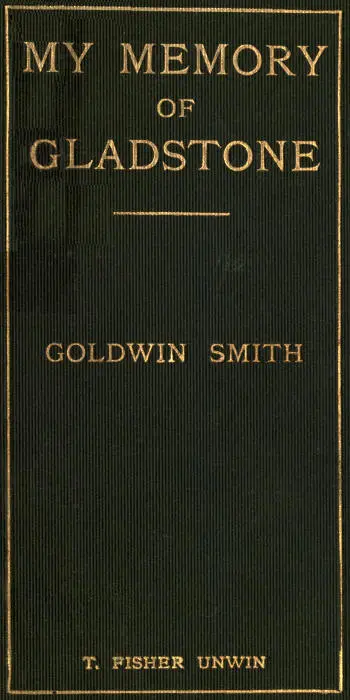
My Memory of Gladstone
Goldwin Smith
THE CLASSIC COLLECTION · 1881
"Lectures and Essays" by Goldwin Smith is a historical and political collection of writings produced during the late 19th century. This compilation focuses on various topics, including the analysis of historical events, literature, and the impact of certain figures on society, revealing an interest in Canada’s literary contributions and reflections on political themes. At the start of the work, the prefatory note outlines Smith's intent to compile these essays and lectures for friends who have expressed interest in previously published materials. The opening essay, titled "The Greatness of the Romans," delves into the factors that contributed to Rome's rise to power while questioning the traditional narratives that attribute their success primarily to military might. Smith argues for a deeper examination of geographical advantages, the evolution of political structures, and the significance of discipline in warfare, setting the stage for discussions that would shed light on the broader nature of historical interpretation and its relevance to contemporary society.
Introduction adapted from the source catalogue; source summaries may be automatically generated.
Free to read · English · 147,186 words · No account needed
MAKE TIME FOR A GOOD BOOK
On by default. Untick to stop anonymous reading totals. Each page counts after 10 seconds in view. How this works.
Anonymous counting is on unless you have switched it off.
Shadows and figments, as they appear to us to be in themselves these attempts to provide a substitute for religion are of the highest importance, as showing that men of great powers of mind, who have thoroughly broken loose not only from Christianity but from natural religion and in some cases placed themselves in violent antagonism to both, are still unable to divest themselves of the religious sentiment or to appease its craving for satisfaction. There being no God, they find it necessary, as Voltaire predicted it would be, to invent one, not for the purposes of police (they are far above such sordid Jesuitism), but as the solution of the otherwise hopeless enigma of our spiritual nature. Science takes cognizance of all phenomena, and this apparently ineradicable tendency of the human mind is a phenomenon like the rest. The thoroughgoing Materialist, of course, escapes all these philosophical exigencies, but he does it by denying Humanity as well as God and reducing the difference between the organism of the human animal and that of any other animal to a mere question of complexity. Still, even in this quarter, there has appeared of late a disposition to make concessions on the subject of human volition hardly consistent with Materialism. Nothing can be more likely than that the impetus of great discoveries has carried the discoverers too far.
Perhaps with the promptings of the religious sentiment there is combined a sense of the immediate danger with which the failure of the religious sanction threatens social order and morality. As we have said already, the men of whom we specially speak are far above anything like social Jesuitism. We have not a doubt but they would regard with abhorrence any schemes of oligarchic illuminism for guarding the pleasures of the few by politic deception of the multitude. But they have probably begun to lay to heart the fact that the existing morality, though not dependent on any special theology, any special view of the relations between soul and body, or any special theory of future rewards and punishments, is largely dependent on a belief in the indefeasible authority of conscience, and in that without which conscience can have no indefeasible authority--the presence of a just and all-seeing God. It may be true that in primaeval society these beliefs are found only in the most rudimentary form, and, as social sanctions, are very inferior in force to mere gregarious instincts or the pressure of tribal need. But man emerges from the primaeval state, and when he does, he demands a reason for his submission to moral law. That the leaders of the anti- theological movement in the present day are immoral, nobody but the most besotted fanatic would insinuate; no candid antagonist would deny that some of them are in every respect the very best of men. The fearless love of truth is usually accompanied by other high qualities; and nothing could be more unlikely than that natures disposed to virtue, trained under good influences, peculiarly sensitive to opinion and guarded by intellectual tastes, would lapse into vice as soon as the traditional sanction was removed. But what is to prevent the withdrawal of the traditional sanction from producing its natural effect upon the morality of the mass of mankind? The commercial swindler or the political sharper, when the divine authority of conscience is gone, will feel that he has only the opinion of society to reckon with, and he knows how to reckon with the opinion of society. If Macbeth is ready, provided he can succeed in this world, to "jump the life to come," much more ready will villainy be to "jump" the bad consequences of its actions to humanity when its own conscious existence shall have closed. Rate the practical effect of religious beliefs as low and that of social influences as high as you may, there can surely be no doubt that morality has received some support from the authority of an inward monitor regarded as the voice of God. The worst of men would have wished to die the death of the righteous; he would have been glad, if he could, when death approached, to cancel his crimes; and the conviction, or misgiving, which this implied, could not fail to have some influence upon the generality of mankind, though no doubt the influence was weakened rather than strengthened by the extravagant and incredible form in which the doctrine of future retribution was presented by the dominant theology.
Your reading position is saved on this browser. Take it to another device with a library code. Reading pages adapt to text, rather than matching a printed edition.
Goldwin Smith
Goldwin Smith
Goldwin Smith
Goldwin Smith
BEHIND THE BOOK
This eBook is for the use of anyone anywhere in the United States and most other parts of the world at no cost and with almost no restrictions whatsoever. You may copy it, give it away or re-use it under the terms of the Project Gutenberg License included with this eBook or online at www.gutenberg.org. If you are not located in the United States, you will have to check the laws of the country where you are located before using this eBook. Read the source licence.
The original source file, including credits and licence, is retained by this library. Request an original-format copy at no charge. Please include the book title and Project Gutenberg identifier #6570.
KEEP YOUR CURIOSITY GOING

David Patterson (Spirit) Hatch

David Patterson (Spirit) Hatch

David Patterson (Spirit) Hatch
Cécile Tormay

Moritz Busch
John L. Ransom