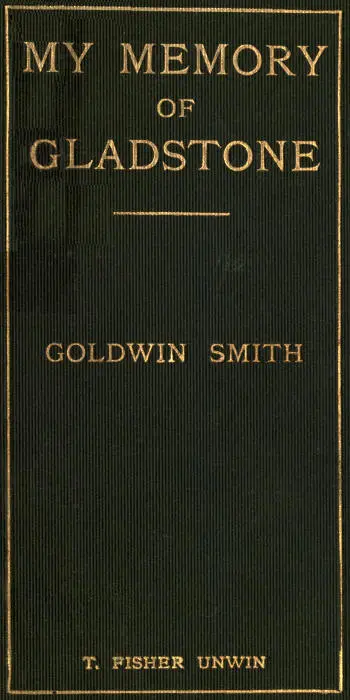
My Memory of Gladstone
Goldwin Smith
THE CLASSIC COLLECTION · 1881
"Lectures and Essays" by Goldwin Smith is a historical and political collection of writings produced during the late 19th century. This compilation focuses on various topics, including the analysis of historical events, literature, and the impact of certain figures on society, revealing an interest in Canada’s literary contributions and reflections on political themes. At the start of the work, the prefatory note outlines Smith's intent to compile these essays and lectures for friends who have expressed interest in previously published materials. The opening essay, titled "The Greatness of the Romans," delves into the factors that contributed to Rome's rise to power while questioning the traditional narratives that attribute their success primarily to military might. Smith argues for a deeper examination of geographical advantages, the evolution of political structures, and the significance of discipline in warfare, setting the stage for discussions that would shed light on the broader nature of historical interpretation and its relevance to contemporary society.
Introduction adapted from the source catalogue; source summaries may be automatically generated.
Free to read · English · 147,186 words · No account needed
MAKE TIME FOR A GOOD BOOK
On by default. Untick to stop anonymous reading totals. Each page counts after 10 seconds in view. How this works.
Anonymous counting is on unless you have switched it off.
Cicero, though he suffered from the imperious temper of Brutus, speaks of him as one of those, the sight of whom banished his fears and anxieties for the republic. That the most famous and most terrible act of this man's life was an act of republican fanaticism, not of selfish ambition, is proved by his refusing, with magnanimous imprudence, to make all sure, as the more worldly spirits about him suggested, by cutting off Antony and the outer leading partisans of Caesar, and by his permitting public honours to be done to the corpse of the man whom he had immolated to civil duty. One almost shrinks from speaking of the death of Caesar; so much modern nonsense on both sides has been talked about this, the most tragic, the most piteous, and at the same time the most inevitable event of ancient story. Peculiar phases of society have their peculiar sentiments, with reference to which events must be explained. The greased cartridges were the real account of the Indian mutiny. Caesar was slain because he had shown that he was going to assume the title of king. Cicero speaks the literal truth, when he says: that the real murderer was Antony, and the fatal day the day of the Lupercalia, when Antony offered and Caesar faintly put aside the crown. A dictator they would have borne, a king they would not bear, neither then nor for ages afterwards; because the title of king to their minds spoke not of a St. Louis, or an Edward I., or even a Louis XIV., but of the unutterable degradation of the Oriental slave. To use a homely image, if you put your leg in the way of a cannon ball which seems spent, but is still rolling, you will suffer by the experiment. This is exactly what Caesar, in the giddiness of victory and supremacy, did, and the consequence was as certain as it was deplorable. The republican sentiment seemed to him to have entirely lost its force, so that he might spurn it with impunity; whereas, it had in it still enough of the momentum gathered through centuries of republican training and glory to destroy him, to restore the republic for a brief period, and to make victory doubtful at Phillipi. He began by celebrating a triumph over his fellow-citizens, against the generous tradition of Rome: in that triumph he displayed pictures of the tragic deaths of Cato and other Roman chiefs, which disgusted even the populace; he sported with the curule offices, the immemorial objects of republican reverence, so wantonly that he might almost as well have given a consulship to his horse; he flooded the Senate with soldiers and barbarians; he forced a Roman knight to appear upon the stage: at last, craving, as natures destitute of a high controlling principle do crave, for the form as well as the substance of power, he put out his hand to grasp a crown. The feeling on that subject was not only of terrible strength, but was actually embodied in a law by which the state solemnly armed the hand of the private citizen against any man who should attempt to make himself a king. How completely Caesar's insight failed him is proved by the general acquiescence or apathy with which his fall was received, the subdued tone in which even his warm friend Marius speaks of it, and the readiness with which his own soldiers and officers served under the restored republic. We have nothing to do here with any problem of modern ethics respecting military usurpation and tyrannicide, two things which must always stand together in the court of morality. Tyrannicide, like suicide, was the rule of the ancient world, and would have been acknowledged by Caesar himself, before he grasped supreme power, as an established duty. And certainly morality would stretch its bounds to include anything really necessary to protect the Greek and Italian republics, with the treasures which they bore in them for humanity, from the barbarous lust of power which was always lying in wait to devour them. I have said that the spirits of Cato and Cicero lived and worked after their deaths. So I suspect did that of Brutus. The Caesars had no God, no fear of public opinion at home, no general sentiment of civilized nations to control their tyranny. They had only the shadow of a hand armed with a dagger. One shrewd observer of the times at least, if I mistake not, had profited by the lesson of Caesar's folly and fate. To the constitutional demeanour and personal moderation of Augustus the world owes an epoch of grandeur of a certain kind, and an example of true dignity in the use of power. And Augustus, I suspect, had studied his part at the foot of Pompey's statue.
Your reading position is saved on this browser. Take it to another device with a library code. Reading pages adapt to text, rather than matching a printed edition.
Goldwin Smith
Goldwin Smith
Goldwin Smith
Goldwin Smith
BEHIND THE BOOK
This eBook is for the use of anyone anywhere in the United States and most other parts of the world at no cost and with almost no restrictions whatsoever. You may copy it, give it away or re-use it under the terms of the Project Gutenberg License included with this eBook or online at www.gutenberg.org. If you are not located in the United States, you will have to check the laws of the country where you are located before using this eBook. Read the source licence.
The original source file, including credits and licence, is retained by this library. Request an original-format copy at no charge. Please include the book title and Project Gutenberg identifier #6570.
KEEP YOUR CURIOSITY GOING

David Patterson (Spirit) Hatch

David Patterson (Spirit) Hatch

David Patterson (Spirit) Hatch
Cécile Tormay

Moritz Busch
John L. Ransom