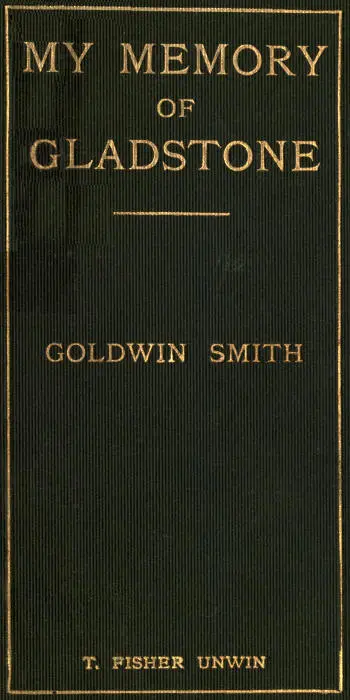
My Memory of Gladstone
Goldwin Smith
THE CLASSIC COLLECTION · 1881
"Lectures and Essays" by Goldwin Smith is a historical and political collection of writings produced during the late 19th century. This compilation focuses on various topics, including the analysis of historical events, literature, and the impact of certain figures on society, revealing an interest in Canada’s literary contributions and reflections on political themes. At the start of the work, the prefatory note outlines Smith's intent to compile these essays and lectures for friends who have expressed interest in previously published materials. The opening essay, titled "The Greatness of the Romans," delves into the factors that contributed to Rome's rise to power while questioning the traditional narratives that attribute their success primarily to military might. Smith argues for a deeper examination of geographical advantages, the evolution of political structures, and the significance of discipline in warfare, setting the stage for discussions that would shed light on the broader nature of historical interpretation and its relevance to contemporary society.
Introduction adapted from the source catalogue; source summaries may be automatically generated.
Free to read · English · 147,186 words · No account needed
MAKE TIME FOR A GOOD BOOK
On by default. Untick to stop anonymous reading totals. Each page counts after 10 seconds in view. How this works.
Anonymous counting is on unless you have switched it off.
Fundamentally, value determines the price the community will give for any article, or any kind of work, just so much as it is worth. But there is no economical deity who, in each individual case, exactly adjusts the price to the value; we may make a good or a bad bargain, as many of us know to our cost. One source of bad bargains is ignorance. Before unions, which have diffused the intelligence of the labour market, and by so doing have equalized prices, the workman hardly knew the rate of wages in the next town. If this was true of the mechanic, it was still more true of the farm labourer. Practically speaking, the farm labourers in each parish of England, ignorant of everything beyond the parish, isolated and, therefore, dependent, had to take what the employers chose to give them. And what the employers chose to give them over large districts was ten shillings a week for themselves and their families, out of which they paid, perhaps, eighteen-pence for rent. A squire the other day, at a meeting of labourers, pointed with pride, and no doubt, with honest pride, to a labourer who had brought up a family of twelve children on twelve shillings a week I will venture to say the squire spent as much on any horse in his stables. Meat never touched the peasant's lips, though game, preserved for his landlord's pleasure, was running round his cottage. His children could not be educated, because they were wanted, almost from their infancy, to help in keeping the family from starving, as stonepickers, or perambulating scarecrows. His abode was a hovel, in which comfort, decency, morality could not dwell; and it was mainly owing to this cause that, as I have heard an experienced clergyman say, even the people in the low quarters of cities were less immoral than the rural poor. How the English peasants lived on such wages as they had, was a question which puzzled the best informed. How they died was clear enough; as penal paupers in a union workhouse. Yet Hodge's back, like that of Jacques Bonhomme, in France, bore everything, bore the great war against Republican France; for the squires and rectors, who made that war for class purposes, got their taxes back in increased rents and tithes. How did the peasantry exist, what was their condition in those days when wheat was at a hundred, or even a hundred and thirty shillings? They were reduced to a second serfage. They became in the mass parish paupers, and were divided, like slaves, among the employers of each parish. Men may be made serfs, and even slaves by other means than open force, in a country where, legally, all are free, where the impossibility of slavery is the boast of the law. Of late benevolence has been, abroad in the English parish, almsgiving and visiting have increased, good landlords have taken up cottage improvements. There have been harvest-homes, at which the young squires have danced with cottagers. But now Hodge has taken the matter into his own hands, and it seems not without effect. In a letter which I have seen, a squire says, "Here the people are all contented; we (the employers) have seen the necessity of raising their wages." Conservative journals begin to talk of measures for the compulsory improvement of cottages, for limiting ground game, giving tenant right to farmers, granting the franchise to rural householders. Yes, in consequence, partly, at least of this movement, the dwellings and the general conditions of the English peasantry will be improved, the game laws will be abolished; the farmers pressed upon from below, and in their turn pressing upon those above, will demand and obtain tenant right; and the country, as well as the city householders will be admitted to the franchise, which, under the elective system, is at once the only guarantee for justice to him and for his loyalty to the State. And when the country householder has the suffrage there will soon be an end of those laws of primogeniture and entail, which are deemed so Conservative, but are in fact most revolutionary, since they divorce the nation from its own soil. And then there will be a happier and a more United England in country as well as in town: the poor law, the hateful, degrading, demoralizing poor law will cease to exist; the huge poor- house will no longer darken the rural landscape with its shadow, in hideous contrast with the palace. Suspicion and hatred will no more cower and mutter over the cottage hearth, or round the beer-house fire: the lord of the mansion will no longer be like the man in Tennyson slumbering while a lion is always creeping nearer. Lord Malmesbury is astonished at this disturbance. He always thought the relation between the lord and the pauper peasant was the happiest possible; he cannot conceive what people mean by proposing a change. But then Lord Malmesbury was placed at rather a delusive point of view. If he knew the real state of Hodge's heart he would rejoice in the prospect of a change, not only for Hodge's sake, but, as he is no doubt a good man, for his own. England will be more religious, too, as well as happier and more harmonious, let the clergy be well assured of it. Social injustice especially when backed by the Church, is unfavourable to popular religion.
Your reading position is saved on this browser. Take it to another device with a library code. Reading pages adapt to text, rather than matching a printed edition.
Goldwin Smith
Goldwin Smith
Goldwin Smith
Goldwin Smith
BEHIND THE BOOK
This eBook is for the use of anyone anywhere in the United States and most other parts of the world at no cost and with almost no restrictions whatsoever. You may copy it, give it away or re-use it under the terms of the Project Gutenberg License included with this eBook or online at www.gutenberg.org. If you are not located in the United States, you will have to check the laws of the country where you are located before using this eBook. Read the source licence.
The original source file, including credits and licence, is retained by this library. Request an original-format copy at no charge. Please include the book title and Project Gutenberg identifier #6570.
KEEP YOUR CURIOSITY GOING

David Patterson (Spirit) Hatch

David Patterson (Spirit) Hatch

David Patterson (Spirit) Hatch
Cécile Tormay

Moritz Busch
John L. Ransom