THE CLASSIC COLLECTION✦Rocky ForkCLASSIC FREE BOOKS
Rocky Fork
Mary Hartwell Catherwood
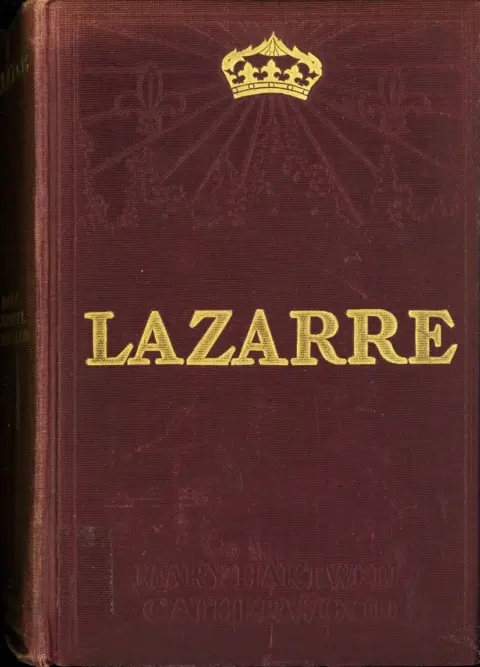
THE CLASSIC COLLECTION · 1901
"Lazarre" by Mary Hartwell Catherwood is a historical novel written in the late 19th century. The story is set against the backdrop of the aftermath of the French Revolution and centers around the character of Lazarre Williams, a young man of mixed heritage, whose identity and past are shrouded in mystery. The novel explores themes of class, identity, and the intersection of different cultures, as Lazarre navigates his position between his Native American upbringing and the courtly expectations of European nobility. The beginning of the novel introduces us to the intriguing world of London in 1795, where young Eagle de Ferrier encounters a silent boy, who is revealed to be the lost Dauphin of France, a child once thought dead. As she interacts with him, we witness the prejudices and tensions between the French émigrés and the English, particularly through the lens of two British women who express disdain for the French. The narrative then shifts to provide a glimpse of Lazarre's awakening, detailing his consciousness amid the conflicting cultures and identities he embodies. As he grapples with his scars and past, the opening sets the stage for a profound exploration of his journey towards discovering who he truly is amidst the chaos of his heritage.
Introduction adapted from the source catalogue; source summaries may be automatically generated.
Free to read · English · 100,097 words · No account needed
MAKE TIME FOR A GOOD BOOK
On by default. Untick to stop anonymous reading totals. Each page counts after 10 seconds in view. How this works.
Anonymous counting is on unless you have switched it off.
"Let us first come to the dauphin. When dauphins are as plentiful as blackberries in France and the court never sees a beggar appear without exclaiming: 'Here comes another dauphin!'--why, may I ask, is Abbe Edgeworth sent so far to seek one?"
He smiled.
"We are supposing that Monseigneur, in whose presence I have the honor to be, is the true dauphin."
"That being the case, how are we to account for the true dauphin's
reception at Mittau?"
"The gross stupidity and many blunders of agents that the court was obliged to employ, need hardly be assumed."
"Poor Bellenger! He has to take abuse from both sides in order that we may be polite to each other."
"As Monseigneur suggests, we will not go into that matter."
Eagle sat as erect as a statue and as white.
I felt an instant's anxiety. Yet she had herself entirely at command.
"We have now arrived at the paper, I trust," said the priest.
"The message?"
"Oh, no. The paper in which you resign all claim to the throne of
France, and which may give you the price of a principality in this
country."
"I do not sign any such paper."
"Not at all?"
"Not at all."
"You are determined to hold to your rights?"
"I am determined not to part with my rights."
"Inducements large enough might be offered." He paused suggestively.
"The only man in France," I said, "empowered to treat for abdication of the throne at present, is Napoleon Bonaparte. Did you bring a message from him?"
Abbe Edgeworth winced, but laughed.
"Napoleon Bonaparte will not last. All Europe is against him. I see we have arrived at the message."
He rose and handed me the paper he held in his hand. I rose and received it, and read it standing.
It was one brief line:--
"Louis: You are recalled.
Marie-Therese."
The blood must have rushed over my face. I had a submerged feeling, looking out of it at the priest.
"Well, Monseigneur?"
"It is like her heavenly goodness."
"Do you see nothing but her heavenly goodness in it?"
"This is the message?"
"It is a message I crossed the ocean to bring."
"With the consent of her uncle?"
"Madame d'Angouleme never expresses a wish contrary to the wishes of his
majesty."
"We are then to suppose that Louis XVIII offers me, through you, monsieur, the opportunity to sign away my rights, and failing that, the opportunity of taking them?"
"Supposing you are Monseigneur the dauphin, we will let our supposition
run as far as this."
Your reading position is saved on this browser. Take it to another device with a library code. Reading pages adapt to text, rather than matching a printed edition.
Mary Hartwell Catherwood
Mary Hartwell Catherwood
Mary Hartwell Catherwood
Mary Hartwell Catherwood
BEHIND THE BOOK
This eBook is for the use of anyone anywhere in the United States and most other parts of the world at no cost and with almost no restrictions whatsoever. You may copy it, give it away or re-use it under the terms of the Project Gutenberg License included with this eBook or online at www.gutenberg.org. If you are not located in the United States, you will have to check the laws of the country where you are located before using this eBook. Read the source licence.
The original source file, including credits and licence, is retained by this library. Request an original-format copy at no charge. Please include the book title and Project Gutenberg identifier #15108.
KEEP YOUR CURIOSITY GOING
Cécile Tormay

Moritz Busch
Coulson Kernahan
John L. Ransom

Maurice Baring
Frances Wright