THE CLASSIC COLLECTION✦Rocky ForkCLASSIC FREE BOOKS
Rocky Fork
Mary Hartwell Catherwood
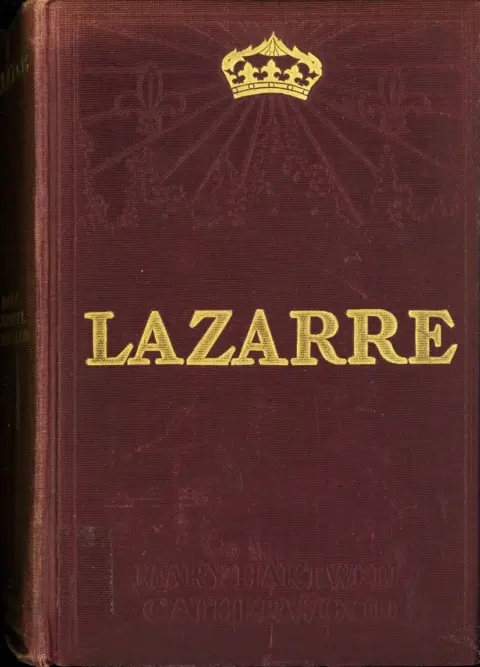
THE CLASSIC COLLECTION · 1901
"Lazarre" by Mary Hartwell Catherwood is a historical novel written in the late 19th century. The story is set against the backdrop of the aftermath of the French Revolution and centers around the character of Lazarre Williams, a young man of mixed heritage, whose identity and past are shrouded in mystery. The novel explores themes of class, identity, and the intersection of different cultures, as Lazarre navigates his position between his Native American upbringing and the courtly expectations of European nobility. The beginning of the novel introduces us to the intriguing world of London in 1795, where young Eagle de Ferrier encounters a silent boy, who is revealed to be the lost Dauphin of France, a child once thought dead. As she interacts with him, we witness the prejudices and tensions between the French émigrés and the English, particularly through the lens of two British women who express disdain for the French. The narrative then shifts to provide a glimpse of Lazarre's awakening, detailing his consciousness amid the conflicting cultures and identities he embodies. As he grapples with his scars and past, the opening sets the stage for a profound exploration of his journey towards discovering who he truly is amidst the chaos of his heritage.
Introduction adapted from the source catalogue; source summaries may be automatically generated.
Free to read · English · 100,097 words · No account needed
MAKE TIME FOR A GOOD BOOK
On by default. Untick to stop anonymous reading totals. Each page counts after 10 seconds in view. How this works.
Anonymous counting is on unless you have switched it off.
"They thought General Harrison was coming," laughed Croghan, as he sat down to an early breakfast, having relieved all the living in the trench and detailed men to bury the dead. "We have lost one man, and have another under the surgeon's hands. Now I'm ready to appear before a court-martial for disobeying orders."
"You mean you're ready for your immortal page in history."
"Paragraph," said Croghan; "and the dislike of poor little boys and girls who will stick their fists in their eyes when they have to learn it at school."
Intense manhood ennobled his long, animated face. The President afterwards made him a lieutenant-colonel, and women and his superior officers praised him; but he was never more gallant than when he said:
"My uncle, George Rogers Clark, would have undertaken to hold this fort; and by heavens, we were bound to try it!"
The other young officers sat at mess with him, hilarious over the outcome, picturing General Proctor's state of mind when he learned the age of his conqueror.
None of them cared a rap that Daniel Webster was opposing the war in the House of Representatives at Washington, and declaring that on land it was a failure.
A subaltern came to the mess room door, touching his cap and asking to
speak with Major Croghan.
"The men working outside at the trenches saw a boy come up from the ravine, sir, and fall every few steps, so they've brought him in."
"Does he carry a dispatch?"
"No, sir. He isn't more than nine or ten years old. I think he was a
prisoner."
"Is he a white boy?"
"Yes, sir, but he's dressed like an Indian."
"I think it unlikely the British would allow the Shawanoes to burden their march with any prisoners."
"Somebody had him, and I'm afraid he's been shot either during the action or in the retreat. He was hid in the ravine."
"Bring him here," said Croghan.
A boy with blue eyes set wide apart, hair clinging brightly and moistly to his pallid forehead, and mouth corners turning up in a courageous smile, entered and stood erect before the officer. He was a well made little fellow. His tiny buckskin hunting shirt was draped with a sash in the Indian fashion, showing the curve of his naked hip. Down this a narrow line of blood was moving. Children of refugees, full of pity, looked through the open door behind him.
"Go to him, Shipp," said Croghan, as the boy staggered. But he waved the
ensign back.
"Who are you, my man?" asked the Major.
"I believe," he answered, "I am the Marquis de Ferrier."
Your reading position is saved on this browser. Take it to another device with a library code. Reading pages adapt to text, rather than matching a printed edition.
Mary Hartwell Catherwood
Mary Hartwell Catherwood
Mary Hartwell Catherwood
Mary Hartwell Catherwood
BEHIND THE BOOK
This eBook is for the use of anyone anywhere in the United States and most other parts of the world at no cost and with almost no restrictions whatsoever. You may copy it, give it away or re-use it under the terms of the Project Gutenberg License included with this eBook or online at www.gutenberg.org. If you are not located in the United States, you will have to check the laws of the country where you are located before using this eBook. Read the source licence.
The original source file, including credits and licence, is retained by this library. Request an original-format copy at no charge. Please include the book title and Project Gutenberg identifier #15108.
KEEP YOUR CURIOSITY GOING
Cécile Tormay

Moritz Busch
Coulson Kernahan
John L. Ransom

Maurice Baring
Frances Wright