THE CLASSIC COLLECTION✦Rocky ForkCLASSIC FREE BOOKS
Rocky Fork
Mary Hartwell Catherwood
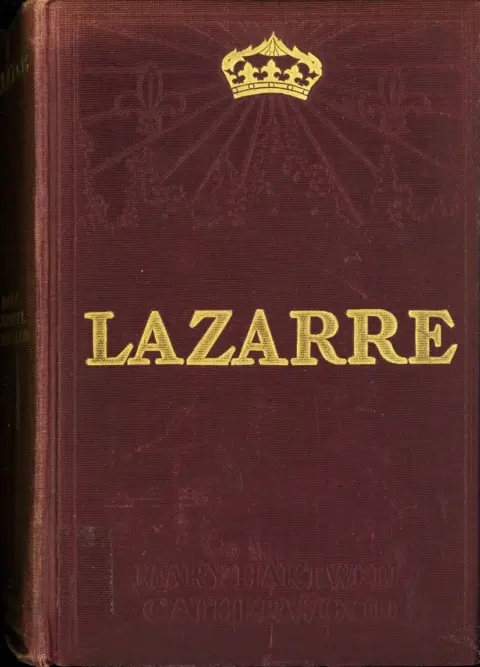
THE CLASSIC COLLECTION · 1901
"Lazarre" by Mary Hartwell Catherwood is a historical novel written in the late 19th century. The story is set against the backdrop of the aftermath of the French Revolution and centers around the character of Lazarre Williams, a young man of mixed heritage, whose identity and past are shrouded in mystery. The novel explores themes of class, identity, and the intersection of different cultures, as Lazarre navigates his position between his Native American upbringing and the courtly expectations of European nobility. The beginning of the novel introduces us to the intriguing world of London in 1795, where young Eagle de Ferrier encounters a silent boy, who is revealed to be the lost Dauphin of France, a child once thought dead. As she interacts with him, we witness the prejudices and tensions between the French émigrés and the English, particularly through the lens of two British women who express disdain for the French. The narrative then shifts to provide a glimpse of Lazarre's awakening, detailing his consciousness amid the conflicting cultures and identities he embodies. As he grapples with his scars and past, the opening sets the stage for a profound exploration of his journey towards discovering who he truly is amidst the chaos of his heritage.
Introduction adapted from the source catalogue; source summaries may be automatically generated.
Free to read · English · 100,097 words · No account needed
MAKE TIME FOR A GOOD BOOK
On by default. Untick to stop anonymous reading totals. Each page counts after 10 seconds in view. How this works.
Anonymous counting is on unless you have switched it off.
"This journey to Mittau changes nothing. You were wilful. You would go to the island in Lake George: you would go to Mittau."
"Both times you sent me."
"Both times I brought you home! Let us not be sorrowful to-night."
"Sorrowful! I am so happy it seems impossible that I come from Mittau, and this day the Marquis du Plessy died to me! I wish the sun had been tied to the trees, as the goose girl tied her gander."
"But I want another day," said Eagle. "I want all the days that are my
due at home."
We ascended the steps of the stone pavilion, and sat down in an arch like a balcony over the sunken garden. Pears and apricots, their branches flattened against the wall, showed ruddy garnered sunlight through the dusk. The tangled enclosure sloped down to the stream, from which a fairy wisp of mist wavered over flower bed and tree. Dew and herbs and the fragrance of late roses sent up a divine breath, invisibly submerging us, like a tide rising out of the night.
Madame de Ferrier's individual traits were surprised in this nearness, as they never had been when I saw her at a distance in alien surroundings. A swift ripple, involuntary and glad, coursed down her body; she shuddered for joy half a minute or so.
Two feet away, I worshiped her smiling eyes and their curved ivory lids, her rounded head with its abundant cap of hair, her chin, her shoulders, her bust, the hands in her lap, the very sweep of her scant gown about her feet.
The flash of extreme happiness passing, she said gravely,
"But that was a strange thing--that you should fall unconscious!"
"Not so strange," I said; and told her how many times before the eclipse--under the edge of which my boyhood was passed--had completely shadowed me. At the account of Ste. Pelagie she leaned toward me, her hands clenched on her breast. When we came to the Hotel Dieu she leaned back pallid against the stone.
"Dear Marquis du Plessy!" she whispered, as his name entered the story.
When it was ended she drew some deep breaths in the silence.
"Sire, you must be very careful. That Bellenger is an evil man."
"But a weak one."
"There may be a strength of court policy behind him."
"The policy of the court at Mittau is evidently a policy of denial."
"Your sister believed in you."
"Yes, she believed in me."
"I don't understand," said Madame de Ferrier, leaning forward on her
arms, "why Bellenger had you in London, and another boy on the
mountain."
"Perhaps we shall never understand it."
Your reading position is saved on this browser. Take it to another device with a library code. Reading pages adapt to text, rather than matching a printed edition.
Mary Hartwell Catherwood
Mary Hartwell Catherwood
Mary Hartwell Catherwood

Mary Hartwell Catherwood
BEHIND THE BOOK
This eBook is for the use of anyone anywhere in the United States and most other parts of the world at no cost and with almost no restrictions whatsoever. You may copy it, give it away or re-use it under the terms of the Project Gutenberg License included with this eBook or online at www.gutenberg.org. If you are not located in the United States, you will have to check the laws of the country where you are located before using this eBook. Read the source licence.
The original source file, including credits and licence, is retained by this library. Request an original-format copy at no charge. Please include the book title and Project Gutenberg identifier #15108.
KEEP YOUR CURIOSITY GOING
Cécile Tormay

Moritz Busch
Coulson Kernahan
John L. Ransom

Maurice Baring
Frances Wright