THE CLASSIC COLLECTION✦Rocky ForkCLASSIC FREE BOOKS
Rocky Fork
Mary Hartwell Catherwood
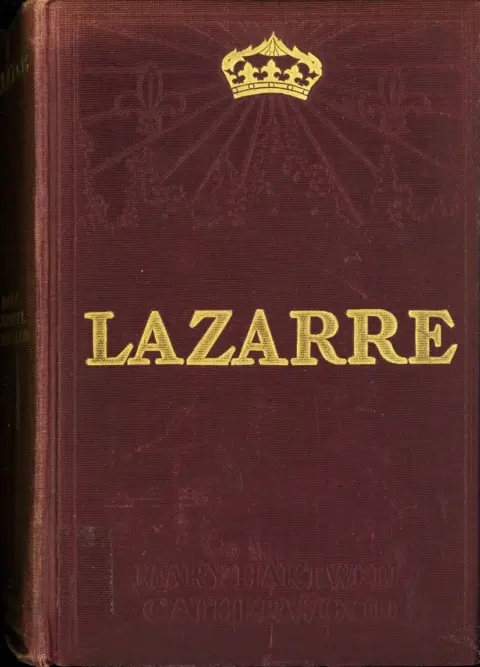
THE CLASSIC COLLECTION · 1901
"Lazarre" by Mary Hartwell Catherwood is a historical novel written in the late 19th century. The story is set against the backdrop of the aftermath of the French Revolution and centers around the character of Lazarre Williams, a young man of mixed heritage, whose identity and past are shrouded in mystery. The novel explores themes of class, identity, and the intersection of different cultures, as Lazarre navigates his position between his Native American upbringing and the courtly expectations of European nobility. The beginning of the novel introduces us to the intriguing world of London in 1795, where young Eagle de Ferrier encounters a silent boy, who is revealed to be the lost Dauphin of France, a child once thought dead. As she interacts with him, we witness the prejudices and tensions between the French émigrés and the English, particularly through the lens of two British women who express disdain for the French. The narrative then shifts to provide a glimpse of Lazarre's awakening, detailing his consciousness amid the conflicting cultures and identities he embodies. As he grapples with his scars and past, the opening sets the stage for a profound exploration of his journey towards discovering who he truly is amidst the chaos of his heritage.
Introduction adapted from the source catalogue; source summaries may be automatically generated.
Free to read · English · 100,097 words · No account needed
MAKE TIME FOR A GOOD BOOK
On by default. Untick to stop anonymous reading totals. Each page counts after 10 seconds in view. How this works.
Anonymous counting is on unless you have switched it off.
Abbe Edgeworth, fine and sweet of presence, stood by the king, facing Bellenger and the idiot. That poor creature, astonished by his environment, gazed at the high room corners, or smiled experimentally at the courtiers, stretching his cracked lips over darkened fangs.
"You are admitted here, Bellenger," said the priest, "to answer his Majesty's questions in the presence of witnesses."
"I thank his Majesty," said Bellenger.
The abbe began as if the idiot attracted his notice for the first time.
"Who is the unfortunate child you hold with your right hand?"
"The dauphin of France, monsieur the abbe," spoke out Bellenger, his
left hand on his hip.
"What! Take care what you say! How do you know that the dauphin of France is yet among the living?"
Bellenger's countenance changed, and he took his hand off his hip and
let it hang down.
"I received the prince, monsieur, from those who took him out of the
Temple prison."
"And you never exchanged him for another person, or allowed him to be
separated from you?"
Bellenger swore with ghastly lips--"Never, on my hopes of salvation,
monsieur the abbe!"
"Admitting that somebody gave you this child to keep--by the way, how
old is he?"
"About twenty years, monsieur."
"What right had you to assume he was the dauphin?"
"I had received a yearly pension, monsieur, from his Majesty himself, for the maintenance of the prince."
"You received the yearly pension through my hand, acting as his Majesty's almoner, His Majesty was ever too bountiful to the unfortunate. He has many dependents. Where have you lived with your charge?"
"We lived in America, sometimes in the woods; and sometimes in towns."
"Has he ever shown hopeful signs of recovering his reason?"
"Never, monsieur the abbe."
Having touched thus lightly on the case of the idiot, Abbe Edgeworth
turned to me.
The king's face retained its granite hardness. But Bellenger's passed from shade to shade of baffled confidence; recovering only when the priest said,
"Now look at this young man. Have you ever seen him before?"
"Yes, monsieur, I have; both in the American woods, and in Paris."
"What was he doing in the American woods?"
"Living on the bounty of one Count de Chaumont, a friend of
Bonaparte's."
"Who is he?"
"A French half-breed, brought up among the Indians."
"What name does he bear?"
"He is called Lazarre."
"But why is a French half-breed named Lazarre attempting to force himself on the exiled court here in Mittau?"
"People have told him that he resembles the Bourbons, monsieur."
"Was he encouraged in this idea by the friend of Bonaparte whom you
mentioned?"
Your reading position is saved on this browser. Take it to another device with a library code. Reading pages adapt to text, rather than matching a printed edition.
Mary Hartwell Catherwood
Mary Hartwell Catherwood
Mary Hartwell Catherwood

Mary Hartwell Catherwood
BEHIND THE BOOK
This eBook is for the use of anyone anywhere in the United States and most other parts of the world at no cost and with almost no restrictions whatsoever. You may copy it, give it away or re-use it under the terms of the Project Gutenberg License included with this eBook or online at www.gutenberg.org. If you are not located in the United States, you will have to check the laws of the country where you are located before using this eBook. Read the source licence.
The original source file, including credits and licence, is retained by this library. Request an original-format copy at no charge. Please include the book title and Project Gutenberg identifier #15108.
KEEP YOUR CURIOSITY GOING
Cécile Tormay

Moritz Busch
Coulson Kernahan
John L. Ransom

Maurice Baring
Frances Wright