THE CLASSIC COLLECTION✦Rocky ForkCLASSIC FREE BOOKS
Rocky Fork
Mary Hartwell Catherwood
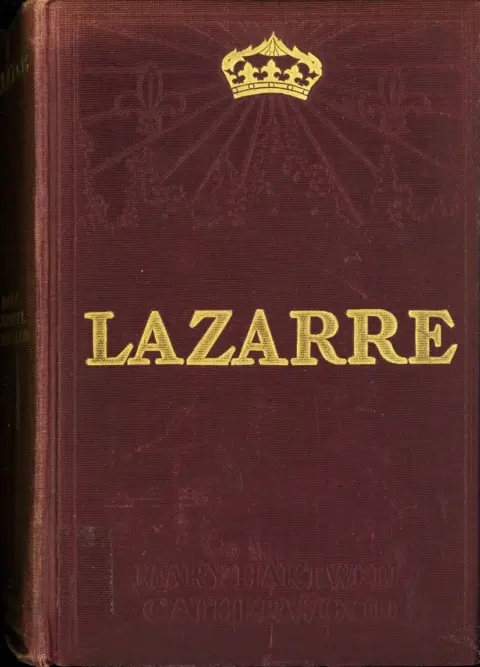
THE CLASSIC COLLECTION · 1901
"Lazarre" by Mary Hartwell Catherwood is a historical novel written in the late 19th century. The story is set against the backdrop of the aftermath of the French Revolution and centers around the character of Lazarre Williams, a young man of mixed heritage, whose identity and past are shrouded in mystery. The novel explores themes of class, identity, and the intersection of different cultures, as Lazarre navigates his position between his Native American upbringing and the courtly expectations of European nobility. The beginning of the novel introduces us to the intriguing world of London in 1795, where young Eagle de Ferrier encounters a silent boy, who is revealed to be the lost Dauphin of France, a child once thought dead. As she interacts with him, we witness the prejudices and tensions between the French émigrés and the English, particularly through the lens of two British women who express disdain for the French. The narrative then shifts to provide a glimpse of Lazarre's awakening, detailing his consciousness amid the conflicting cultures and identities he embodies. As he grapples with his scars and past, the opening sets the stage for a profound exploration of his journey towards discovering who he truly is amidst the chaos of his heritage.
Introduction adapted from the source catalogue; source summaries may be automatically generated.
Free to read · English · 100,097 words · No account needed
MAKE TIME FOR A GOOD BOOK
On by default. Untick to stop anonymous reading totals. Each page counts after 10 seconds in view. How this works.
Anonymous counting is on unless you have switched it off.
A little man, that I did not know was in the room, shuffled across the floor to keep my father from entering. Around the base of his head he had a thin curtain of hair scarcely reaching his shoulders. His nose pointed upward. Its tip was the shape of a candle extinguisher. He wore horn spectacles; and knee breeches, waistcoat and coat of black like the ink which fades to brown in a drying ink-horn. He put his hands together and took them apart uncertainly, and shot out his lip and frowned, as if he had an universal grudge and dared not vent it.
He said something in a language I did not understand, and my father made no answer. Then he began a kind of Anglo-French, worse than the patois we used at St. Regis when we did not speak Iroquois. I made out the talk between the two, understanding each without hesitation.
"Sir, who are you?"
"The chief, Thomas Williams," answered my father.
"Pardon me, sir; but you are unmistakably an Indian."
"Iroquois chief," said my father. "Mohawk."
"That being the case, what authority have you for calling yourself Thomas Williams?" challenged the little man.
"Thomas Williams is my name."
"Impossible, sir! Skenedonk, the Oneida, does not assume so much. He lays no claim to William Jones or John Smith, or some other honest British name."
The chief maintained silent dignity.
"Come, sir, let me have your Indian name! I can hear it if I cannot
repeat it."
Silently contemptuous, my father turned toward me.
"Stop, sir!" the man in the horn spectacles cried. "What do you want?"
"I want my boy."
"Your boy? This lad is white."
"My grandmother was white," condescended the chief. "A white prisoner from Deerfield. Eunice Williams."
"I see, sir. You get your Williams from the Yankees. And is this lad's
mother white, too?"
"No. Mohawk."
"Why, man, his body is like milk! He is no son of yours."
The chief marched toward me.
"Let him alone! If you try to drag him out of the manor I will appeal to the authority of Le Ray de Chaumont."
My father spoke to me with sharp authority--
"Lazarre!"
"What do you call him?" the little man inquired, ambling beside the
chief.
"Eleazer Williams is his name. But in the lodges, at St. Regis,
everywhere, it is Lazarre."
"How old is he?"
"About eighteen years."
Your reading position is saved on this browser. Take it to another device with a library code. Reading pages adapt to text, rather than matching a printed edition.
Mary Hartwell Catherwood
Mary Hartwell Catherwood
Mary Hartwell Catherwood
Mary Hartwell Catherwood
BEHIND THE BOOK
This eBook is for the use of anyone anywhere in the United States and most other parts of the world at no cost and with almost no restrictions whatsoever. You may copy it, give it away or re-use it under the terms of the Project Gutenberg License included with this eBook or online at www.gutenberg.org. If you are not located in the United States, you will have to check the laws of the country where you are located before using this eBook. Read the source licence.
The original source file, including credits and licence, is retained by this library. Request an original-format copy at no charge. Please include the book title and Project Gutenberg identifier #15108.
KEEP YOUR CURIOSITY GOING
Cécile Tormay

Moritz Busch
Coulson Kernahan
John L. Ransom

Maurice Baring
Frances Wright