The Carcellini Emerald, With Other Tales
Burton, Mrs. Harrison
THE CLASSIC COLLECTION · 1906
"Latter-Day Sweethearts" by Mrs. Burton Harrison is a novel written in the early 20th century. The story revolves around Helen Carstairs, a young woman departing for a year-long trip to Europe, attempting to extricate herself from the discomforts of home life that include her father's recent marriage to a woman she despises. As she boards the ship "Baltic," Helen grapples with feelings of isolation and a secret past love for John Glynn, who now seems to be moving on with another young woman. The opening of the novel introduces us to Helen as she prepares for her journey, feeling the weight of solitude amidst the bustling crowd. As she contemplates her past, we learn of her discontent with her father's new wife and her failed romance with Glynn. Helen's thoughts are interrupted by the lively presence of another woman, who calls out to John Glynn as he makes his way through the crowd, igniting feelings of jealousy and lingering affection in Helen. Along with her companion, Miss Bleecker, Helen embarks on a voyage that promises to intertwine her fate with new characters, including the charismatic and engaging Miss Posey Winstanley, who represents a stark contrast to her own restrained demeanor, setting the stage for a story of love, identity, and social dynamics aboard the ocean liner.
Introduction adapted from the source catalogue; source summaries may be automatically generated.
Free to read · English · 62,066 words · No account needed
MAKE TIME FOR A GOOD BOOK
On by default. Untick to stop anonymous reading totals. Each page counts after 10 seconds in view. How this works.
Anonymous counting is on unless you have switched it off.
"Well, ma'am, I've, so to say, some little experience. I resided formerly in Norfolk, Virginia, and went round to Baltimo, Maryland, on several trips by sea. Know Baltimo, ma'am? Can't exactly compare it to New York, I reckon, but still it's a fine city. Celebrated for its monuments, canvasbacks, and pretty girls, the saying used to be. Worn't dead stuck on canvasbacks myself, though; got overfed with them on my father's plantation when I was a lad, preferred bacon and greens any day in the year. But I'll give in to the praise of Baltimo women to my last breath. Married one of 'em, in fact, an' if God ever sent an angel into a man's life, 'twas she."
Miss Carstairs, to her surprise, detected simultaneously with a tender adoring look coming upon his withered face, a suspicion of moisture in her interlocutor's eyes. She sat up, felt that here was something so out of the way as to verge upon impropriety, made a movement to depart, and finally concluded to remain where she was.
"Yes, ma'am, she was too good for me, or any man. Born among the best, as the saying is, and I, one of the small potatoes in the heap. 'Tisn't any wonder I should be thinking of her to-day, the way she wanted all her life to go to Europe and never dreamed of managing to get there."
"I hope this thought won't spoil your own pleasure in the journey," Helen said, embarrassed to find an answer.
"Oh! no, ma'am, no chance of that. Why, she's been with me in spirit ever since we parted, ten years ago, an' I always feel as if she was sharing things. She'd need a good deal to make up to her for the hardships she had with me. You see, I was first leftenant of infantry, just come out o' the war, 'n 'bout as bare o' money as when I came into the world, I reckon, when I met her first off in Baltimo, where I was lookin' for a job. I was bred up as a drug clerk, and so was glad to take a place in a poor little store, 'n we began life together in one room of a boarding-house, 'n a hall bedroom at that! She, mind you, was a general's daughter of the real old Maryland first chop stock, but as poor as me. After her father was killed at Gettysburg, you see, her mother went to pickling for a living, 'n 'twas hard work, with two other daughters on her hands, neither one o' them likely to marry much, being the kind the Lord makes homely for reasons of His own. My wife, now, was a beauty, no mistaking her! I never understood how she came to take up with me, 'n when I asked her why, she said she was just tired o' pickles, anyway! That was only her fun, ma'am; we had to have a little, to make the wheels go round. Please excuse me for taking the liberty of talking so sociably. We Southerners have that way, I reckon, and, besides, it seemed like my heart was so full of wife to-day, I had to say something to somebody, or break a trace."
Your reading position is saved on this browser. Take it to another device with a library code. Reading pages adapt to text, rather than matching a printed edition.
Burton, Mrs. Harrison
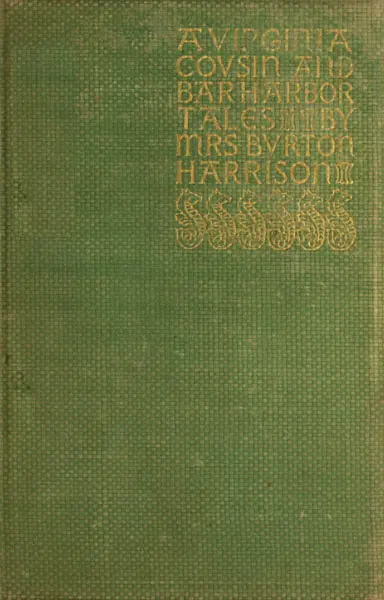
Burton, Mrs. Harrison
BEHIND THE BOOK
This eBook is for the use of anyone anywhere in the United States and most other parts of the world at no cost and with almost no restrictions whatsoever. You may copy it, give it away or re-use it under the terms of the Project Gutenberg License included with this eBook or online at www.gutenberg.org. If you are not located in the United States, you will have to check the laws of the country where you are located before using this eBook. Read the source licence.
The original source file, including credits and licence, is retained by this library. Request an original-format copy at no charge. Please include the book title and Project Gutenberg identifier #49494.
KEEP YOUR CURIOSITY GOING
Wilfrid Scawen Blunt
Wilfrid Scawen Blunt

E. W. (Edgar Watson) Howe
Coulson Kernahan

Maurice Baring
Frances Wright