The Open Boat and Other Stories
Stephen Crane
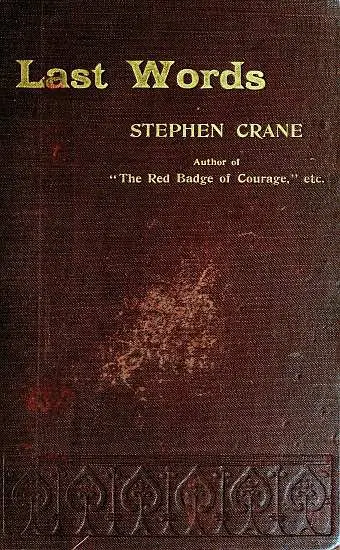
THE CLASSIC COLLECTION · 1902
"Last Words" by Stephen Crane is a collection of short stories written in the late 19th century. The stories within this collection range widely in themes and settings, including tales of war, personal conflict, and observations of human nature, showcasing Crane's characteristic lyrical style and psychological depth. The opening of "Last Words" introduces readers to two characters at the beach, engaging in a humorous and somewhat juvenile critique of one another's physical appearances as they prepare to go swimming. The freckled man expresses a sense of vanity and self-consciousness about his looks, prompting a spirited back-and-forth with his taller companion. The dialogue captures their contrasting personalities, with the freckled man attempting to assert himself despite the tall man's blunt honesty. This dynamic serves as a gentle exploration of friendship, embarrassment, and the human condition, setting the stage for more introspective and dramatic themes to emerge later in the collection.
Introduction adapted from the source catalogue; source summaries may be automatically generated.
Free to read · English · 68,089 words · No account needed
MAKE TIME FOR A GOOD BOOK
On by default. Untick to stop anonymous reading totals. Each page counts after 10 seconds in view. How this works.
Anonymous counting is on unless you have switched it off.
Presently she laughed as one familiar with the humours of an old man. "Oh, I guess yer cussin' mad about yer supper, dad," she said, and she almost entered the room, but suddenly faltered, overcome by a feminine instinct to fly from this black interior, peopled with imagined dangers.
Again she called, "Daddie!" Her voice had an accent of appeal. It was as if she knew she was foolish but yet felt obliged to insist upon being reassured. "Oh, daddie!"
Of a sudden a cry of relief, a feminine announcement that the stars still hung, burst from her. For, according to some mystic process, the smouldering coals of the fire went aflame with sudden, fierce brilliance, splashing parts of the walls, the floor, the crude furniture, with a hue of blood-red. And in the light of this dramatic outburst of light, the girl saw her father seated at a table with his back turned toward her.
She entered the room, then, with an aggrieved air, her logic evidently concluding that somebody was to blame for her nervous fright. "Oh, yer on'y sulkin' 'bout yer supper. I thought mebbe ye'd gone somewheres."
Her father made no reply. She went over to a shelf in the corner, and, taking a little lamp, she lit it and put it where it would give her light as she took off her hat and jacket in front of the tiny mirror. Presently, she began to bustle among the cooking utensils that were crowded into the sink, and as she worked she rattled talk at her father, apparently disdaining his mood.
"I'd 'a come home earlier t'night, dad, o'ny that fly foreman, he kep' me in th' shop 'til half-past six. What a fool. He came t' me, yeh know, an' he ses, 'Nell, I wanta give yeh some brotherly advice.' Oh, I know him an' his brotherly advice. 'I wanta give yeh some brotherly advice. Yer too purty, Nell,' he ses, 't' be workin' in this shop an' paradin' through the streets alone, without somebody t' give yeh good brotherly advice, an' I wanta warn yeh, Nell. I'm a bad man, but I ain't as bad as some, an' I wanta warn yeh.' 'Oh, g'long 'bout yer business,' I ses. I know 'im. He's like all of 'em, o'ny he's a little slyer. I know 'im. 'You g'long 'bout yer business,' I ses. Well, he ses after a while that he guessed some evenin' he'd come up an' see me. 'Oh, yeh will,' I ses, 'yeh will? Well, you jest let my ol' man ketch yeh comin' foolin' 'round our place. Yeh'll wish yeh went t' some other girl t' give brotherly advice.' 'What th' 'ell do I care fer yer father?' he ses. 'What's he t' me?' 'If he throws yeh down stairs, yeh'll care for 'im,' I ses. 'Well,' he ses, 'I'll come when 'e ain't in, b' Gawd, I'll come when 'e ain't in.' 'Oh, he's allus in when it means takin' care 'a me,' I ses. 'Don't yeh fergit it either. When it comes t' takin' care 'a his dorter, he's right on deck every single possible time.'"
Your reading position is saved on this browser. Take it to another device with a library code. Reading pages adapt to text, rather than matching a printed edition.
BEHIND THE BOOK
This eBook is for the use of anyone anywhere in the United States and most other parts of the world at no cost and with almost no restrictions whatsoever. You may copy it, give it away or re-use it under the terms of the Project Gutenberg License included with this eBook or online at www.gutenberg.org. If you are not located in the United States, you will have to check the laws of the country where you are located before using this eBook. Read the source licence.
The original source file, including credits and licence, is retained by this library. Request an original-format copy at no charge. Please include the book title and Project Gutenberg identifier #33579.
KEEP YOUR CURIOSITY GOING

David Patterson (Spirit) Hatch

David Patterson (Spirit) Hatch

David Patterson (Spirit) Hatch
Coulson Kernahan

Ralph Waldo Emerson

Maurice Baring