
Letters of Marque
Rudyard Kipling
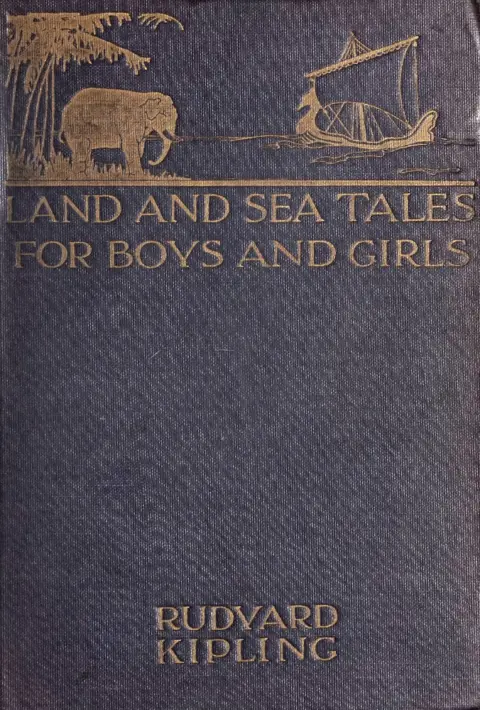
THE CLASSIC COLLECTION · 1893
"Land and Sea Tales for Boys and Girls" by Rudyard Kipling is a collection of short stories written in the late 19th century. This compilation features adventure tales that explore themes of bravery, character, and heroism, often drawing on Kipling's experiences with British colonial culture and the sea. The stories can be enjoyed by younger readers, making them a delightful read for both children and adults alike. The opening of the collection begins with a preface that sets the tone for the tales to follow, emphasizing the importance of being fit—both in mind and body. It introduces the idea that true valor comes in various forms, whether in quiet acts of courage or on the battlefield. The first story, "Winning the Victoria Cross," recounts the history and significance of the prestigious military honor awarded for acts of bravery, with examples illustrating the diverse ways in which heroism manifests. This establishes a framework for the subsequent tales, which promise to celebrate valor and the adventurous spirit of young and old alike against the backdrop of land and sea.
Introduction adapted from the source catalogue; source summaries may be automatically generated.
Free to read · English · 57,228 words · No account needed
MAKE TIME FOR A GOOD BOOK
On by default. Untick to stop anonymous reading totals. Each page counts after 10 seconds in view. How this works.
Anonymous counting is on unless you have switched it off.
They went on one by one, carefully imitating the well-observed actions of their elders, even to the tapping of the cartridge on the rifle-butt. They scowled and grunted and compared notes as they set and reset their sights. They brought up their rifles just as shadow gave place to sun, and, holding too long, fired when the cheating cloud returned. It was unhappy, cold, nose-running, eye-straining work, but they enjoyed it passionately. At the end they showed up their score-cards; one twenty-seven, two twenty-fives, a twenty-four, and two twenty-twos. Boy Jones, his hands on his knees, had made no remark from first to last.
“Could I have a shot?” he began in a strangely meek voice.
But the chilled Sergeant had already whistled the marker out of the butt. The wind-flags were being collected by the youngsters, and, with a tinkle of spent cartridge-cases returned to the Sergeant’s bag, shooting ended.
“Not so bad,” said the Sergeant.
“One of those boys was hump-backed,” said Boy Jones, with the healthy animal’s horror of deformity.
“But his shots aren’t,” said the Sergeant. “He was the twenty-seven card. Milligan’s his name.”
“I should like to have had a shot,” Boy Jones repeated. “Just for the
fun of the thing.”
“Well, just for the fun of the thing,” the Friend suggested, “suppose you fill and empty a magazine. Have you got any dummies, Sergeant?”
The Sergeant produced a handful of dummy cartridges from his
inexhaustible bag.
“How d’you put ’em in?” said Boy Jones, picking up a cartridge by the bullet end with his left hand, and holding the rifle with his right.
“Here, Milligan,” the Friend called. “Fill and empty this magazine, will
you, please?”
The cripple’s fingers flickered for an instant round the rifle-breech. The dummies vanished clicking. He turned towards the butt, pausing perhaps a second on each aimed shot, ripped them all out again over his shoulder. Mechanically Boy Jones caught them as they spun in the air; for he was a good fielder.
“Time, fifteen seconds,” said the Friend. “You try now.” Boy Jones shook his head. “No, thanks,” he said. “This isn’t my day out. That’s called magazine-fire, I suppose.”
“Yes,” said the Sergeant, “but it’s more difficult to load in the dark or in a cramped position.”
The boys drew off, larking among themselves. The others strolled homewards as the wind freshened. Only the Sergeant, after a word or two with the marker, struck off up the line of firing-butts.
Your reading position is saved on this browser. Take it to another device with a library code. Reading pages adapt to text, rather than matching a printed edition.
Rudyard Kipling

Rudyard Kipling
Rudyard Kipling

Rudyard Kipling
BEHIND THE BOOK
This eBook is for the use of anyone anywhere in the United States and most other parts of the world at no cost and with almost no restrictions whatsoever. You may copy it, give it away or re-use it under the terms of the Project Gutenberg License included with this eBook or online at www.gutenberg.org. If you are not located in the United States, you will have to check the laws of the country where you are located before using this eBook. Read the source licence.
The original source file, including credits and licence, is retained by this library. Request an original-format copy at no charge. Please include the book title and Project Gutenberg identifier #63619.
KEEP YOUR CURIOSITY GOING
Coulson Kernahan

Maurice Baring
Frances Wright
Cécile Tormay

Frederic Jesup Stimson

W. H. P. (William Henry Pope) Jarvis