
Letters of Marque
Rudyard Kipling
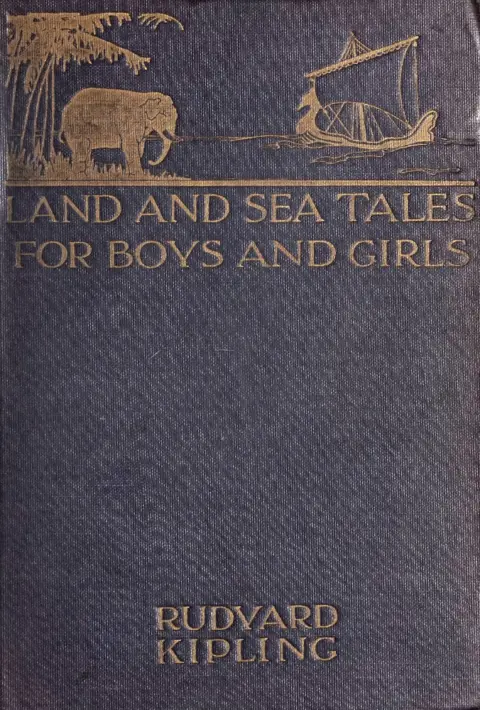
THE CLASSIC COLLECTION · 1893
"Land and Sea Tales for Boys and Girls" by Rudyard Kipling is a collection of short stories written in the late 19th century. This compilation features adventure tales that explore themes of bravery, character, and heroism, often drawing on Kipling's experiences with British colonial culture and the sea. The stories can be enjoyed by younger readers, making them a delightful read for both children and adults alike. The opening of the collection begins with a preface that sets the tone for the tales to follow, emphasizing the importance of being fit—both in mind and body. It introduces the idea that true valor comes in various forms, whether in quiet acts of courage or on the battlefield. The first story, "Winning the Victoria Cross," recounts the history and significance of the prestigious military honor awarded for acts of bravery, with examples illustrating the diverse ways in which heroism manifests. This establishes a framework for the subsequent tales, which promise to celebrate valor and the adventurous spirit of young and old alike against the backdrop of land and sea.
Introduction adapted from the source catalogue; source summaries may be automatically generated.
Free to read · English · 57,228 words · No account needed
MAKE TIME FOR A GOOD BOOK
On by default. Untick to stop anonymous reading totals. Each page counts after 10 seconds in view. How this works.
Anonymous counting is on unless you have switched it off.
“They’m all safe an’ to rights,” said the officious Abraham, producing the key. “Rackon us’ll come in an’ hold ’em for yeou. Hey! The cows are fair ragin’ still. Us’ll have to run for it.”
The barn being next to the shed, the boys could not see that stately
entry. But they heard.
“Gone an’ hided in the hay. Aie! They’m proper afraid,” cried Abraham.
“Rout un out! Rout un out!” roared Vidley, rattling a stick impatiently
on the root-cutter.
“Oh, my Aunt!” said Corkran, standing on one foot.
“Shut the door. Shut the door, I tal ’ee. Rackon us can find un in the dark. Us don’t want un boltin’ like rabbits under our elbows.” The big barn door closed with a clang.
“My Gum!” said Corkran, which was always his War oath in time of action. He dropped down and was gone for perhaps twenty seconds.
“And that’s all right,” he said, returning at a gentle saunter.
“Hwatt?” McTurk almost shrieked, for Corkran, in the shed below, waved a
large key.
“Stalks! Frabjous Stalks! Bottled ’em! all four!” was the reply, and Beetle fell on his bosom. “Yiss. They’m so’s to say, like, locked up. If you’re goin’ to laugh, Beetle, I shall have to kick you again.”
“But I must!” Beetle was blackening with suppressed mirth.
“You won’t do it here, then.” He thrust the already limp Beetle through the cartshed window. It sobered him; one cannot laugh on a bed of nettles. Then Corkran stepped on his prostrate carcass, and McTurk followed, just as Beetle would have risen; so he was upset, and the nettles painted on his cheek a likeness of hideous eruptions.
“’Thought that ’ud cure you,” said Corkran, with a sniff.
Beetle rubbed his face desperately with dock-leaves, and said nothing. All desire to laugh had gone from him. They entered the lane.
Then a clamour broke from the barn—a compound noise of horse-like kicks, shaking of door-panels, and fivefold yells.
“They’ve found it out,” said Corkran. “How strange!” He sniffed again.
“Let ’em,” said Beetle. “No one can hear ’em. Come on up to Coll.”
“What a brute you are, Beetle! You only think of your beastly self. Those cows want milkin’. Poor dears! Hear ’em low,” said McTurk.
“Go back and milk ’em yourself, then.” Beetle danced with pain. “We shall miss call-over, hangin’ about like this; an’ I’ve got two black marks this week already.”
“Then you’ll have fatigue-drill on Monday,” said Corkran. “Come to think of it, I’ve got two black marks aussi. Hm! This is serious. This is hefty serious.”
Your reading position is saved on this browser. Take it to another device with a library code. Reading pages adapt to text, rather than matching a printed edition.
Rudyard Kipling

Rudyard Kipling
Rudyard Kipling

Rudyard Kipling
BEHIND THE BOOK
This eBook is for the use of anyone anywhere in the United States and most other parts of the world at no cost and with almost no restrictions whatsoever. You may copy it, give it away or re-use it under the terms of the Project Gutenberg License included with this eBook or online at www.gutenberg.org. If you are not located in the United States, you will have to check the laws of the country where you are located before using this eBook. Read the source licence.
The original source file, including credits and licence, is retained by this library. Request an original-format copy at no charge. Please include the book title and Project Gutenberg identifier #63619.
KEEP YOUR CURIOSITY GOING
Coulson Kernahan

Maurice Baring
Frances Wright
Cécile Tormay

Frederic Jesup Stimson

W. H. P. (William Henry Pope) Jarvis