
Letters of Marque
Rudyard Kipling
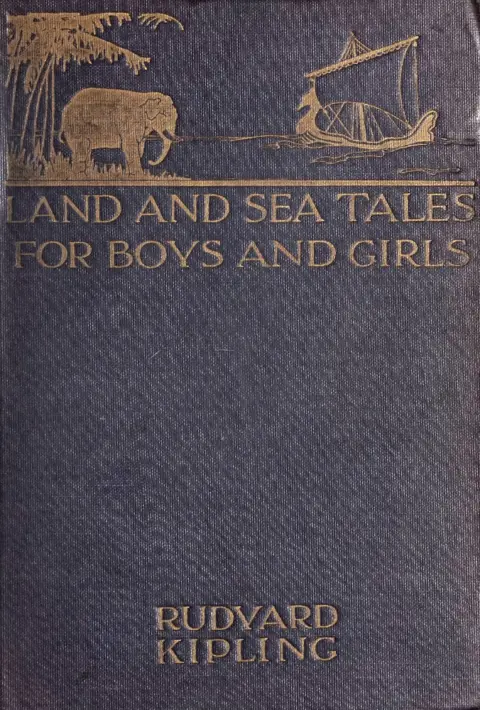
THE CLASSIC COLLECTION · 1893
"Land and Sea Tales for Boys and Girls" by Rudyard Kipling is a collection of short stories written in the late 19th century. This compilation features adventure tales that explore themes of bravery, character, and heroism, often drawing on Kipling's experiences with British colonial culture and the sea. The stories can be enjoyed by younger readers, making them a delightful read for both children and adults alike. The opening of the collection begins with a preface that sets the tone for the tales to follow, emphasizing the importance of being fit—both in mind and body. It introduces the idea that true valor comes in various forms, whether in quiet acts of courage or on the battlefield. The first story, "Winning the Victoria Cross," recounts the history and significance of the prestigious military honor awarded for acts of bravery, with examples illustrating the diverse ways in which heroism manifests. This establishes a framework for the subsequent tales, which promise to celebrate valor and the adventurous spirit of young and old alike against the backdrop of land and sea.
Introduction adapted from the source catalogue; source summaries may be automatically generated.
Free to read · English · 57,228 words · No account needed
MAKE TIME FOR A GOOD BOOK
On by default. Untick to stop anonymous reading totals. Each page counts after 10 seconds in view. How this works.
Anonymous counting is on unless you have switched it off.
Then he found they were changing engines at Guldee Haut, and old Rustomjee, a Parsee, was the new driver, with Number Forty in hand. Young Ottley took this opportunity to go forward and tell Rustomjee exactly what they thought of him in the Sheds, where the ’prentices had been repairing some of his carelessness in the way of a dropped crown-sheet, the result of inattention and bad stoking.
Rustomjee said he had bad luck with engines, and young Ottley went back to his carriage and slept. He was waked by a bang, a bump, and a jar, and saw on the opposite bunk a subaltern who was travelling north with a detachment of some twenty English soldiers.
“What’s that?” said the subaltern.
“Rustomjee has blown her up, perhaps,” said young Ottley, and dropped out into the wet, the subaltern at his heels. They found Rustomjee sitting by the side of the line, nursing a scalded foot and crying aloud that he was a dead man, while the gunner-guard—who is a kind of extra-hand—looked respectfully at the roaring, hissing machine.
“What has happened?” said young Ottley, by the light of the
gunner-guard’s lantern.
“Phut gya [she has gone smash],” said Rustomjee, still hopping.
“Without doubt; but where?”
“Khuda jahnta! [God knows]. I am a poor man. Number Forty is broke.”
Young Ottley jumped into the cab and turned off all the steam he could find, for there was a good deal escaping. Then he took the lantern and dived under the drive-wheels, where he lay face up, investigating among spurts of hot water.
“Doocid plucky,” said the subaltern. “I shouldn’t like to do that myself. What’s gone wrong?”
“Cylinder-head blown off, coupler-rod twisted, and several more things. She is very badly wrecked. Oah, yes, she is a tottal wreck,” said young Ottley between the spokes of the right-hand driver.
“Awkward,” said the subaltern, turning up his coat-collar in the wet. “What’s to be done, then?”
Young Ottley came out, a rich black all over his grey uniform with the red facings, and drummed on his teeth with his finger nails, while the rain fell and the native passengers shouted questions and old Rustomjee told the gunner-guard to walk back six or seven miles and wire to someone for help.
“I cannot swim,” said the gunner-guard. “Go and lie down.” And that, as you might say, settled that. Besides, as far as one could see by the light of the gunner-guard’s lantern, all Bengal was flooded.
Your reading position is saved on this browser. Take it to another device with a library code. Reading pages adapt to text, rather than matching a printed edition.
Rudyard Kipling

Rudyard Kipling
Rudyard Kipling

Rudyard Kipling
BEHIND THE BOOK
This eBook is for the use of anyone anywhere in the United States and most other parts of the world at no cost and with almost no restrictions whatsoever. You may copy it, give it away or re-use it under the terms of the Project Gutenberg License included with this eBook or online at www.gutenberg.org. If you are not located in the United States, you will have to check the laws of the country where you are located before using this eBook. Read the source licence.
The original source file, including credits and licence, is retained by this library. Request an original-format copy at no charge. Please include the book title and Project Gutenberg identifier #63619.
KEEP YOUR CURIOSITY GOING
Coulson Kernahan

Maurice Baring
Frances Wright
Cécile Tormay

Frederic Jesup Stimson

W. H. P. (William Henry Pope) Jarvis