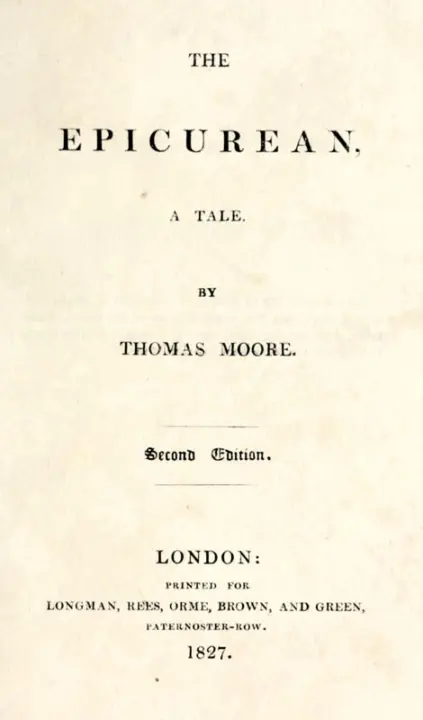
The Epicurean: A Tale
Thomas Moore
THE CLASSIC COLLECTION · 1817
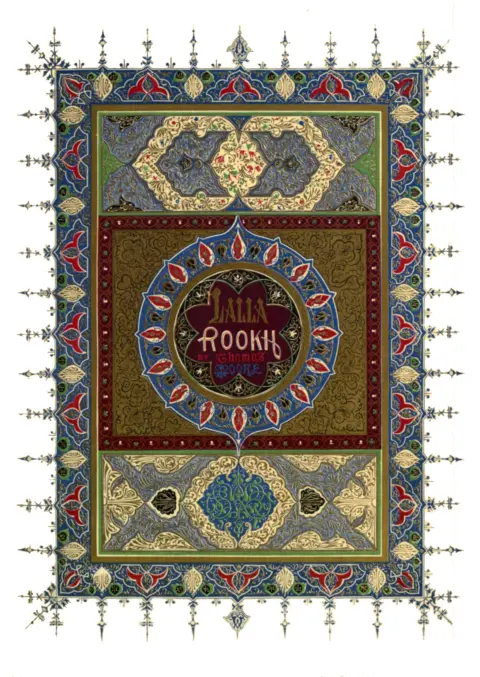
"Lalla Rookh: An Oriental romance" by Thomas Moore is a romantic work first published in 1817. The poem follows Princess Lalla Rookh, daughter of Mughal emperor Aurangzeb, as she journeys to marry the King of Bukhara. Along the way, she falls in love with Feramorz, a poet in her entourage who entertains her with four enchanting tales. The work blends a frame narrative with interpolated poems set in sumptuous Eastern settings, exploring themes of love, disguise, and identity in a world of Persian splendor.
Introduction adapted from the source catalogue; source summaries may be automatically generated.
Free to read · English · 77,115 words · No account needed
MAKE TIME FOR A GOOD BOOK
On by default. Untick to stop anonymous reading totals. Each page counts after 10 seconds in view. How this works.
Anonymous counting is on unless you have switched it off.
With respect to the style, it was worthy of the matter;—it had not even those politic contrivances of structure, which make up for the commonness of the thoughts by the peculiarity of the manner, nor that stately poetical phraseology by which sentiments mean in themselves, like the blacksmith’s[152] apron converted into a banner, are so easily gilt and embroidered into consequence. Then, as to the versification, it was, to say no worse of it, execrable: it had neither the copious flow of Ferdosi, the sweetness of Hafez, nor the sententious march of Sadi; but appeared to him, in the uneasy heaviness of its movements, to have been modelled upon the gait of a very tired dromedary. The licences, too, in which it indulged, were unpardonable;—for instance, this line, and the poem abounded with such:—
Like the faint, exquisite music of a dream.
“What critic that can count,” said FADLADEEN, “and has his full complement of fingers to count withal, would tolerate for an instant such syllabic superfluities?” He here looked round, and discovered that most of his audience were asleep; while the glimmering lamps seemed inclined to follow their example. It became necessary, therefore, however painful to himself, to put an end to his valuable animadversions for the present, and he accordingly concluded, with an air of dignified candour, thus:—“Notwithstanding the observations which I have thought it my duty to make, it is by no means my wish to discourage the young man:—so far from it, indeed, that if he will but totally alter his style of writing and thinking, I have very little doubt that I shall be vastly pleased with him.”
Some days elapsed, after this harangue of the Great Chamberlain, before LALLA ROOKH could venture to ask for another story. The youth was still a welcome guest in the pavilion—to one heart, perhaps, too dangerously welcome:—but all mention of poetry was, as if by common consent, avoided. Though none of the party had much respect for FADLADEEN, yet his censures, thus magisterially delivered, evidently made an impression on them all. The Poet himself, to whom criticism was quite a new operation, (being wholly unknown in that Paradise of the Indies, Cashmere,) felt the shock as it is generally felt at first, till use has made it more tolerable to the patient;—the Ladies began to suspect that they ought not to be pleased, and seemed to conclude that there must have been much good sense in what FADLADEEN said, from its having sent them all so soundly to sleep;—while the self-complacent Chamberlain was left to triumph in the idea of having, for the hundred and fiftieth time in his life, extinguished a Poet. LALLA ROOKH alone—and Love knew why—persisted in being delighted with all she had heard, and in resolving to hear more as speedily as possible. Her manner, however, of first returning to the subject was unlucky. It was while they rested during the heat of noon near a fountain, on which some hand had rudely traced those well-known words from the Garden of Sadi,—“Many, like me, have viewed this fountain, but they are gone, and their eyes are closed for ever!”—that she took occasion, from the melancholy beauty of this passage, to dwell upon the charms of poetry in general. “It is true,” she said, “few poets can imitate that sublime bird, which flies always in the air, and never touches the earth:[153]—it is only once in many ages a Genius appears, whose words, like those on the Written Mountain, last for ever:[154] but still there are some, as delightful, perhaps, though not so wonderful, who, if not stars over our head, are at least flowers along our path, and whose sweetness of the moment we ought gratefully to inhale, without calling upon them for a brightness and a durability beyond their nature. In short,” continued she, blushing, as if conscious of being caught in an oration, “it is quite cruel that a poet cannot wander through his regions of enchantment, without having a critic for ever, like the old Man of the Sea, upon his back!”[155]—FADLADEEN, it was plain, took this last luckless allusion to himself, and would treasure it up in his mind as a whetstone for his next criticism. A sudden silence ensued; and the Princess, glancing a look at FERAMORZ, saw plainly she must wait for a more courageous moment.
Your reading position is saved on this browser. Take it to another device with a library code. Reading pages adapt to text, rather than matching a printed edition.
BEHIND THE BOOK
This eBook is for the use of anyone anywhere in the United States and most other parts of the world at no cost and with almost no restrictions whatsoever. You may copy it, give it away or re-use it under the terms of the Project Gutenberg License included with this eBook or online at www.gutenberg.org. If you are not located in the United States, you will have to check the laws of the country where you are located before using this eBook. Read the source licence.
The original source file, including credits and licence, is retained by this library. Request an original-format copy at no charge. Please include the book title and Project Gutenberg identifier #76794.
KEEP YOUR CURIOSITY GOING
Coulson Kernahan

Maurice Baring
Frances Wright
Cécile Tormay

Frederic Jesup Stimson

W. H. P. (William Henry Pope) Jarvis