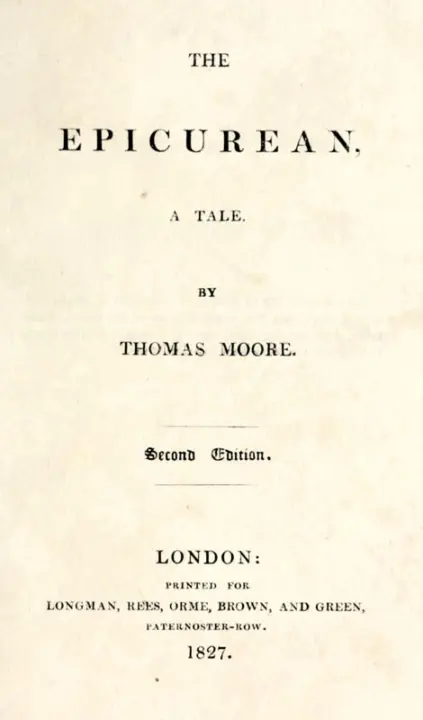
The Epicurean: A Tale
Thomas Moore
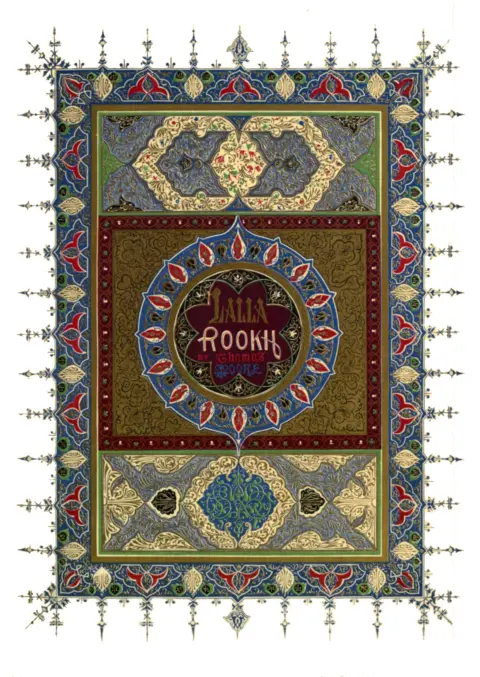
THE CLASSIC COLLECTION · 1817
"Lalla Rookh: An Oriental romance" by Thomas Moore is a romantic work first published in 1817. The poem follows Princess Lalla Rookh, daughter of Mughal emperor Aurangzeb, as she journeys to marry the King of Bukhara. Along the way, she falls in love with Feramorz, a poet in her entourage who entertains her with four enchanting tales. The work blends a frame narrative with interpolated poems set in sumptuous Eastern settings, exploring themes of love, disguise, and identity in a world of Persian splendor.
Introduction adapted from the source catalogue; source summaries may be automatically generated.
Free to read · English · 77,115 words · No account needed
MAKE TIME FOR A GOOD BOOK
On by default. Untick to stop anonymous reading totals. Each page counts after 10 seconds in view. How this works.
Anonymous counting is on unless you have switched it off.
“These are the butterflies which are called in the Chinese language Flying Leaves. Some of them have such shining colours, and are so variegated, that they may be called flying flowers; and indeed they are always produced in the finest flower-gardens.”—Dunn.
Footnote 357:
p. 310.—The features of young Arab maids.
“The Arabian women wear black masks with little clasps prettily ordered.”—Carreri. Niebuhr mentions their showing but one eye in conversation.
Footnote 358:
p. 311.—On CASBIN’S hills.
“The golden grapes of Casbin.”—Description of Persia.
Footnote 359:
p. 311.—And sunniest apples that Caubul—
“The fruits exported from Caubul are apples, pears, pomegranates,”
&c.—Elphinstone.
Footnote 360:
p. 311.—in all its thousand gardens bears.
“We sat down under a tree, listened to the birds, and talked with the son of our Mehmaundar about our country and Caubul, of which he gave an enchanting account: that city and its 100,000 gardens,” &c.—Id.
Footnote 361:
p. 311.—MALAYA’S nectar’d mangusteen.
“The mangusteen, the most delicate fruit in the world; the pride of the Malay islands.”—Marsden.
Footnote 362:
p. 311.—Seed of the Sun, from IRAN’S land.
“A delicious kind of apricot, called by the Persians tokm-ek-shems, signifying sun’s seed.”—Description of Persia.
Footnote 363:
p. 311.—With rich conserve of Visna cherries.
“Sweetmeats, in a crystal cup, consisting of rose-leaves in conserve, with lemon of Visna cherry orange flowers,” &c.—Russel.
Footnote 364:
p. 311.—Feed on in Erac’s rocky dells.
“Antelopes, cropping the fresh berries of Erac.”—The Moallakat, Poem
of Tarafa.
Footnote 365:
p. 311.—And urns of porcelain from that isle.
Mauri-ga-Sima, an island near Formosa, supposed to have been sunk in the sea for the crimes of its inhabitants. The vessels which the fishermen and divers bring up from it are sold at an immense price in China and Japan.—See Kæmpfer.
Footnote 366:
p. 312.—Amber Rosolli.—Persian Tales.
Footnote 367:
p. 312.—From vineyards of the Green-Sea gushing.
The white wine of Kishma.
Footnote 368:
p. 312.—Offer’d a city’s wealth.
“The King of Zeilan is said to have the very finest ruby that was ever seen. Kublai-Khan sent and offered the value of a city for it, but the King answered he would not give it for the treasure of the world.”—Marco Polo.
Footnote 369:
p. 312.—Upon a rosy lotus wreath.
The Indians feign that Cupid was first seen floating down the Ganges on the Nymphæa Nelumbo.—See Pennant.
Footnote 370:
p. 312.—When warm they rise from Teflis’ brooks.
Teflis is celebrated for its natural warm baths.—See Ebn Haukal.
Footnote 371:
p. 312.—Of a syrinda.
“The Indian Syrinda, or guitar.”—Symez.
Footnote 372:
p. 313.—It is this, it is this.
Your reading position is saved on this browser. Take it to another device with a library code. Reading pages adapt to text, rather than matching a printed edition.
BEHIND THE BOOK
This eBook is for the use of anyone anywhere in the United States and most other parts of the world at no cost and with almost no restrictions whatsoever. You may copy it, give it away or re-use it under the terms of the Project Gutenberg License included with this eBook or online at www.gutenberg.org. If you are not located in the United States, you will have to check the laws of the country where you are located before using this eBook. Read the source licence.
The original source file, including credits and licence, is retained by this library. Request an original-format copy at no charge. Please include the book title and Project Gutenberg identifier #76794.
KEEP YOUR CURIOSITY GOING
Coulson Kernahan

Maurice Baring
Frances Wright
Cécile Tormay

Frederic Jesup Stimson

W. H. P. (William Henry Pope) Jarvis