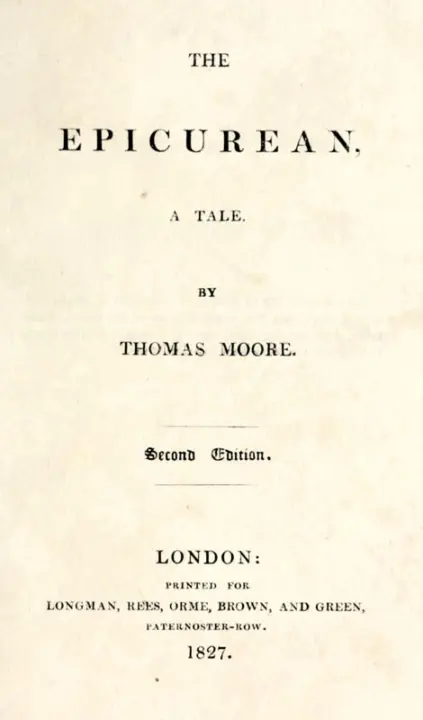
The Epicurean: A Tale
Thomas Moore
THE CLASSIC COLLECTION · 1817
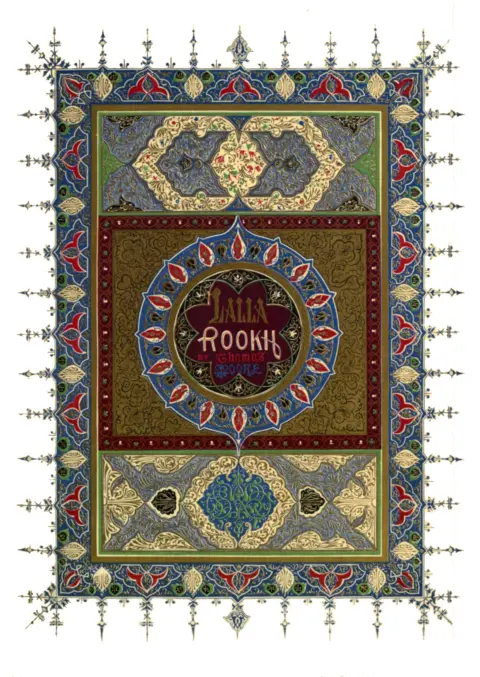
"Lalla Rookh: An Oriental romance" by Thomas Moore is a romantic work first published in 1817. The poem follows Princess Lalla Rookh, daughter of Mughal emperor Aurangzeb, as she journeys to marry the King of Bukhara. Along the way, she falls in love with Feramorz, a poet in her entourage who entertains her with four enchanting tales. The work blends a frame narrative with interpolated poems set in sumptuous Eastern settings, exploring themes of love, disguise, and identity in a world of Persian splendor.
Introduction adapted from the source catalogue; source summaries may be automatically generated.
Free to read · English · 77,115 words · No account needed
MAKE TIME FOR A GOOD BOOK
On by default. Untick to stop anonymous reading totals. Each page counts after 10 seconds in view. How this works.
Anonymous counting is on unless you have switched it off.
p. 190.—Ornamented with the most beautiful porcelain.—“The Ficus Indica is called the Pagod Tree and Tree of Councils; the first, from the idols placed under its shade; the second, because meetings were held under its cool branches. In some places it is believed to be the haunt of spectres, as the ancient spreading oaks of Wales have been of fairies; in others are erected beneath the shade pillars of stone, or posts, elegantly carved, and ornamented with the most beautiful porcelain to supply the use of mirrors.”—Pennant.
Footnote 238:
p. 192.—And o’er the Green Sea palely shines.
The Persian Gulf—“To dive for pearls in the Green Sea, or Persian Gulf.”—Sir W. Jones.
Footnote 239:
p. 192.—Revealing BAHREIN’S groves of palm,
And lighting KISHMA’S amber vines.
Islands in the Gulf.
Footnote 240:
p. 192.—Blow round SELAMA’S sainted cape.
Or Selemeh, the genuine name of the headland at the entrance of the Gulf, commonly called Cape Musseldom. “The Indians, when they pass the promontory, throw cocoa-nuts, fruits, or flowers, into the sea, to secure a propitious voyage.”—Morier.
Footnote 241:
p. 193.—The nightingale now bends her flight.
“The nightingale sings from the pomegranate groves in the day-time, and from the loftiest trees at night.”—Russel’s Aleppo.
Footnote 242:
p. 193.—The best and brightest scimitar.
In speaking of the climate of Shiraz, Francklin says, “The dew is of such a pure nature, that if the brightest scimitar should be exposed to it all night, it would not receive the least rust.”
Footnote 243:
p. 194.—Who, on CADESSIA’S bloody plains.
The place where the Persians were finally defeated by the Arabs, and their ancient monarchy destroyed.
Footnote 244:
p. 194.—Beyond the Caspian’s Iron Gates.
Derbend.—“Les Turcs appellent cette ville Demir Capi, Porte de Fer; ce sont les Caspiæ Portæ des anciens.”—D’Herbelot.
Footnote 245:
p. 195.—They burst, like Zeilan’s giant palm.
The Talpot or Talipot-tree. “This beautiful palm-tree, which grows in the heart of the forests, may be classed among the loftiest trees, and becomes still higher when on the point of bursting forth from its leafy summit. The sheath which then envelopes the flower is very large, and, when it bursts, makes an explosion like the report of a cannon.”—Thunberg.
Footnote 246:
p. 196.—Before whose sabre’s dazzling light.
“When the bright cimitars make the eyes of our heroes wink.”—The Moallakat, Poem of Amru.
Footnote 247:
p. 198.—Sprung from those old, enchanted kings.
Your reading position is saved on this browser. Take it to another device with a library code. Reading pages adapt to text, rather than matching a printed edition.
BEHIND THE BOOK
This eBook is for the use of anyone anywhere in the United States and most other parts of the world at no cost and with almost no restrictions whatsoever. You may copy it, give it away or re-use it under the terms of the Project Gutenberg License included with this eBook or online at www.gutenberg.org. If you are not located in the United States, you will have to check the laws of the country where you are located before using this eBook. Read the source licence.
The original source file, including credits and licence, is retained by this library. Request an original-format copy at no charge. Please include the book title and Project Gutenberg identifier #76794.
KEEP YOUR CURIOSITY GOING
Coulson Kernahan

Maurice Baring
Frances Wright
Cécile Tormay

Frederic Jesup Stimson

W. H. P. (William Henry Pope) Jarvis