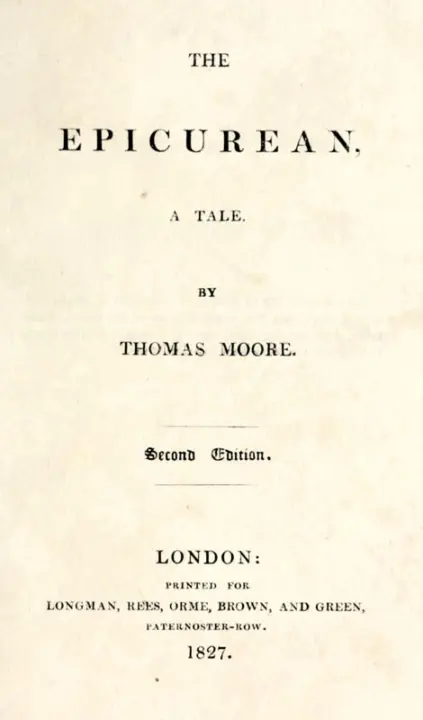
The Epicurean: A Tale
Thomas Moore
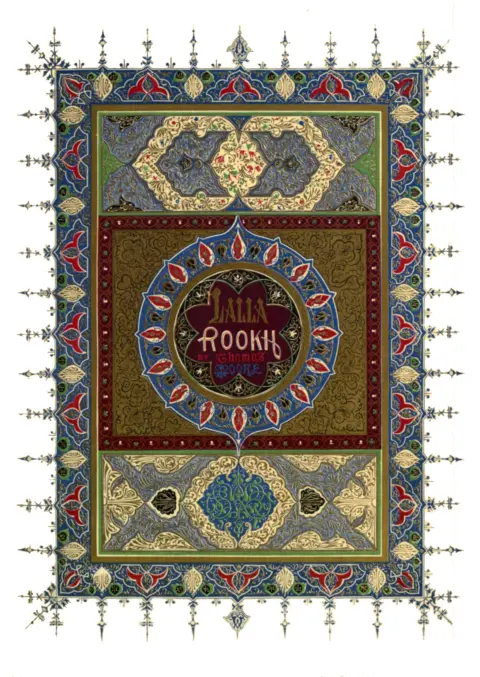
THE CLASSIC COLLECTION · 1817
"Lalla Rookh: An Oriental romance" by Thomas Moore is a romantic work first published in 1817. The poem follows Princess Lalla Rookh, daughter of Mughal emperor Aurangzeb, as she journeys to marry the King of Bukhara. Along the way, she falls in love with Feramorz, a poet in her entourage who entertains her with four enchanting tales. The work blends a frame narrative with interpolated poems set in sumptuous Eastern settings, exploring themes of love, disguise, and identity in a world of Persian splendor.
Introduction adapted from the source catalogue; source summaries may be automatically generated.
Free to read · English · 77,115 words · No account needed
MAKE TIME FOR A GOOD BOOK
On by default. Untick to stop anonymous reading totals. Each page counts after 10 seconds in view. How this works.
Anonymous counting is on unless you have switched it off.
Birds of Paradise, which, at the nutmeg season, come in flights from the southern isles to India; and “the strength of the nutmeg,” says Tavernier, “so intoxicates them, that they fall dead drunk to the earth.”
Footnote 74:
p. 55.—Build their high nests of budding cinnamon.
“That bird which liveth in Arabia, and buildeth its nest with cinnamon.”—Brown’s Vulgar Errors.
Footnote 75:
p. 55.—Sleeping in light, like the green birds that dwell.
“The spirits of the martyrs will be lodged in the crops of green birds.” Gibbon, vol. ix. p. 421.
Footnote 76:
p. 55.—More like the luxuries of that impious King.
Shedad, who made the delicious gardens of Irim, in imitation of Paradise, and was destroyed by lightning the first time he attempted to enter them.
Footnote 77:
p. 57.—In its blue blossoms hum themselves to sleep.
“My Pandits assure me that the plant before us (the Nilica) is their Sephalica, thus named because the bees are supposed to sleep on its blossoms.”—Sir W. Jones.
Footnote 78:
p. 59.—As they were captives to the King of Flowers.
“They deferred it till the King of Flowers should ascend his throne of enamelled foliage.”—The Bahardanush.
Footnote 79:
p. 60.—But a light golden chain-work round her hair.
“One of the head-dresses of the Persian women is composed of a light golden chain-work, set with small pearls, with a thin gold plate pendant, about the bigness of a crown-piece, on which is impressed an Arabian prayer, and which hangs upon the cheek below the ear.”—Hanway’s Travels.
Footnote 80:
p. 60.—Such as the maids of YEZD and SHIRAS wear.
“Certainly the women of Yezd are the handsomest women in Persia. The proverb is, that to live happy a man must have a wife of Yezd, eat the bread of Yezdecas, and drink the wine of Shiraz.”—Tavernier.
Footnote 81:
p. 61.—Upon a musnud’s edge.
Musnuds are cushioned seats, usually reserved for persons of
distinction.
Footnote 82:
p. 61.—In the pathetic mode of ISFAHAN.
The Persians, like the ancient Greeks, call their musical modes or Perdas by the names of different countries or cities, as the mode of Isfahan, the mode of Irak, &c.
Footnote 83:
p. 61.—There’s a bower of roses by BENDEMEER’S stream.
A river which flows near the ruins of Chilminar.
Footnote 84:
p. 64.—The hills of crystal on the Caspian shore.
“To the north of us (on the coast of the Caspian, near Badku) was a mountain, which sparkled like diamonds, arising from the sea-glass and crystals with which it abounds.”—Journey of the Russian Ambassador to Persia, 1746.
Footnote 85:
p. 64.—Of EDEN, shake in the eternal breeze.
Your reading position is saved on this browser. Take it to another device with a library code. Reading pages adapt to text, rather than matching a printed edition.
BEHIND THE BOOK
This eBook is for the use of anyone anywhere in the United States and most other parts of the world at no cost and with almost no restrictions whatsoever. You may copy it, give it away or re-use it under the terms of the Project Gutenberg License included with this eBook or online at www.gutenberg.org. If you are not located in the United States, you will have to check the laws of the country where you are located before using this eBook. Read the source licence.
The original source file, including credits and licence, is retained by this library. Request an original-format copy at no charge. Please include the book title and Project Gutenberg identifier #76794.
KEEP YOUR CURIOSITY GOING
Coulson Kernahan

Maurice Baring
Frances Wright
Cécile Tormay

Frederic Jesup Stimson

W. H. P. (William Henry Pope) Jarvis