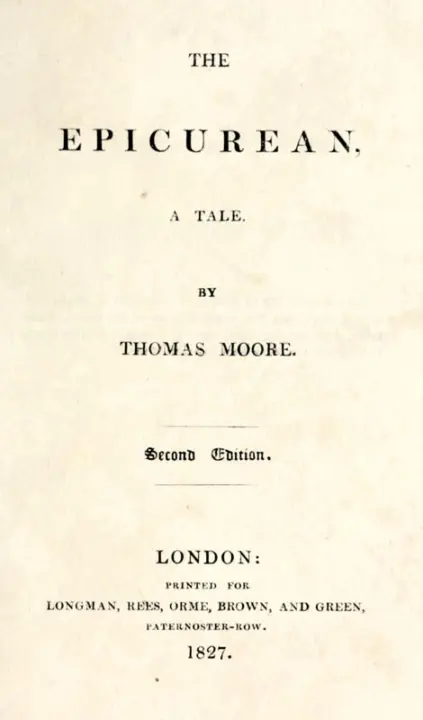
The Epicurean: A Tale
Thomas Moore
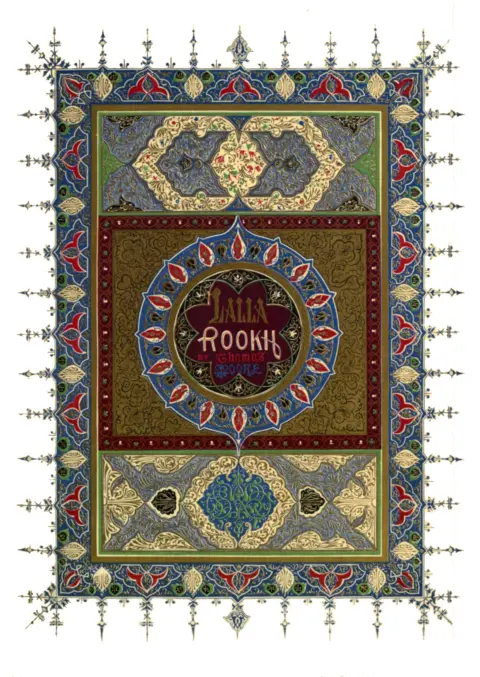
THE CLASSIC COLLECTION · 1817
"Lalla Rookh: An Oriental romance" by Thomas Moore is a romantic work first published in 1817. The poem follows Princess Lalla Rookh, daughter of Mughal emperor Aurangzeb, as she journeys to marry the King of Bukhara. Along the way, she falls in love with Feramorz, a poet in her entourage who entertains her with four enchanting tales. The work blends a frame narrative with interpolated poems set in sumptuous Eastern settings, exploring themes of love, disguise, and identity in a world of Persian splendor.
Introduction adapted from the source catalogue; source summaries may be automatically generated.
Free to read · English · 77,115 words · No account needed
MAKE TIME FOR A GOOD BOOK
On by default. Untick to stop anonymous reading totals. Each page counts after 10 seconds in view. How this works.
Anonymous counting is on unless you have switched it off.
An island in the Persian Gulf, celebrated for its white wine.
Footnote 50:
p. 34.—Like ZEMZEM’S Spring of Holiness, had power.
The miraculous well at Mecca; so called, says Sale, from the murmuring
of its waters.
Footnote 51:
p. 35.—Whom INDIA serves, the monkey deity.
The God Hannaman.—“Apes are in many parts of India highly venerated, out of respect to the God Hannaman, a deity partaking of the form of that race.”—Pennant’s Hindoostan.
See a curious account, in Stephen’s Persia, of a solemn embassy from some part of the Indies to Goa, when the Portuguese were there, offering vast treasures for the recovery of a monkey’s tooth, which they held in great veneration, and which had been taken away upon the conquest of the kingdom of Jafanapatan.
Footnote 52:
p. 35.—To bend in worship, LUCIFER was right.
This resolution of Eblis not to acknowledge the new creature, man, was, according to Mahometan tradition, thus adopted:—“The earth (which God had selected for the materials of his work) was carried into Arabia to a place between Mecca and Tayef, where, being first kneaded by the angels, it was afterwards fashioned by God himself into a human form, and left to dry for the space of forty days, or, as others say, as many years; the angels, in the mean time, often visiting it, and Eblis (then one of the angels nearest to God’s presence, afterwards the devil) among the rest; but he, not contented with looking at it, kicked it with his foot till it rung; and knowing God designed that creature to be his superior, took a secret resolution never to acknowledge him as such.”—Sale on the Koran.
Footnote 53:
p. 36.—From dead men’s marrow guides them best at night.
A kind of lantern formerly used by robbers, called the Hand of Glory, the candle for which was made of the fat of a dead malefactor. This, however, was rather a western than an eastern superstition.
Footnote 54:
p. 37.—In that best marble of which Gods are made.
The material of which images of Gaudma (the Birman Deity) are made, is held sacred. “Birmans may not purchase the marble in mass, but are suffered, and indeed encouraged, to buy figures of the Deity ready made.”—Symes’s Ava, vol. ii. p. 376.
Footnote 55:
p. 41.—Of Kerzrah flowers, came fill’d with pestilence.
“It is commonly said in Persia, that if a man breathe in the hot south wind, which in June or July passes over that flower (the Kerzereh), it will kill him.”—Thevenot.
Footnote 56:
p. 44.—Within the crocodile’s stretch’d jaws to come.
Your reading position is saved on this browser. Take it to another device with a library code. Reading pages adapt to text, rather than matching a printed edition.
BEHIND THE BOOK
This eBook is for the use of anyone anywhere in the United States and most other parts of the world at no cost and with almost no restrictions whatsoever. You may copy it, give it away or re-use it under the terms of the Project Gutenberg License included with this eBook or online at www.gutenberg.org. If you are not located in the United States, you will have to check the laws of the country where you are located before using this eBook. Read the source licence.
The original source file, including credits and licence, is retained by this library. Request an original-format copy at no charge. Please include the book title and Project Gutenberg identifier #76794.
KEEP YOUR CURIOSITY GOING
Coulson Kernahan

Maurice Baring
Frances Wright
Cécile Tormay

Frederic Jesup Stimson

W. H. P. (William Henry Pope) Jarvis