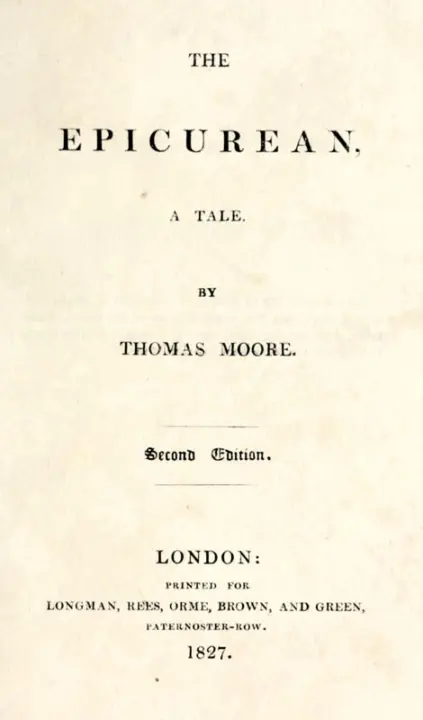
The Epicurean: A Tale
Thomas Moore
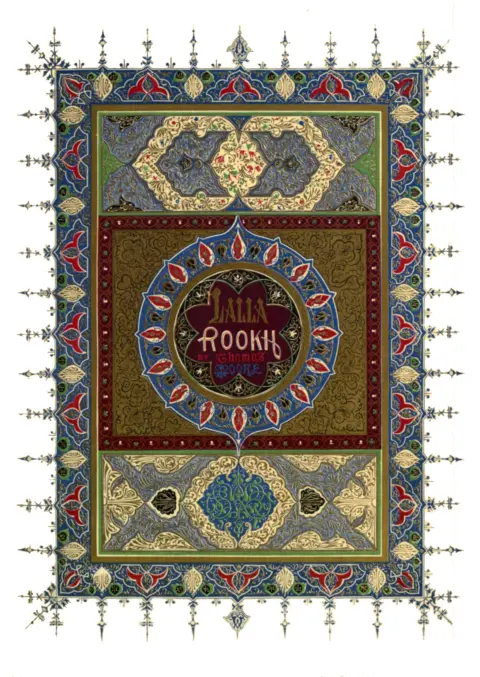
THE CLASSIC COLLECTION · 1817
"Lalla Rookh: An Oriental romance" by Thomas Moore is a romantic work first published in 1817. The poem follows Princess Lalla Rookh, daughter of Mughal emperor Aurangzeb, as she journeys to marry the King of Bukhara. Along the way, she falls in love with Feramorz, a poet in her entourage who entertains her with four enchanting tales. The work blends a frame narrative with interpolated poems set in sumptuous Eastern settings, exploring themes of love, disguise, and identity in a world of Persian splendor.
Introduction adapted from the source catalogue; source summaries may be automatically generated.
Free to read · English · 77,115 words · No account needed
MAKE TIME FOR A GOOD BOOK
On by default. Untick to stop anonymous reading totals. Each page counts after 10 seconds in view. How this works.
Anonymous counting is on unless you have switched it off.
p. 12.—O’er MOUSSA’S cheek, when down the Mount he trod.
“Ses disciples assuroient qu’il se couvroit le visage, pour ne pas éblouir ceux qui l’approchoient par l’éclat de son visage comme Moyse.”—D’Herbelot.
Footnote 30:
p. 12.—In hatred to the Caliph’s hue of night.
Black was the colour adopted by the Caliphs of the House of Abbas, in their garments, turbans, and standards.—“Il faut remarquer ici touchant les habits blancs des disciples de Hakem, que la couleur des habits, des coëffures et des étendards des Khalifes Abassides étant la noire, ce chef de Rebelles ne pouvoit pas choisir une qui lui fut plus opposée.”—D’Herbelot.
Footnote 31:
p. 12.—With javelins of the light Kathaian reed.
“Our dark javelins, exquisitely wrought of Khathaian reeds, slender and delicate.”—Poem of Amru.
Footnote 32:
p. 13.—Fill’d with the stems.
Pichula, used anciently for arrows by the Persians.
Footnote 33:
p. 13.—That bloom on IRAN’S rivers.
The Persians call this plant Gaz. The celebrated shaft of Isfendiar, one of their ancient heroes, was made of it.—“Nothing can be more beautiful than the appearance of this plant in flower during the rains on the banks of rivers, where it is usually interwoven with a lovely twining asclepias.”—Sir W. Jones, Botanical Observations on Select Indian Plants.
Footnote 34:
p. 13.—Like a chenar-tree grove, when winter throws.
The oriental plane. “The chenar is a delightful tree; its bole is of a fine white and smooth bark; and its foliage, which grows in a tuft at the summit, is of a bright green.”—Morier’s Travels.
Footnote 35:
p. 14.—From those who kneel at BRAHMA’S burning founts.
The burning fountains of Brahma near Chittogong, esteemed as
holy.—Turner.
Footnote 36:
p. 14.—To the small, half-shut glances of KATHAY.—China.
Footnote 37:
p. 15.—Like tulip-beds, of different shape and dyes.
“The name of tulip is said to be of Turkish extraction, and given to the flower on account of its resembling a turban.”—Beckmann’s History of Inventions.
Footnote 38:
p. 15.—And fur-bound bonnet of Bucharian shape.
“The inhabitants of Bucharia wear a round cloth bonnet, shaped much after the Polish fashion, having a large fur border. They tie their kaftans about the middle with a girdle of a kind of silk crape, several times round the body.”—Account of Independent Tartary, in Pinkerton’s Collection.
Footnote 39:
p. 15.—O’erwhelm’d in fight and captive to the Greek.
In the war of the Caliph Mahadi against the Empress Irene, for an account of which vide Gibbon, vol. x.
Footnote 40:
p. 18.—The flying throne of star-taught SOLIMAN.
Your reading position is saved on this browser. Take it to another device with a library code. Reading pages adapt to text, rather than matching a printed edition.
BEHIND THE BOOK
This eBook is for the use of anyone anywhere in the United States and most other parts of the world at no cost and with almost no restrictions whatsoever. You may copy it, give it away or re-use it under the terms of the Project Gutenberg License included with this eBook or online at www.gutenberg.org. If you are not located in the United States, you will have to check the laws of the country where you are located before using this eBook. Read the source licence.
The original source file, including credits and licence, is retained by this library. Request an original-format copy at no charge. Please include the book title and Project Gutenberg identifier #76794.
KEEP YOUR CURIOSITY GOING
Coulson Kernahan

Maurice Baring
Frances Wright
Cécile Tormay

Frederic Jesup Stimson

W. H. P. (William Henry Pope) Jarvis