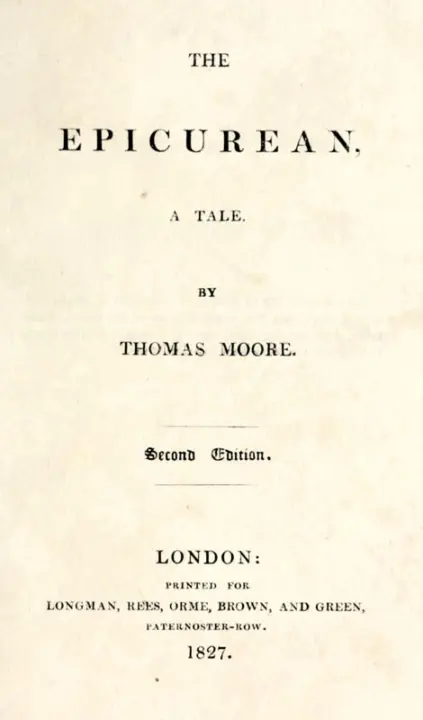
The Epicurean: A Tale
Thomas Moore
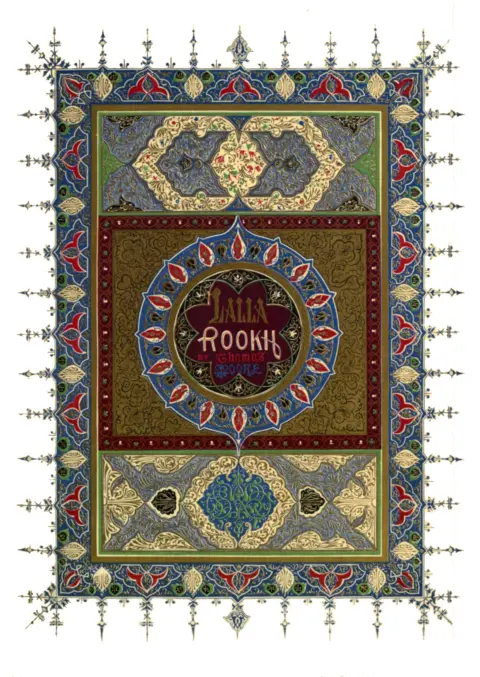
THE CLASSIC COLLECTION · 1817
"Lalla Rookh: An Oriental romance" by Thomas Moore is a romantic work first published in 1817. The poem follows Princess Lalla Rookh, daughter of Mughal emperor Aurangzeb, as she journeys to marry the King of Bukhara. Along the way, she falls in love with Feramorz, a poet in her entourage who entertains her with four enchanting tales. The work blends a frame narrative with interpolated poems set in sumptuous Eastern settings, exploring themes of love, disguise, and identity in a world of Persian splendor.
Introduction adapted from the source catalogue; source summaries may be automatically generated.
Free to read · English · 77,115 words · No account needed
MAKE TIME FOR A GOOD BOOK
On by default. Untick to stop anonymous reading totals. Each page counts after 10 seconds in view. How this works.
Anonymous counting is on unless you have switched it off.
Then, fare thee well—I’d rather make
My bower upon some icy lake
When thawing suns begin to shine,
Than trust to love so false as thine!
There was a pathos in this lay,
That, e’en without enchantment’s art,
Would instantly have found its way
Deep into SELIM’S burning heart;
But, breathing, as it did, a tone
To earthly lutes and lips unknown;
With every chord fresh from the touch
Of Music’s Spirit,—’twas too much!
Starting, he dash’d away the cup,—
Which, all the time of this sweet air,
His hand had held, untasted, up,
As if ’twere fix’d by magic there,—
And naming her, so long unnam’d,
So long unseen, wildly exclaim’d,
“Oh NOURMAHAL! oh NOURMAHAL!
“Hadst thou but sung this witching strain,
“I could forget—forgive thee all,
“And never leave those eyes again.”
The mask is off—the charm is wrought—
And SELIM to his heart has caught,
In blushes, more than ever bright,
His NOURMAHAL, his Haram’s Light!
And well do vanish’d frowns enhance
The charm of every brightened glance;
And dearer seems each dawning smile
For having lost its light awhile:
And, happier now for all her sighs,
As on his arm her head reposes,
She whispers him with laughing eyes,
“Remember, love, the Feast of Roses!”
FADLADEEN, at the conclusion of this light rhapsody, took occasion to sum up his opinion of the young Cashmerian’s poetry,—of which, he trusted, they had that evening heard the last. Having recapitulated the epithets, “frivolous”—“inharmonious”—“nonsensical,” he proceeded to say that, viewing it in the most favourable light, it resembled one of those Maldivian boats, to which the Princess had alluded in the relation of her dream,[378]—a slight, gilded thing, sent adrift without rudder or ballast, and with nothing but vapid sweets and faded flowers on board. The profusion, indeed, of flowers and birds, which this poet had ready on all occasions,—not to mention dews, gems, &c.—was a most oppressive kind of opulence to his hearers; and had the unlucky effect of giving to his style all the glitter of the flower-garden without its method, and all the flutter of the aviary without its song. In addition to this, he chose his subjects badly, and was always most inspired by the worst parts of them. The charms of paganism, the merits of rebellion,—these were the themes honoured with his particular enthusiasm; and, in the poem just recited, one of his most palatable passages was in praise of that beverage of the Unfaithful, wine;—“being, perhaps,” said he, relaxing into a smile, as conscious of his own character in the Haram on this point, “one of those bards, whose fancy owes all its illumination to the grape, like that painted porcelain,[379] so curious and so rare, whose images are only visible when liquor is poured into it.” Upon the whole, it was his opinion, from the specimens which they had heard, and which, he begged to say, were the most tiresome part of the journey, that—whatever other merits this well-dressed young gentleman might possess—poetry was by no means his proper avocation: “and indeed,” concluded the critic, “from his fondness for flowers and for birds, I would venture to suggest that a florist or a bird-catcher is a much more suitable calling for him than a poet.”
Your reading position is saved on this browser. Take it to another device with a library code. Reading pages adapt to text, rather than matching a printed edition.
BEHIND THE BOOK
This eBook is for the use of anyone anywhere in the United States and most other parts of the world at no cost and with almost no restrictions whatsoever. You may copy it, give it away or re-use it under the terms of the Project Gutenberg License included with this eBook or online at www.gutenberg.org. If you are not located in the United States, you will have to check the laws of the country where you are located before using this eBook. Read the source licence.
The original source file, including credits and licence, is retained by this library. Request an original-format copy at no charge. Please include the book title and Project Gutenberg identifier #76794.
KEEP YOUR CURIOSITY GOING
Coulson Kernahan

Maurice Baring
Frances Wright
Cécile Tormay

Frederic Jesup Stimson

W. H. P. (William Henry Pope) Jarvis