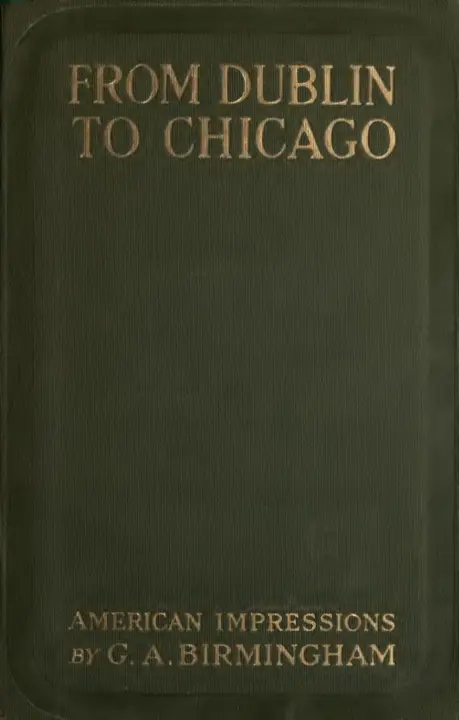
From Dublin to Chicago: Some Notes on a Tour in America
George A. Birmingham
THE CLASSIC COLLECTION · 1911
"Lalage's Lovers" by George A. Birmingham is a novel written in the early 20th century. The narrative follows the charming and spirited Lalage Beresford, a young girl navigating her unique world filled with playful antics and witty exchanges, particularly with her churchwarden friend, who finds himself drawn into her escapades and musings. The opening of the book introduces us to the protagonist Lalage, a lively fourteen-year-old girl, as she engages in mischievous and thought-provoking conversations with her friend, working through her complicated relationship with her governess, Miss Battersby, in the playful confines of a pigsty, a site representative of her free-spirited nature. This setting reveals Lalage's brazen character and her humorous yet insightful critiques of authority figures around her, particularly women like her governess, whom she nicknames "Cattersby" in a cheeky display of youthful irreverence. As the story unfolds, her interactions reflect her precociousness and the broader implications of how she navigates societal expectations while maintaining her individualism, laying the groundwork for her development throughout the novel.
Introduction adapted from the source catalogue; source summaries may be automatically generated.
Free to read · English · 70,210 words · No account needed
MAKE TIME FOR A GOOD BOOK
On by default. Untick to stop anonymous reading totals. Each page counts after 10 seconds in view. How this works.
Anonymous counting is on unless you have switched it off.
“It is,” I said, “and always was. It’s a great pity that it wasn’t found out sooner. Think of the time I wasted in Portugal and of that wretched episode in East Connor. However, there’s no use going back on past mistakes.”
“They weren’t altogether mistakes,” said Lalage. “We couldn’t have known that you were literary until we found out that you weren’t any good at anything else.”
“That view of literature,” I said, “as the last refuge of the incompetent, is quite unworthy of you, Lalage. Recollect that you once edited a magazine yourself. You should have more respect for the profession of letters.”
“Don’t argue,” said Lalage. “All we say is that if you can’t do anything else you must be able to write.”
Then the truth began to become clear to me. My dream of a life of cultured ease, spent, with intervals for recreation, in the society of gentle poets, faded.
“Do you mean,” I said, “that I’m to----?”
“Certainly,” said Lalage.
“To write a book?” I said desperately.
“That’s the reason,” said Lalage, “why I refurnished your study and bought that perfectly sweet Dutch marquetry bureau and hung up the picture of Milton dictating ‘Paradise Lost’ to his two daughters.”
I have hated that picture since the day it first appeared in in my study. I only agreed to letting it in because I knew the alternative was Titherington’s hospital nurse. The Dutch bureau, if it is Dutch, is most uncomfortable to write at. There was no use, however, wrangling about details. I brought forward the one strong objection to the plan which occurred to me at the moment.
“Has my uncle been consulted?” I asked. “From what I know of Thormanby I should say he’s not at all likely to agree to my spending my life in writing poetry.”
“His idea,” said my mother, “is that you should bring out a comprehensive work on the economic condition of Ireland in the twentieth century.”
“He thinks,” Lalage added, “that when you do go into Parliament it will be a great advantage to you to be a recognized authority on something, even if it’s only Irish economics.”
I knew, of course, that I should have to give in to a certain extent in the end; but I was not prepared to fall in with Thormanby’s absurd suggestion.
“Very well,” I said, “I shall write a book. I shall write my
reminiscences.”
“Reminiscences,” said Lalage, “are rather rot as a rule.”
“The bent of my genius,” I said, “is entirely reminiscent.”
Your reading position is saved on this browser. Take it to another device with a library code. Reading pages adapt to text, rather than matching a printed edition.
George A. Birmingham
George A. Birmingham
George A. Birmingham
George A. Birmingham
BEHIND THE BOOK
This eBook is for the use of anyone anywhere in the United States and most other parts of the world at no cost and with almost no restrictions whatsoever. You may copy it, give it away or re-use it under the terms of the Project Gutenberg License included with this eBook or online at www.gutenberg.org. If you are not located in the United States, you will have to check the laws of the country where you are located before using this eBook. Read the source licence.
The original source file, including credits and licence, is retained by this library. Request an original-format copy at no charge. Please include the book title and Project Gutenberg identifier #23946.
KEEP YOUR CURIOSITY GOING
Coulson Kernahan

Maurice Baring
Frances Wright
Cécile Tormay

Frederic Jesup Stimson

W. H. P. (William Henry Pope) Jarvis