
Life of Harriet Beecher Stowe Compiled From Her Letters and Journals by Her Son Charles Edward Stowe
Harriet Beecher Stowe
THE CLASSIC COLLECTION · 1870
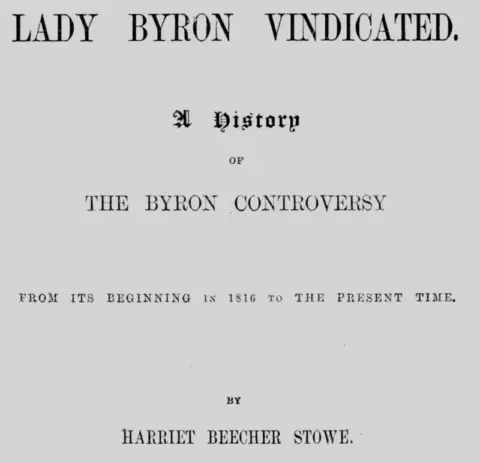
"Lady Byron Vindicated: A History of the Byron Controversy" by Harriet Beecher Stowe is a historical account written in the late 19th century. The book aims to defend Lady Byron's reputation against the slanders and accusations that emerged during and after her marriage to Lord Byron, particularly focusing on the controversies surrounding their separation and subsequent events. Stowe seeks to present a comprehensive narrative that counters the allegations made against Lady Byron and establishes her innocence and integrity. The opening of the book sets a somber tone as Stowe reflects on the public discourse surrounding Lady Byron, highlighting the distress and slander that her character has endured. Stowe reveals her motivation for writing the account, which is driven by a deep sense of justice and concern for her friend's legacy. She asserts that the attacks on Lady Byron's reputation were orchestrated by Lord Byron himself and claims that these defamatory narratives have reached a peak even after Lady Byron's death. By establishing this context, Stowe prepares the groundwork for a detailed examination of the Byron controversy, promising to present evidence and testimonies that will vindicate Lady Byron in the eyes of the world.
Introduction adapted from the source catalogue; source summaries may be automatically generated.
Free to read · English · 99,630 words · No account needed
MAKE TIME FOR A GOOD BOOK
On by default. Untick to stop anonymous reading totals. Each page counts after 10 seconds in view. How this works.
Anonymous counting is on unless you have switched it off.
Again she says,'Though he would not suffer me to remain his wife, he cannot prevent me from continuing his friend.' Do these words not say that in some past time, in some decided manner, Lord Byron had declared to her his rejection of her as a wife? I shall yet have occasion to explain these words.
Again she says, 'I silenced accusations by which my conduct might have been more fully justified.'
The people in England who are so very busy in searching out evidence against my true story have searched out and given to the world an important confirmation of this assertion of Lady Byron's.
It seems that the confidential waiting-maid who went with Lady Byron on her wedding journey has been sought out and interrogated, and, as appears by description, is a venerable, respectable old person, quite in possession of all her senses in general, and of that sixth sense of propriety in particular, which appears not to be a common virtue in our days.
As her testimony is important, we insert it just here, with a
description of her person in full. The ardent investigators thus
speak:--
'Having gained admission, we were shown into a small but neatly furnished and scrupulously clean apartment, where sat the object of our visit. Mrs. Mimms is a venerable-looking old lady, of short stature, slight and active appearance, with a singularly bright and intelligent countenance. Although midway between eighty and ninety years of age, she is in full possession of her faculties, discourses freely and cheerfully, hears apparently as well as ever she did, and her sight is so good that, aided by a pair of spectacles, she reads the Chronicle every day with ease. Some idea of her competency to contribute valuable evidence to the subject which now so much engages public attention on three continents may be found from her own narrative of her personal relations with Lady Byron. Mrs. Mimms was born in the neighbourhood of Seaham, and knew Lady Byron from childhood. During the long period of ten years she was Miss Milbanke's lady's-maid, and in that capacity became the close confidante of her mistress. There were circumstances which rendered their relationship peculiarly intimate. Miss Milbanke had no sister or female friend to whom she was bound by the ties of more than a common affection; and her mother, whatever other excellent qualities she may have possessed, was too high-spirited and too hasty in temper to attract the sympathies of the young. Some months before Miss Milbanke was married to Lord Byron, Mrs. Mimms had quitted her service on the occasion of her own marriage with Mr. Mimms; but she continued to reside in the neighbourhood of Seaham, and remained on the most friendly terms with her former mistress. As the courtship proceeded, Miss Milbanke concealed nothing from her faithful attendant; and when the wedding-day was fixed, she begged Mrs. Mimms to return and fulfil the duties of lady's-maid, at least during the honeymoon. Mrs. Mimms at the time was nursing her first child, and it was no small sacrifice to quit her own home at such a moment, but she could not refuse her old mistress's request. Accordingly, she returned to Seaham Hall some days before the wedding, was present at the ceremony, and then preceded Lord and Lady Byron to Halnaby Hall, near Croft, in the North Riding of Yorkshire, one of Sir Ralph Milbanke's seats, where the newly married couple were to spend the honeymoon. Mrs. Mimms remained with Lord and Lady Byron during the three weeks they spent at Halnaby Hall, and then accompanied them to Seaham, where they spent the next six weeks. It was during the latter period that she finally quitted Lady Byron's service; but she remained in the most friendly communication with her ladyship till the death of the latter, and for some time was living in the neighbourhood of Lady Byron's residence in Leicestershire, where she had frequent opportunities of seeing her former mistress. It may be added that Lady Byron was not unmindful of the faithful services of her friend and attendant in the instructions to her executors contained in her will. Such was the position of Mrs. Mimms towards Lady Byron; and we think no one will question that it was of a nature to entitle all that Mrs. Mimms may say on the subject of the relations of Lord and Lady Byron to the most respectful consideration and credit.'
Your reading position is saved on this browser. Take it to another device with a library code. Reading pages adapt to text, rather than matching a printed edition.
Harriet Beecher Stowe

Harriet Beecher Stowe
Harriet Beecher Stowe

Harriet Beecher Stowe
BEHIND THE BOOK
This eBook is for the use of anyone anywhere in the United States and most other parts of the world at no cost and with almost no restrictions whatsoever. You may copy it, give it away or re-use it under the terms of the Project Gutenberg License included with this eBook or online at www.gutenberg.org. If you are not located in the United States, you will have to check the laws of the country where you are located before using this eBook. Read the source licence.
The original source file, including credits and licence, is retained by this library. Request an original-format copy at no charge. Please include the book title and Project Gutenberg identifier #44791.
KEEP YOUR CURIOSITY GOING
Cécile Tormay

Moritz Busch
John L. Ransom
Frances Wright
Cécile Tormay

Mabel Potter Daggett