
Life of Harriet Beecher Stowe Compiled From Her Letters and Journals by Her Son Charles Edward Stowe
Harriet Beecher Stowe
THE CLASSIC COLLECTION · 1870
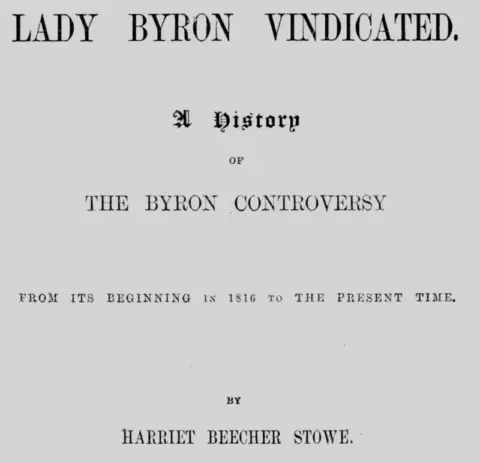
"Lady Byron Vindicated: A History of the Byron Controversy" by Harriet Beecher Stowe is a historical account written in the late 19th century. The book aims to defend Lady Byron's reputation against the slanders and accusations that emerged during and after her marriage to Lord Byron, particularly focusing on the controversies surrounding their separation and subsequent events. Stowe seeks to present a comprehensive narrative that counters the allegations made against Lady Byron and establishes her innocence and integrity. The opening of the book sets a somber tone as Stowe reflects on the public discourse surrounding Lady Byron, highlighting the distress and slander that her character has endured. Stowe reveals her motivation for writing the account, which is driven by a deep sense of justice and concern for her friend's legacy. She asserts that the attacks on Lady Byron's reputation were orchestrated by Lord Byron himself and claims that these defamatory narratives have reached a peak even after Lady Byron's death. By establishing this context, Stowe prepares the groundwork for a detailed examination of the Byron controversy, promising to present evidence and testimonies that will vindicate Lady Byron in the eyes of the world.
Introduction adapted from the source catalogue; source summaries may be automatically generated.
Free to read · English · 99,630 words · No account needed
MAKE TIME FOR A GOOD BOOK
On by default. Untick to stop anonymous reading totals. Each page counts after 10 seconds in view. How this works.
Anonymous counting is on unless you have switched it off.
I remain, sir, your obedient servant,
DUNECHT, Sept. 3.
SIR,--Your paper of the 4th of September, containing an able and deeply interesting 'Vindication of Lord Byron,' has followed me to this place. With the general details of the 'True Story' (as it is termed) of Lady Byron's separation from her husband, as recorded in 'Macmillan's Magazine,' I have no desire or intention to grapple. It is only with the hypothesis of insanity, as suggested by the clever writer of the 'Vindication' to account for Lady Byron's sad revelations to Mrs. Beecher Stowe, with which I propose to deal. I do not believe that the mooted theory of mental aberration can, in this case, be for a moment maintained. If Lady Byron's statement of facts to Mrs. B. Stowe is to be viewed as the creation of a distempered fancy, a delusion or hallucination of an insane mind, what part of the narrative are we to draw the boundary-line between fact and delusion, sanity and insanity? Where are we to fix the point d'appui of the lunacy? Again: is the alleged 'hallucination' to be considered as strictly confined to the idea that Lord Byron had committed the frightful sin of incest? or is the whole of the 'True Story' of her married life, as reproduced with such terrible minuteness by Mrs. Beecher Stowe, to be viewed as the delusion of a disordered fancy? If Lady Byron was the subject of an 'hallucination' with regard to her husband, I think it not unreasonable to conclude that the mental alienation existed on the day of her marriage. If this proposition be accepted, the natural inference will be, that the details of the conversation which Lady Byron represents to have occurred between herself and Lord Byron as soon as they entered the carriage never took place. Lord Byron is said to have remarked to Lady Byron, 'You might have prevented this (or words to this effect): you will now find that you have married a devil.' Is this alleged conversation to be viewed as fact, or fiction? evidence of sanity, or insanity? Is the revelation which Lord Byron is said to have made to his wife of his 'incestuous passion' another delusion, having no foundation except in his wife's disordered imagination? Are his alleged attempts to justify to Lady Byron's mind the morale of the plea of 'Continental latitude--the good-humoured marriage, in which complaisant couples mutually agree to form the cloak for each other's infidelities,'--another morbid perversion of her imagination? Did this conversation ever take place? It will be difficult to separate one part of the 'True Story' from another, and maintain that this portion indicates insanity, and that portion represents sanity. If we accept the hypothesis of hallucination, we are bound to view the whole of Lady Byron's conversations with Mrs. B. Stowe, and the written statement laid before her, as the wild and incoherent representations of a lunatic. On the day when Lady Byron parted from her husband, did she enter his private room, and find him with the 'object of his guilty passion?' and did he say, as they parted, 'When shall we three meet again?' Is this to be considered as an actual occurrence, or as another form of hallucination? It is quite inconsistent with the theory of Lady Byron's insanity to imagine that her delusion was restricted to the idea of his having committed 'incest.' In common fairness, we are bound to view the aggregate mental phenomena which she exhibited from the day of the marriage to their final separation and her death. No person practically acquainted with the true characteristics of insanity would affirm, that, had this idea of 'incest' been an insane hallucination, Lady Byron could, from the lengthened period which intervened between her unhappy marriage and death, have refrained from exhibiting her mental alienation, not only to her legal advisers and trustees, but to others, exacting no pledge of secrecy from them as to her disordered impressions. Lunatics do for a time, and for some special purpose, most cunningly conceal their delusions; but they have not the capacity to struggle for thirty-six years with a frightful hallucination, similar to the one Lady Byron is alleged to have had, without the insane state of mind becoming obvious to those with whom they are daily associating. Neither is it consistent with experience to suppose that, if Lady Byron had been a monomaniac, her state of disordered understanding would have been restricted to one hallucination. Her diseased brain, affecting the normal action of thought, would, in all probability, have manifested other symptoms besides those referred to of aberration of intellect.
Your reading position is saved on this browser. Take it to another device with a library code. Reading pages adapt to text, rather than matching a printed edition.
Harriet Beecher Stowe

Harriet Beecher Stowe
Harriet Beecher Stowe

Harriet Beecher Stowe
BEHIND THE BOOK
This eBook is for the use of anyone anywhere in the United States and most other parts of the world at no cost and with almost no restrictions whatsoever. You may copy it, give it away or re-use it under the terms of the Project Gutenberg License included with this eBook or online at www.gutenberg.org. If you are not located in the United States, you will have to check the laws of the country where you are located before using this eBook. Read the source licence.
The original source file, including credits and licence, is retained by this library. Request an original-format copy at no charge. Please include the book title and Project Gutenberg identifier #44791.
KEEP YOUR CURIOSITY GOING
Cécile Tormay

Moritz Busch
John L. Ransom
Frances Wright
Cécile Tormay

Mabel Potter Daggett