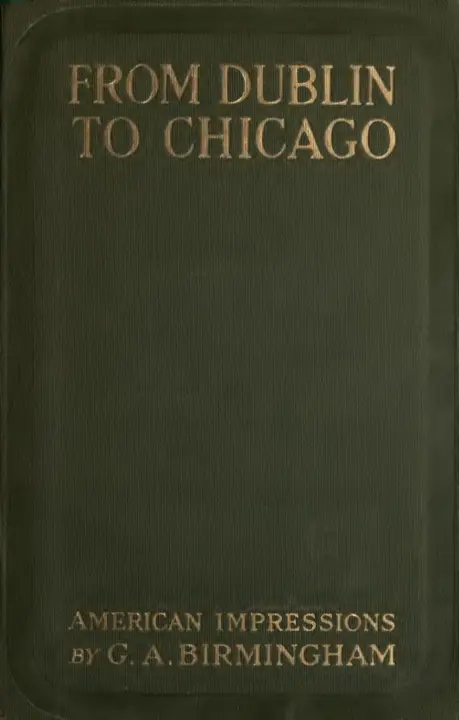
From Dublin to Chicago: Some Notes on a Tour in America
George A. Birmingham
THE CLASSIC COLLECTION · 1922
"Lady Bountiful" by George A. Birmingham is a novel written in the early 20th century. The book explores the social dynamics of a village in the west of Ireland, showcasing the life of Lady Corless, formerly Bridie Malone, a cook who unexpectedly marries an older baronet, Sir Tony Corless. Despite her humble beginnings, she navigates her new role with pragmatism and a fresh approach to traditional hierarchical norms, leading to significant changes in her community. At the start of the story, readers are introduced to the unique social attitudes of Irish society, particularly focusing on the marriage of Sir Tony to Bridie, which caused much gossip and shifted social standings. Through their domestic life at Castle Affey, we see Lady Corless taking charge not only of the household but also of the local economy by employing her relatives who then receive unemployment pay, leading to unexpected prosperity in the village. This innovative use of a government scheme indicates her practical nature and transforms her into a pivotal character within her community, while her husband enjoys a carefree life thanks to her management. The stage is set for a humorous examination of class, gender, and society in Ireland during a time of change.
Introduction adapted from the source catalogue; source summaries may be automatically generated.
Free to read · English · 51,935 words · No account needed
MAKE TIME FOR A GOOD BOOK
On by default. Untick to stop anonymous reading totals. Each page counts after 10 seconds in view. How this works.
Anonymous counting is on unless you have switched it off.
“Hullo, Jimmy,” she said. “What a frowst! Fancy sitting in that poky little carriage with both windows shut. Get up and put away your silly old papers. If you come along at once we’ll just be in time for dinner.”
“How did you get here,” said Sir James. “I never thought--. In this weather--. How did you get here?”
“On my bike, of course,” said Molly. “Did a regular sprint. Wind behind me. Going like blazes. I’d have done it in forty minutes, only Michael ran into a sheep and I had to wait for him.”
Sir James was aware that the engine driver, grinning broadly, was on the step of the carriage behind Molly.
“I lent Michael Dad’s old bike,” said Molly, “and barring the accident with the sheep, he came along very well.”
“What I’m thinking,” said the driver, “is that you’ll never be able to fetch back against the wind that does be in it. I wouldn’t say but you might do it, miss; but the gentleman wouldn’t be fit. He’s not accustomed to the like.”
“We’re not going to ride back,” said Molly. “You’re going to take us back on the engine, with the two bikes in the tender, on top of the coal.”
“I can’t do it, miss,” said the driver. “I declare to God I’d be afraid of my life to do it. Didn’t I tell you I was out on strike?”
“We oughtn’t to ask him,” said Sir James. “Surely, Molly, you must understand that. It would be an act of gross disloyalty on his part, disloyalty to his union, to the cause of labour. And any effort we make to persuade him---- My dear Molly, the right of collective bargaining which lies at the root of all strikes----”
Molly ignored Sir James and turned to the engine driver.
“Just you wait here five minutes,” she said, “till I get someone who knows how to talk to you.”
She jumped out of the carriage and ran down the railway embankment. Sir James and the engine driver watched her anxiously. “I wouldn’t wonder,” said Michael, “but it might be my wife she’s after.”
He was quite right. Five minutes later, Molly and the engine driver’s wife were climbing the embankment together.
“I don’t see,” said Sir James, “what your wife has to do with the
matter.”
“By this time to-morrow,” said Michael, “you will see; if so be you’re married by then, which is what Miss Molly said you will be.”
His wife, with Molly after her, climbed into the carriage.
Your reading position is saved on this browser. Take it to another device with a library code. Reading pages adapt to text, rather than matching a printed edition.
George A. Birmingham
George A. Birmingham
George A. Birmingham
George A. Birmingham
BEHIND THE BOOK
This eBook is for the use of anyone anywhere in the United States and most other parts of the world at no cost and with almost no restrictions whatsoever. You may copy it, give it away or re-use it under the terms of the Project Gutenberg License included with this eBook or online at www.gutenberg.org. If you are not located in the United States, you will have to check the laws of the country where you are located before using this eBook. Read the source licence.
The original source file, including credits and licence, is retained by this library. Request an original-format copy at no charge. Please include the book title and Project Gutenberg identifier #24155.
KEEP YOUR CURIOSITY GOING
Coulson Kernahan

Maurice Baring
Frances Wright
Cécile Tormay

Frederic Jesup Stimson

W. H. P. (William Henry Pope) Jarvis